Using writing, and meditation, and ice cream, and reading, and dreams,

and a whole lot of other tools to rediscover who I am,

after six years living with a man with OCPD.


Showing posts with label A-Z. Show all posts

Monday, April 30, 2012

A-Z: Zen - Much Like Obscenity

I find the idea of the Zen mind, of "Zen" in general, to be a lot like obscenity. It's hard to describe, but I know it when I see it.

This is a Zen thought, for example.

Source: weheartit.com via Pinterest

Too often we churn over the past, playing the game of "If only I had done/said this," beating ourselves up for whatever mistake we believe we've made. To what end? We didn't do or say that other thing. And if it was truly a mistake, certainly, let's take steps to repair any hurt we caused to others, but we can't undo the past.

(Mind you, it's not okay to keep hurting another person in the same way, and then using the excuse, "Hey, let's not linger on the past." If we truly can't stop continually hurting someone in a particular way, because of mental illness or bad habits or anything else, we need to get help.)

One way to "be Zen": To connect with a Higher Entity: Buddha, Jesus, God, Allah, Mary...

One thought: "Being Zen refers to meditating, reaching a peaceful state; to be one with the world around you and yourself."


In this video clip, there's reference to the stream. The idea of being Zen is to not be swirled up in the stream (of thoughts and emotions), but to be sitting peacefully beside it. "Look, there's a leaf, how interesting." To be a calm observer, who mindfully decides what, if any, actions or speeches to make.

Let's say someone says something to you that is terribly insulting, and your immediate feeling is hurt and/or anger.

If you are operating "in a Zen way," you don't immediately respond. You examine the feeling ("Oh, I feel very, very angry," or "Oh, I feel terribly hurt,") and then, after carefully observing and understanding the feeling, choose what action you want to take.
  • You may let the insult slide past, like water off a duck's back.
  • You may punch the other person in the nose.
  • You may tell the other person how angry you feel.
  • You may cry.
  • You may ask the other person for clarification, "What you said sounded very insulting, but I know, given the kind of person you are, you wouldn't deliberately insult me. Could you explain what you meant?"
  • You may turn your back and walk away.
  • You may calmly tell the other person how hurt you feel, and why.
  • You may do any number of things. Point being, you are deliberately, thoughtfully choosing what you want to do, not simply reacting without thinking.
I'm working on trying to "be more Zen," but I'm thinking, it's the work of a lifetime.
***

So, we've made it, from Anosognosia to Zen. Phew! Next week, May 8, we'll return to Too Perfect Tuesdays and the regular blog posts.


My A-Z theme is Issues related to Mental Health or Mental Illness.

Do you have comments on the idea of being Zen?
Is there a subject you'd like to see on this blog in the coming months?
Did you have a favorite post for the A-Z posts here?

Saturday, April 28, 2012

A-Z: Yoga Strengthens Body & Soul

I admit it, people were all "You should try yoga, you should try yoga" for years, and I didn't want to, simply because I felt pushed towards it. And partly because it seemed kind of wussy and weird.

Then I hurt my back, and my physical therapists strongly recommended yoga. And I was hurting so much I thought, what the hey. I have nothing to lose.
While any regular exercise is good for a body, yoga is "do-able" even for most people with health conditions, whereas running or weight training may not be. 
 
I started with a DVD like this one (actually, I started with a video tape, and got DVD's later). DVD's work for me because I can do them at home, before work/shower, and not squander the time driving to/from a gym. Plus, there's the money issue - one flat amount, and you don't keep paying.


Yoga Zone Beginners: Introduction to Yoga [DVD]

 Yoga Conditioning for Weight Loss [DVD]For someone else, going out to a class might be the best solution.It's also a good idea consult your doctor to make sure yoga is safe for you (thought it's safe for almost everyone).

Later, I added more DVD's to my repertoire, so as not to get bored.

Once I got into a routine of daily yoga, I found that I felt more flexible, stronger, and better about life in general. When things were rough between me and my ex, and I skipped my morning yoga, I didn't feel nearly as capable of handling the stress.

All in my head? Maybe, and maybe not.

From the Mayo Clinic:
The potential health benefits of yoga are numerous and may include:
  • Stress reduction. With its quiet, precise movements, yoga draws your focus away from your busy, chaotic day and toward calm as you move your body through poses that require balance and concentration.
  • Increased fitness. As you learn and refine new poses, you may enjoy improved balance, flexibility, range of motion and strength. And this means you're less likely to injure yourself in other physical endeavors or in your daily activities.
  • Management of chronic health conditions. Yoga might help with a variety of health conditions, such as cancer, depression, pain, anxiety and insomnia, by helping with sleep problems, fatigue and mood. Yoga also can help reduce heart rate and blood pressure.
  • Weight loss. If you're overweight or have binge-eating disorder, yoga may help you make the healthy lifestyle changes necessary to gain control of your eating and drop those extra pounds.

 from Healthplus24:
Mental Health Benefits
A few benefits of yoga on mental health are:
  • improvements in concentration, memory, attention,
  • learning efficiency,
  • mood,
  • depth perception,
  • increases in well-being,
  • self-confidence,
  • social skills,
  • decrease/elimination in depression, anxiety, hostility, etc.

Yoga is helpful in reducing stress

Emotional distress is an increasing public health problem and yoga has been claimed to induce stress reduction and empowerment in practicing subjects. Yoga therapy has been shown to be associated with improved mood, and is possibly a useful way of reducing stress in patients admitted for psychiatric treatment.11Michalsen et al. showed in a study that women suffering from mental distress participating in a 3-month Iyengar yoga class show significant improvements on measures of stress, anxiety, well-being, vigor, fatigue and depression. Physical well-being is also increased, and those subjects suffering from headache or back pain reported marked pain relief.12

Yoga shown beneficial in psychotic treatment

Yoga practice has also been shown to improve different aspects of sleep in the elderly population.13Treatment of schizophrenia has remained unsatisfactory despite the availability of antipsychotics. A study by Duraiswamy et al. examined the efficacy of yoga therapy as an add-on treatment to the ongoing antipsychotic treatment. Patients were randomly assigned to either yoga therapy or physical therapy. Subjects in the yoga therapy group had significantly less psychopathology than those in the physical therapy group at the end of 4 months. They also had significantly greater social and occupational functioning and quality of life. Both nonpharmacological interventions contributed to reduction in symptoms with yoga therapy having better efficacy.14

I know yoga worked for me, and I went from being a skeptic to being a fan. If you haven't tried it, why wouldn't you see if it might be something good for you? Don't worry about doing the more extreme poses (I don't do 'em), just give it a few weeks and see if you like it. You have nothing to lose but your pain and stress.


My A-Z theme is Issues related to Mental Health or Mental Illness.

Are you a yoga fan, or have you never tried it?
If you've never tried it, what holds you back?
If you practice yoga, what do you like about it?

Friday, April 27, 2012

A-Z: Xcess - That Invisible Dividing Line from Quirky to Crazy

How do we tell when somebody has crossed the line from quirky to crazy? That's part of the problem, because many symptoms of mental illness actually look quite admirable - in smaller doses.

The key is Xcess and Xtreme. (Getting a bit creative with the spelling here, so what.) Take someone who is bipolar. During a more low key manic cycle, she may be animated, creative, fun to be around. Then perhaps a little down and sad. During an extreme cycle, she may want the entire family to join her in painting the kitchen - at 2:00 a.m. Or be unable to drag herself out of bed for days at a time.

Cleanliness, admirable. Sterilizing kitchens and bathrooms like a hazmat team, not so much.

Being an ardent recycler and repurposer, great. Having an endless collection of boxes, pen lids, and food containers... hoarder.

From  My Mother In law is Still Siting Between Us... Randomness (7/29/10). All pictures used by permission.

Pen lids
Hundreds and hundreds of crosswords, cut out, dated (aren't they already?), and meticulously labeled. She had a note on each, about whether or not she had checked the answers, and a list of the numbers (6 across, 17 down) which she hadn't yet checked. Some of these date back to '89.
Crossword puzzles
 
Empty See's candy boxes - apparently, one can never have too many.
Burned out light bulbs, with notes as to the date each burned out, and the fixture.
What's so bad about keeping some useless junk? Nothing, if it stops at a small stash of empty boxes or burned out light bulbs.  But too often, it crosses the line to this:
The Kitchen

Inside the fridge

Yeah. Horrifying, isn't it? The tragic thing, for adult children of hoarders, is that even when their parents "maintain" a home in conditions like this (or worse), there are legally no options to force them to get the help they so clearly need. It's a matter of having to wait until they die, and then...cleaning the Augean Stables. Only there's usually not a handy river nearby.

Other areas where a line gets crossed:

Having a close personal relationship with God/Jesus/Allah, perhaps even believing that He speaks to you... harmless, perhaps even helpful. Hearing the Voice of God/Jesus/Allah telling you to kill your children/congresspeople... dangerous.

With OCPD, in moderation, there are many wonderful qualities. They're usually very tidy and timely, give great attention to detail, and truly care very deeply about people they love.  There's a great blog written by an OCPD'r I know on the subject, The Gift of OCPD.

We would have many fewer inventions and modern conveniences that we take for granted, were it not for people with Aspergers, OCPD, and many other mental illnesses. Peter Roget (Roget's Thesaurus) probably had OCPD. Steve Jobs may have had it. When OCPD symptoms become extreme, however, they are devastating to both those who have the condition, and those who live with and love them.

The line is where the "quirks" become either harmful or dangerous, to oneself or others. Unfortunately, it is almost impossible for the person with the mental illness, or someone who has lived with him/her for a long time and perhaps become desensitized to odd behavior, to determine when the line has been crossed. Or what to do if it has.


My A-Z theme is Issues related to Mental Health or Mental Illness.

Have you ever had quirks that went to extremes?
If so, how did you recognize it, and what did you do?
Have you ever lived with someone who seemed to go "too far"?

Thursday, April 26, 2012

A-Z: Work on Yourself

from styledip.com
When we're in a relationship with a person with a mental illness, we want them to "go get fixed." Am I right?

Here was my personal progression, when my OCPD ex and I moved in together.

1) We're having a very rough transition into this living together business. Surely things will settle down in a few months. After all, I know we love each other deeply.

2) He's having a rough time, but after all, he did just recently lose his parents. He has the right to grieve; I should just be loving and supportive, and with enough time and love on my part, he'll get over it.

3) Self doubt. This is a nightmare. Maybe everything is my fault. Maybe I just don't try hard enough, love enough, give enough. I don't know how I could give/try/love more, but I should find a way.

Or maybe I should just give up, now. *fantasies of slitting my wrists, letting all the blood and pain drain into the sink*

from Unwanted Advice


4) There is something wrong with him. It's not me - or at least, it's not ALL me.

5) Oh! It's OCPD. Now all I have to do is let him in on it, in the Right Way, and he will be eager to get counseling, because I know he deeply loves me, as much as I love him. We will be able to fix this problem and live happily ever after.

6) I join a couple of OCPD support boards, to get the info on the exact Right Way to broach the subject. Because all I need are the magic words, he will have a Light Bulb Moment, and go get himself fixed.

7) Okay, so the Big Reveal isn't a good idea. Still, this is a mental illness. I wouldn't run out on a partner with diabetes or a heart condition, right? If I am loving enough and caring enough, and broach it in exactly the right way, he'll be willing to go get fixed. Maybe I can talk him into getting joint counseling...

8) A year into my individual counseling, and he still isn't willing to even talk to my counselor. Not even though I beg him, as a way of helping me.

9) I realize can't "save" him. I don't doubt, for an instant he loves me, as much and as deeply as he has ever loved anyone. I love him so much it makes my heart ache, but I can't save him. In fact, everything I do is probably enabling his disorder and making him worse. (Two years now after I left, and I still weep as I type these words.)

10) After a fight that is no worse than others, yet which served, for me, as the last straw on the camel's back, I moved out. Began focusing on me, on my pitifully weak boundaries, on figuring out who I am and what I want.

from Brandozin's Weblog


Your path and your journey are undoubtedly different. Yet here is the reality.

We can't save other people 
unless they want to be saved.

I didn't understand that. When I joined the support boards, in the beginning, I was sure there was some magic word/key/answer they were selfishly withholding from me. Or that, perhaps, only I was smart enough to figure out. (Hello, ego!) I would figure out what it was and share it with everyone and I would be acclaimed as this brilliant OCPD monster-slayer.

When everyone kept advising me to "work on yourself," I thought they were smoking crack. "Hello, he is the one with the problem. Just tell me how to convince him that he needs to get fixed, that's what I'm looking for."

I felt like I was asking, "What's 2 + 2?" and I was being answered, "Tangerines and corduroy, with a  splash of Chanel No. 5."  Really, WTF?

The reality of dealing with a loved one with mental illness, is there is nothing an outsider can do to reach inside those distorted thoughts and neurotransmitter imbalances to "fix it" for them. We cannot control other people. What we can do is to take a look at ourselves - our own thoughts, our own behaviors, our own automatic reactions.
funny pictures - I can't sit on top of the TV all day. Stop being so cheap and just get the cable fixed already.

Sometimes, when we address our own behaviors, erect the kinds of healthy boundaries we need for our own sake, there will be a dramatic shift in the way the disordered person behaves.

Sometimes, this will serve as what my OCPD friend LizaJane calls "getting hit in the head with the cosmic 2 x 4" and spur the person with a mental disorder to seek or accept help, and change.

Sometimes, it will not.

One thing is certain. We cannot control, fix, help, adjust, or otherwise move a person who is disordered or troubled when we ourselves are not "coming from" a place of stability and mental healthiness. We just can't. It's like seeing someone drowning and jumping in after them. without a life preserver or even being able to swim, ourselves.

We really and truly have to work on ourselves first. Put on our own oxygen mask first, and all that jazz.

I get it now. They were not smoking crack when they said, "Tangerines and corduroy, with a splash of Chanel No. 5."


My A-Z theme is Issues related to Mental Health or Mental Illness.

Have you ever experienced the
"Work on your own issues first" directive?
How did you react?
What did you learn?

Wednesday, April 25, 2012

A-Z: Validation Station

Not talking about for your parking pass.  Of course, it's important for us all to develop a strong inner sense of self, and not be constantly seeking the approval of others.

Yet both giving and receiving emotional validation is a key part of being a human being. People by nature are interdependent with one another.  What brings people together? A sense that we share the same feelings about: progressive music, or baseball, or RomCom movies.

When I am overflowing with feelings, and go to someone I love, I don't want to be cut off, told my feelings are stupid, or "fixed."

From Eqi.org

What Validation Is
To validate someone's feelings is first to accept someone's feelings. Next, it is to understand them, and finally it is to nurture them. 

To validate is to acknowledge and accept one's unique identity and individuality. Invalidation, on the other hand, is to reject, ignore, or judge their feelings, and hence, their individual identity. 

When we validate someone, we allow them to safely share their feelings and thoughts. We are reassuring them that it is okay to have the feelings they have. We are demonstrating that we will still accept them after they have shared their feelings. We let them know that we respect their perception of things at that moment. We help them feel heard, acknowledged, understood and accepted. 

Sometimes validation entails listening, sometimes it is a nod or a sign of agreement or understanding, sometimes it can be a hug or a gentle touch. Sometimes it means being patient when the other person is not ready to talk.

The concept of validation is what's behind this phrase from the movie Avatar, "I see you."


Being seen, being accepted, being honored not for the shell of our bodies, but as a soul, a divine spark. Namaste is sometimes translated as "I honor the place in you in which the entire universe dwells. I honor the place in you which is of love, of truth, of light and of peace. When you are in that place in you, and I am in that place in me, we are one." (from livestrong.com)

from The Antidote To Anger and Frustration:
Emotional Validation is a Basic Human Need
Emotional validation is something we all seek and crave far more than we realize. When we are upset, angry, frustrated, disappointed or hurt, our tendency is to want to discuss our feelings with others so we can get it off our chest.

However, getting things off our chest by telling others about our feelings is not always satisfying or cathartic. If the person to whom we vent simply looks at us and shrugs or responds by giving us advice or by telling us what we did wrong, we won't feel any better and we will probably feel worse after speaking with them.

What we seek when venting to others is for that person to 'get it', to understand what happened to us and why we feel the way we do. We want them to validate our feelings by conveying that understanding to us and to do so with a dollop of sympathy or empathy (read: How to Test Your Empathy).

When we are extremely angry or upset, we tell someone why and they totally get it truly and effectively validates our feelings. As a result, the relief and catharsis we experience is tremendous! Only then can we actually let go of at least some of the feelings we had built up. It is that which feels like an authentic visceral 'release'.


We don't have to agree with what someone is feeling to validate those feelings. We don't even have to be particularly empathetic to be good at validation.

Here's one technique, the I AM MAD. (Works for more than BPD)
Because I tend to be a fixer, myself, one thing I try to do when someone is telling me a story and I am overflowing with advice, is take a step back, and ASK, "Do you need suggestions or advice, or are you just looking to vent?"

Hoping with practice to get ever better at it.


My A-Z theme is Issues related to Mental Health or Mental Illness.

Have you ever felt emotionally invalidated?
How did it make you feel?
Do you try hard to validate the feelings of others?
Got any good tips?

Tuesday, April 24, 2012

A-Z - Unchosen Relationships - When You Can't Get Away

Sibling!
Sibling! (Photo credit: Gus Dahlberg)
We can choose our friends, but we can't choose our family. For the letter U today, I'm going to excerpt and comment upon the excellent piece from Out of the Fog.
Unchosen relationships are relationships with family members who suffer from personality disorders.
 And other mental illnesses.
Unchosen is a term used to describe those of us who did not choose their relationship to a person with a personality disorder. Some of us have parents with this disorder; others have a sibling, in-laws, or other familial relationships. We did not choose this relationship the same way a person chooses a relationship to a partner with or a friend with a personality disorder. 
With a spouse, love partner, neighbor, boss, co-worker, we can choose to leave the relationship, to move, to change jobs. It might be painful and very difficult, but we can get away. It's harder to get away from family, or to abandon a family member (sibling, parent, child) who has married a dysfunctional person; however, in those cases, we are normally dealing with the unpleasant in-law from an adult, rather than a child's, perspective.
For instance: someone who grew up with a personality disordered parent will have had a vastly different struggle than someone who had a relatively normal childhood, but ended up with a disordered partner. That doesn't mean the "Unchosen" person's pain is any greater or any less than the "Chosen" person's pain, but very often, the abuse and inappropriate behaviors modeled during his or her formative years will have deeply affected the Unchosen Non child's core sense of being (and well-being), and may have long-lasting impacts on trust, self-esteem and the ability to form or maintain healthy relationships in adulthood.
In the paragraph above, "non" refers to a child without a personality disorder.  Being a "non" as compared to a person with a personality disorder does not mean everything is a-ok with us. In fact, a non may have many other Issues, and behave inappropriately and harmfully to self and others, too.

I can personally testify that it is really hard to choose a healthy love relationship, when you have no friggin' clue how to recognize it. If there are no models in your family of origin, how do you even know what one looks like? TV and movies? Books?  

cast of Leave It To Beaver
I know that my own relationship with my OCPD ex was in large part an attempt to heal wounds left by my relationship with my narcissistic, alcoholic father. Sadly, my ex was just f---ed up in a different way. In large part because I was used to dysfunction, I missed the red flags, and when I did see them, I thought, well, now, with my adult skills, I could fix him.
When the personality disordered individual is a child, the pain and disruption is experienced by the entire family. Adults feel responsible, trapped, frustrated and depressed. Non-personality-disordered siblings feel fearful and neglected as their parents focus on the problems created by the disordered individual. 
Partly because of poor understanding of where mental disorders come from, there is the guilty assumption by parents that if only one had loved the child enough, been patient enough, done the right thing, his/her mental disorder would not be so severe. Or, possibly, there may be guilt for passing down defective genes or eating or drinking the wrong thing during pregnancy. Siblings may have very mixed feelings, especially as teenagers; sometimes loving their troubled sibling to pieces, other times perhaps even wishing s/he were dead. 
The Unchosen Relationship
To be in an unchosen relationship is difficult and often traumatizing. We are told repeatedly by society and well-meaning people that we "must," "should," "have to" (fill in the blank) because they - the personality disordered - are family. 
"After all, he is your father." Boy, if only I had a dollar for every time someone said that to me!
We are often asked to overlook continued abuses because the person is ill. In other instances we are expected to “be the bigger person” and stuff our emotions so as not to upset the ill family member. We are asked to parent our parent while still trying to have a life of our own. 

People who haven’t been where we have been truly have no idea what we live with. Some of us are constantly torn between trying to protect and heal ourselves and trying to have some sort of relationship with our families, however dysfunctional they may be. Others have decided that they no longer want a relationship with the ill family member. Many of us have been subjected to a lifetime of emotional, verbal, physical, and sometimes sexual abuse. These abuses do not disappear just because time has passed or because we are adults. Sometimes the worst scars cannot be seen.

In this section, you may see terms like NC (no contact) or LC (limited contact). Many people choose one or the other, or drift back and forth between them trying to find a balance with which they are comfortable. Some choose to try and tolerate what they can, when they can, knowing they are unable to completely remove themselves from a parent or other relative. Understand that what works for one simply does not work for everyone.
After decades of trying to begin a new relationship with my father, as an adult, which efforts were ignored and/or abused by him, I decided upon LC. It was the best way for me to forgive his past offenses and remember the good things about him (which I could count on my fingers). For myself, I couldn't "deal" with fresh offenses and his constant attempts at emotional manipulation.

My oldest sister chose to become more involved, supervising his finances and getting him placed in a good veteran's home facility, but even she drew the line at bring him into her home, or even into our state. Our other sister's choice was similar to mine, LC. When our father died last year, our middle sister chose to attend the memorial service, in support of our oldest sister. I chose to stay away - also in support of our oldest sister. Because once people began spouting the usual post-death BS about what a great guy the man was, I would probably have lost it and spoken up. This would have hurt my sister to no good purpose.

So I don't judge people who don't visit their parents or mentally ill siblings; don't call them, or make other efforts to avoid contact. It may show an admirable amount of restraint that they don't accidentally-on-purpose poison the person who's brought so much pain into their lives.

An Unchosen Perspective on Boundaries
It can be difficult to maintain or define boundaries when you are involved in a familial or otherwise unchosen relationship. Often, we are taught as children "not to make waves" or to “just get along;” that is, to not assert or define our own boundaries. As children we want to please our disordered parent and get along with a disordered sibling or relative; however, a personality disordered individual lacks appropriate personal boundaries of their own. This can result in inappropriate affectionate gestures and lack of personal privacy for the child. 
 This is why we should never "make" children kiss Aunt Clara, or sit on Santa's lap.
When our own personal boundaries are routinely broken, the message we learn is that our own needs and feelings don’t count - we are required to accept how others treat us without question. As we grow into adults, these lessons can become our way of life. We often feel taken advantage of, feel used or feel that our desires are unimportant. We become frustrated and angry that our boundaries are violated yet we are unable to express what, exactly, our boundaries are. 
In a healthy relationship, there are always boundaries. Children should be able to have their own special toys that they are not expected to share, for example, especially if they have a "special" sibling who tends to break or destroy much of what s/he plays with.


Constant yielding to a parent, sibling or relative becomes second nature. We lose our own sense of self and often find ourselves in unhappy relationships, jobs and life situations. The early lessons - that our feelings, views and opinions don’t count - continue to dominate our lives, sometimes subconsciously. 
We may feel we are only worthy if/when we are pleasing someone else. If we're doing something purely for ourselves - reading a book, watching a movie that nobody else in the household wants to watch, getting a massage - we may feel selfish, weird. 
This can result in poor life choices, from entering into careers or occupations that are a poor fit for us, to marrying the person we “should” rather than the person we love. The yielding to others we were taught as children can spill over into every relationship we have as adults. The consequences can be disastrous and painful. It sometimes feels as if we are living someone else’s life. 
Because we don't have our own sense of self, we may Rescue others and follow the pattern assuming responsibility for how we "make" others feel. I know people who keep themselves quite busy being problem scouts - spotting and "helping" other people's potential problems before they even have a chance to notice and take care of the issue, themselves.

Then the problem scout wonders why her adult children don't seem to show any initiative, or make poor decisions on the rare occasion they do decide something for themselves.
Learning to enforce boundaries takes practice and patience. Yet it can be done - and lead us to a healthier, happier life. You can read some more ideas on setting healthy boundaries in our boundaries section.
And here: Boundary Betty.  Boundaries are different than walls, but it may help to think of them as castle walls. Something from the outside is stopped on the other side of the moat. After thorough examination, either the drawbridge is let down and it's invited in, or it's turned away.

When we have weak or no boundaries, anything someone says to us, does to us or even does around us gets hustled right in. We arrange our universe around what we think is gong on. Somebody makes a strange face - we must have done something to annoy him. (When the reality is, maybe he's just suppressing a fart. It's not always all about us.)
Types of Unchosen Relationships
There are distinct categories of non-personality-disordered individuals who call themselves “Unchosen”:
Children forced to live in an environment where someone else is abused.
Please take note of the last. Even if the child is not him or herself battered, sexually or verbally abused, it is not healthy for children to live in an environment where they regularly witness one member of the household abuse another. Perhaps Grandpa has come to live with the family and he's a raging a-hole to his adult daughter, the child's mother. Perhaps the mother is personality-disordered and regularly tears the father a new one.

Yes, "splitting the household apart" might be painful and quite difficult. But please, consider that you may be training the child up to recreate a household just like the one s/he grew up in.

I get that leaving is not always possible. I know my mother wanted to leave my father, but when you have a young child, and are terminally ill with cancer, your options are limited. Besides which, that was the early 1970's, and women had only a fraction of the legal rights in divorce they have today.

Still, there were avenues she could have explored: moving in with friends or family members, perhaps. If she had the physical and emotional strength to pursue them. I don't blame her; I understand that when you live with someone whose view of the world is black-or-white, your own thinking tends to become that way as well. You fail to see there are not two choices; there are probably two dozen choices.

There are always options.  Please, please, please, do not bring children into the world when you are in a dysfunctional relationship, thinking that a baby will make everything better and help your partner heal. And if you already have children, please consider whether continuing in a household where a severely dysfunctional person lives is healthy for them. Leaving or throwing out the disordered person are not the only choices; I know a woman who actually sent her children away, to live with some family friends who acted as guardians for them. It broke her heart, and yet, was probably much better for them than continuing in that household.


My A-Z theme is Issues related to Mental Health or Mental Illness.

Are you in any unchosen relationships 
with a mentally disordered person?
Is this a new thing, or did it begin when you were a child?
How has it affected the way you see the world and relationships?
Enhanced by Zemanta

Monday, April 23, 2012

A-Z: Therapy Is Not A Dirty Word

IMO, more people are afraid of a bad therapist than a bad marriage. Generally those who've experienced a disastrous love relationship will be willing to try again with a new partner, but if they've had a bad therapy experience...!

Besides which, there's a huge stigma factor.

When we hear that someone has been "in therapy" for an extended period of time, our initial reaction is not, "Oh, what a brave and courageous person. Kudos to her/him for facing her/his issues head on and getting the help s/he needs." It's more along the lines of, "Wow, that person must be really f---ed up."Am I right?

I am ashamed to admit, I tend to think that way - and I know better! I've had long term counseling myself, and I'd do it again tomorrow.

Sometimes people get stuck in a rut, whether that rut is grief, PTSD, or choosing bad relationships. If our car is stuck in a rut, would we feel ashamed or embarrassed to need a little push getting out of the ditch? (Okay, maybe a little embarrassed, depending on how we got into that ditch.)

But if we'd been in a car accident, and needed physical therapy to recover the use of, say, an arm, wouldn't we commit to it for as long as it took to get the maximum use of our arm back?

Yes, there are personality clashes, and sometimes, despite any number of impressive degrees, we may have hit on a "bad" therapist, but mostly, therapy fails because:
  • We aren't seeing the right kind of therapist.
  • We aren't getting the right kind of therapy.
  • We aren't committed to the very hard emotional homework of being honest with our therapist, and working on the exercises or changes s/he suggests.
Here's the different types of therapists:
  • Psychotherapist
  • Psychologist
  • School Psychologist
  • Psychiatrist
  • Mental Health Counselor
  • Marriage & Family
  • Social Worker
  • Psychiatric Nurse
  • Pastoral Counselor
The amount of education and training required for each varies, from none to a substantial amount. A psychiatrist is actually an M.D. and can write prescriptions for medications (in a few states, so can a psychologist), but generally a psychiatrist will refer any ongoing therapy work to a psychologist.

Because someone is "lower on the food chain," does not necessarily mean he or she will be an ineffective therapist. For some problems and disorders, medication is not indicated.  For others it may be helpful on a short-term basis in conjunction with CBT or other brain retraining exercises; and for some people, long-term medication may be necessary. In yet others inpatient care may be required. A nutritionist may add needed support.

A good therapist will recognize when a client needs more help than s/he can provide, and be eager to steer her/his client to the right kinds of additional help.

Different types of therapy include:

  • Psychoanalysis
  • Cognitive Behavior Therapy (CBT)
  • Dialectic Behavior Therapy (DBT)
  • Antipsychotic and/or antidepressant medications, and/or mood stabilizers

A treatment once promoted, which fell into some disrepute, and now gaining some proponents is ECT (Electroshock Therapy) as a treatment for bipolar disorder and depression. Diet modification, music therapy, group therapy, yoga and mindfulness exercises; all can form an integral part of helping a person become as whole and mentally healthy as possible.


The most important factor in therapy success is being committed to it. If we are not willing to embrace the process and say, "Yes, this area of my life is causing me and my loved ones too much pain. I will do whatever it takes to make it better for everyone I love - including me," then no matter how experienced and skilled the therapist, no matter how effective the treatment, it's not going to work.

Changing lifelong behaviors and thinking patterns is hard, hard work. In an earlier post, I compared it to shifting the course of the river - the river tries to flow along the same channels it always has. This is where medication in partnership with therapy often works well, interrupting the old patterns long enough for new ones to form (they say about 90+ days is the minimum time frame to quit an old habit or form a new one).


I know people who are diagnosed as mentally ill who religiously follow their medication, exercise, diet, and therapy regimes. I know others diagnosed as mentally ill who are willing to try certain therapies but not others. I know some who refuse to see any kind of counselor, under any circumstances, even if it means being fired from a job or losing a spouse or partner, using the excuse of, "I saw a therapist once, and it didn't help." They believe all it takes is willpower and determination to not be disordered.

Guess which group is most successful at managing their condition?


My A-Z theme is Issues related to Mental Health or Mental Illness.

Have you ever had good or bad therapy?
Would you be willing to try it again?
Why or why not?
Enhanced by Zemanta

Saturday, April 21, 2012

A-Z: Finding A Scapegoat Doesn't Make Anyone All Better

The Scapegoat by William Homan Hunt via Wikimedia Commons

Got goats?

Most people understand what a scapegoat in modern terms is. It's the wide receiver who dropped the ball on the last play of the game (though the whole team played poorly up to that point); the department head who gets very publicly fired for carrying out the unfair policies set by her superiors; the husband who fails to properly read his wife's mind.

In ancient Syria, Greece, and Biblical times, an actual goat (or beggar, or cripple) was designated as the bearer of sins for the entire community. The scapegoat might be driven out of the community into an inhospitable region (theoretically taking all the evil/sin with it), where presumably it would in fact, die. Or it might be killed outright.

A similar concept was practiced in the Middle Ages, depicted in an old Night Gallery episode called Sins of the Fathers. The Sin-eater would consume food spread around the body of a dying or recently deceased person, so that the soul of the dead person would then be able to rest in peace or float to heaven, free of sin. Of course, if something happened to the village Sin Eater...

Except in certain religious connotations, nobody believes (on paper) in the concept of scapegoating anymore. As a parent with two children, say, we certainly wouldn't punish Child A because Child B misbehaved, right?

In practice... people do it all the time. (See butterfingered wide receiver, above.) Child B may be wearing down his mother's nerves all day long, but when Child A also does something annoying, that's when Mom snaps and takes it out on Child A. Fair? No. Human? Yes.

In real life, scapegoating and 'projection' go hand in hoof. Just as it felt too uncomfortable to drag around the guilt and sin in the village, for many people, acknowledging our own faults, shortcomings, and bad feelings is too heavy to carry. So it's got to be put over there, onto a target. Away from us.

See, we are good people. If there is something wrong, bad, or nasty in the room, it's because somebody else - not us - brought it in here.

From Wikipedia:
According to Sigmund Freud, projection is a psychological defense mechanism whereby one "projects" one's own undesirable thoughts, motivations, desires, and feelings onto someone else. 'Emotions or excitations which the ego tries to ward off are "split out" and then felt as being outside the ego...perceived in another person'.[4] It is a common process.[5] The related defense of 'projective identification differs from projection in that the impulse projected onto an external object does not appear as something alien and distant from the ego because the connection of the self with that projected impulse continues'.[6]
In one example of the process, a person might have thoughts of infidelity with respect to a spouse or other partner. Instead of dealing with these undesirable thoughts consciously, the subject unconsciously projects these feelings onto the other person, and begins to think thatthe other has thoughts of infidelity and that the other may be having an affair. In this way, the subject may obtain 'acquittal by his conscience - if he projects his own impulses to faithlessness on to the partner to whom he owes faith'.[7] In this sense, projection is related to denial, arguably the only more primitive defense mechanism than projection, which, like all defense mechanisms, provides a function whereby a person can protect the conscious mind from a feeling that is otherwise repulsive.
Let's say someone is what we might call "toxic." He seems frequently angry and bitter, is usually finding fault with other people, uses verbally abusive language, and rarely accepts responsibility for his actions.  If we have an interaction with this guy, he may attempt to project his bad feelings onto us, or use us as his scapegoat.

It's got to be pretty painful to walk around with a heart/body overflowing with anger and bad feelings. An emotionally unhealthy person is not going to be mindful, sit with his feelings, decide why they are occurring, and what action, if any, he wants to take when he feels upset. An unhealthy person is going to look for "the person who made me feel this way" as quickly as possible, and "let 'em have it."


If we tend to be Rescuers (see yesterday's post) we may accept, even encourage this person to "let it all out," even come to believe we deserve to be abused or called names, because, after all, we did forget to replace the batteries in the remote (or whatever the error was). Maybe we made a huge mistake, one that cost our boss an important contract. Anyway, we can suck it up and take it; we can "be the bigger person,"  and this will help the toxic person feel better.

No. If we do, we are only feeding fuel to an already unhealthy dynamic. No matter what has gone on, nobody "deserves" to be abused. (We might deserve to be fired, but even if we do, we do not deserve to be kicked on our way out the door.)

When we accept scapegoating, it's bad for us (obviously), but it is also bad for the abusers. They are experiencing momentary relief, true, but we are denying them the opportunity to deal in a healthy way with their feelings and problems. The underlying reasons why they are building up anger and resentment are not being addressed.

We can, firmly and politely, refuse to accept a truck load of toxic abuse dumped onto the front lawns of our hearts. We can put up a hand, and say, "Stop. If you cannot talk to me without name calling and abusive language, the conversation is over. Let me know when you are ready to speak to me respectfully, and I'll be happy to take up the subject again." (Caveat: if you live with a physically abusive person, this approach may not be safe. Please contact a domestic violence support network, and do whatever you need to do to stay safe. In the US, 1.800.799.SAFE www.thehotline.org.  A partial listing of facilities in other countries is available here.)

Everyone deserves to be treated with dignity and respect, and everyone should seek to treat others with dignity and respect, as well.


My A-Z theme is Issues related to Mental Health or Mental Illness.


Have you ever been scapegoated?
Ever scapegoated someone else, and realized it later?
How about projecting your bad feelings onto someone else?
Enhanced by Zemanta

Wednesday, April 18, 2012

A-Z: Personality Disorders: Not Just Being a Jackhole

from articles about men
If you grew up when I did, you're familiar with the convention, often applied to the fat girl, "but she has such a pretty face, and a wonderful personality."  The girl or boy might be overweight, or poor, or academically challenged, but they've chosen to cultivate a warm speaking voice, a kind attitude, or become the class clown and make everyone laugh.

So, many people, hearing the word "Personality Disorder," associate it with a conscious choice made by the person.  If it's applied to you, it probably feels bad, like people think you have chosen to be a jackhole.

Not so. It's a mental illness, just as much as being bipolar. (Though some with a personality disorder might prefer the jackhole label to that of being mentally ill.)

from Advances in Psychiatric Treatment:
One reason that personality disorders may not be diagnosed is the misconception that they are not mental disorders (see Adshead, 2001 for a discussion of the concepts of disease, illness and disorder as they relate to personality disorder).
The ICD–10 definition of a mental disorder refers to:“the existence of a recognisable set of symptoms and behaviours in most cases associated with distress and interference with social function” (World Health Organization, 1992: p. 5).
The definition of a personality disorder in DSM–IV (American Psychiatric Association, 1994: p. 633). includes the following characteristics:“an enduring pattern of inner experience and behavior that deviates markedly from the expectations of the individual's culture. This pattern is manifested in two or more of the following areas:
  1. cognition (i.e., ways of perceiving and interpreting self, other people and events)
  2. affectivity (i.e., the range, intensity, lability, and appropriateness of emotional response)
  3. interpersonal functioning
  4. impulse control”.
The pattern must be inflexible and pervasive across a broad range of personal and social situations. For a diagnosis to be made, the enduring pattern of inner experience and behaviour (i.e. the symptoms) must lead to clinically significant distress or impairment in social, occupational or other important areas of functioning.
Thus, the term mental disorder applies as much to personality disorder as it does to Axis I disorders such as schizophrenia. Individuals may need help as a result of their distress or because their symptoms are interfering with their everyday functioning. Personality disorders are associated with high levels of dysfunction, comparable to major Axis I disorders (Nakao et al, 1992).
See again "high levels of dysfunction." People with personality disorders tend to have difficult relationships with people over the long term, though in the short term they may be amazingly charming and charismatic.

We don't know why some people develop personality disorders; however, both genetic and environmental factors may contribute. Some of the people I know with OCPD, for example, recall an unloving childhood with strict and undemonstrative parents; feeling like they were never "good enough" to please their parents. Others recall a more loving environment, and recall having meltdowns over making a "mistake" in coloring a picture or some other standard they had set for themselves.

From Listverse on Mental Illness Myths:
Some people think that the name “personality disorders” and the fact that these disorders affect people so thoroughly mean that they are simply a part of the person and are, therefore, incurable. It may not always be possible to cure someone of a personality disorder, but people with personality disorders certainly can go through therapy to learn more useful ways of dealing with themselves and other people. Someone’s personality can change over time, and as is proved by many people who overcame mental illness, it is always possible (even if very difficult) to change patterns of thought and behavior.

If you think you know quite a bit about Personality Disorders, take this test at Discovery Fit & Health and find out.

The DSM-IV lists ten personality disorders:

*Antisocial
*Avoidant
*Borderline
Dependent
Histrionic
*Narcissistic
*Obsessive-compulsive (not to be confused with OCD)
Paranoid
Schizoid
*Schizotypal

The Personality Disorders identified with an *asterisk, above, are currently "keepers" in the DSM-V, currently a Work-In-Progress. There would also be a large residual category of Personality Disorder Not Otherwise Specified.

Chatanika River via Wikimedia

A Personality Disorder may be something like a river. The brain has a pattern of flowing along this way; but rivers can be redirected, and evidence points to the ability of the brain to form new patterns, just like rivers can. A river that's longer or more voluminous may take more work; a person with a personality disorder that is more severe may take more effort, but there is no reason to give up. Change can happen, if it's wanted badly enough.

from schoolworkhelper
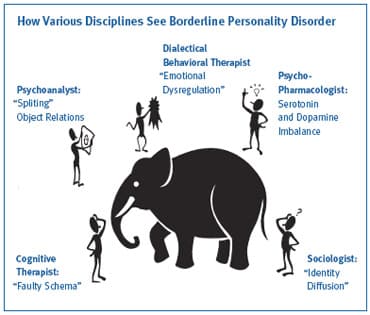
Therapy may include medication either briefly while new behaviors are being trained, or for an extended period of time. Yes, mental health professionals do tend to be prejudiced along the lines of their own comfort zones, per the drawing, above. My personal recommendation is find a good therapist who will work with you as to your comfort level re: meds, exercises to practice at home, diet, exercise.   If you are not making progress, seek out an alternative counselor.

Don't give up! If you blew out your knee, and it was "do physical therapy, or resign yourself to a wheelchair for the rest of your life," you'd probably opt for the physical therapy, hard though it can be. I know people who've made considerable progress in battling their dysfunction. You could be one of them.

Blessings and healing to you, and to your loved ones.


My A-Z theme is Issues related to Mental Health or Mental Illness.


Do you know, or think you know someone with a Personality Disorder?
Have you had any of the therapies, shown above with the elephant? 
Your thoughts?
Enhanced by Zemanta

Tuesday, April 17, 2012

A-Z: Obsession Stinks - And I Ain't Talking About the Cologne

Magnificent Obsession (1935 film)Magnificent Obsession (1935 film)
(Photo credit: Wikipedia)
As I blogged before, Obsession and Compulsion go together in many people's minds like peanut butter and jelly. Or better yet, Bonnie and Clyde - a couple who might not have been all that terrible when separated, but together, deadly.

For the purposes of this post though, I'm giving them a trial separation. (Sorry, Clyde.)

Obsession, all by itself, is a thought with no action. 

When we fall in love, we tend to think of the other person frequently, perhaps even obsessing over what s/he is doing, thinking, replaying everything s/he said or texted or the way s/he looked at us, in our minds. (When we text or call her/him 50 times a day, we've moved into action.)

We might obsess over something less pleasant. Am I going to be laid off? Did I remember to turn off the stove? It's a thought loop that we keep replaying, in our minds, like a NASCAR car running laps.

Excluding the cologne, I believe there are three kinds of obsessions.

Romantic/celebrity/hobby obsession.
George ClooneyGeorge Clooney
(Image via RottenTomatoes.com)
Any action here can be mild, or it can be annoying, even life-threatening.  Let's say I create a Pinterest board containing every picture I can find of George Clooney. If it's something I spend an hour or two every day on... as long as I still carry on with my regular life, no harm, no foul. If I skip work,  meals, and baths to look for those pictures, I've gone too far.

Someone else could be equally devoted to finding the missing part for the classic car he is restoring, or the last Monkees lunchbox in a set.

Somewhere along the way, though, a line may be crossed. We frequently hear of celebrity stalkers, such as the woman who kept breaking into David Letterman's house, the man who attacked George Harrison, or the man who murdered actress Rebecca Schaeffer. Ordinary people may also have obsessed exes, sometimes someone they never married or even dated, simply an admirer, who pursues them.

I had somebody who I knew casually, that I met for a single lunch date. It was okay... but there was something a little off about him, especially towards the end of the date. I decided I didn't want to see him again. Told him so, clearly, at the end of the date, when he asked if we could go out again; you're a nice guy, but this isn't working for me. Closed with: Thank you, but I don't want to go out with you again. He continued to call me at work (I never gave him my work phone number; he told me he drove around until he spotted my car parked in the lot in front of the building) wanting to discuss "our relationship" until I threatened to call the police. Luckily, that was enough to make him leave me alone, but I admit, thinking about the guy still creeps me out.

Obsession as in OCD. 
This kind of obsession is obsessive thoughts that are intrusive, possibly even horrible.  Fantasizing about killing your children, say, or sex with ducks, that keep looping through one's mind. They might think about all the bacteria swarming all over a doorknob.

Someone with OCD may pair their obsession with a compulsive action; for instance, someone obsessed with whether the back door is locked may flip the lock back and forth exactly eight times, to be sure it's locked. They may engage in counting rituals. They may try to overpower or replace the obsessive thoughts through willpower. They may be so obsessed with germs and cleanliness that they wash their hands to the point of chapping and bleeding.

In any event, the OCD'r recognizes the obsession as obtrusive and unwanted. (ego-dystonic) It feels to them as if it's something that comes in from outside of themselves.


Obsession as in OCPD.
A person might obsess over a past event, running it over and over in his mind, replaying how wrong the other person was and how hurt and angry he feels about it. Or overanalyzing a future situation, like packing for a trip, making a list and checking it over and over again. 

For the OCPD'r, their obsessive thoughts are logical and rational. Everyone should devote as much time and care and energy to these things. (ego-systonic) OCPD'r think that theirs is The Right Way to think. Jeff Lewis, star of Bravo's Flipping Out, believes his disorder makes him successful (if not a candidate for Boss of the Year).

This difference in between attitudes is what makes those with OCPD very different from those with OCD (though there can be co-morbidity, that is, a person can have traits of more than one disorder).  Those with OCD will often seek out help, because they want their obsessive thoughts to go away. Those with romantic/hobby obsessions or OCPD, rarely seek help because they feel there is nothing wrong with the way they think, or how much "head space" they devote to their obsessions.

Unfortunately, because of their disorder, those with untreated obsessions may not recognize when their behavior crosses the line from harmless or helpful, to downright destructive. While most of those with mental disorders, including erotomania  and OCPD, are much more likely to be the victims of a physical assault than the perpetrators, some individuals with mental illness can be dangerous, to others and even themselves. David Letterman's stalker ended her own life a few years ago.


My A-Z theme is Issues related to Mental Health or Mental Illness.


Have you ever had an obsession 
that crossed the line to unhealthy behaviors?
Have you ever had someone obsessed with you?
If you have had OCD or OCPD, 
what is the most helpful tip or information?
Enhanced by Zemanta