Using writing, and meditation, and ice cream, and reading, and dreams,

and a whole lot of other tools to rediscover who I am,

after six years living with a man with OCPD.


Showing posts with label Personality disorder. Show all posts

Tuesday, July 17, 2012

Too Perfect Tuesdays - Chap 9 - The Driving Forces
The Pressure of Perfectionism & The Angst of All-Or-Nothing

English: perfectionist measuring and cutting grass
English: perfectionist measuring and cutting grass (Photo credit: Wikipedia)
This post continues with The Driving Forces: THE PRESSURE OF PERFECTIONISM and THE ANGST OF ALL-OR-NOTHING from Chapter Nine.

This series looks at a small snippet of The book on the Perfectionist Personality, aka The Obsessive Compulsive disordered Personality, aka OCPD, each week. Please follow along, leave your comments, engage more on the FaceBook website... whatever your heart calls you to do.


When Being in Control Gets Out of Control by Allan E. Mallinger, M.D. and Jeanette DeWyze was published by Random House in 1992.  If   you believe you are dealing with OCPD or someone who is "Too Perfect," whether that's you or a loved one, please buy a copy of the book and read it for additional insights that will not all be covered in these excerpts.
The Driving Forces
Every workaholic isn't necessarily obsessive. But most strongly obsessive people are workaholics - driven to overwork by any number of their obsessive traits, including the following leading culprits.

THE PRESSURE OF PERFECTIONISM
The person who can't tolerate making mistakes, or who has to be perceived as irreproachable, is more likely to find himself at his deak late at night, laboring to catch any possible error and striving to make his work perfect. Lydia, for example, was a thirty-one-year-old travel agent who worked until eight or nine o'clock every evening - two or three hours longer than all the other agents in her office. She was not paid for putting in the extra hours, but she couldn't bear the thought of overlooking any of the details that would give her clients the best possible trips. <snip>

"I really enjoy my time off," Lydia insisted. "And my husband has pleaded with me for years to come home earlier. I'd like to, but I really empathize with my clients, and I simply have to do my best for them."

<snip> One other aspect of perfectionism also can foster workaholism. Remember that subscribing to the Perfectionist's Credo often results in unproductive and time-consuming behavior patterns. Fear of making an error may cause the perfectionist to procrastinate, for instance, or he may waffle over decisions, or be unable to wrap up his projects. As a result, some perfectionists have to work long just to accomplish the same amount as someone less perfectionistic.


THE ANGST OF ALL-OR-NOTHING

The familiar force of all-or-nothing thinking also shapes the work-heavy lifestyles of many obsessives. They seem to feel as if cutting back on their work hours even slightly will lead them to cut back more and ever more, eventually bringing them to a horrifying state of indolence.

Many find it hard to start certain projects, knowing that once they start they'll have trouble stopping before the task is completed (and perfectly, at that). Their reluctance to interrupt the work, in turn, comes partly from their knowledge that if they lose their momentum it'll be hard to start up again. It's a vicious cycle that is conveyed by one character in Thomas Wolfe's You Can't Go Home Again:

"I've got an idea that a lot of the work in this world gets done by lazy people. That's the reason they work - because they're so lazy.... It's this way: You work because you're afraid not to. You work because you have to drive yourself to such a fury to begin. That part's just plain hell! It's so hard to get started that once you do you're afraid of slipping back. You'd rather do anything than go through that agony again - so you keep going... til you couldn't stop even if you wanted to... Then people say you're a glutton for work, but it isn't so. It's laziness - just plain simple, damned, simple laziness, that's all.
***
I was helping my ex with a set of back bank reconciliations. It was off by eleven cents - and he had to find those eleven cents. No matter how long it took.


Logically, that's not cost-effective. If you make, say $20 an hour for your services (I charge a lot more), each minute of your time is worth at least thirty-three cents. I tend to want to look for that dime, too, like filling in the last line of a crossword puzzle, but I have learned that devoting hours to prove that the bank cleared a check for $xx.56 when they should have cleared it for $xx.66 is not the best use of my time.

I, too, fear losing momentum. But not finishing something isn't the worst thing in the world. I *have* been able to pick up again where I left off.

These are the two things facets that (to me) seem to link OCPD to hoarding (again, not all OCPD'rs hoard, and not all who hoard have OCPD.) But hoarders can't think big picture. Their attitude is, why even start unless you're prepared to devote the entire day or weekend, keep going until you're done?

Sometimes this makes sense.  For instance, when it's the middle of the rainy season, here in So Cal, and there's the forecast for two days of sunshine, is not the smartest time to try to have your roof repaired. But most jobs CAN be tackled in small bites.

And when you keep adding more things to the room/closet/garage, you will never, ever be able to finish in one day.


Do you know someone who stays up late correcting minor mistakes?
Who works extra hours to make sure his/her work is perfect?
Or who won't start a big project unless it can be done?
Your thoughts?
Enhanced by Zemanta

Tuesday, April 24, 2012

A-Z - Unchosen Relationships - When You Can't Get Away

Sibling!
Sibling! (Photo credit: Gus Dahlberg)
We can choose our friends, but we can't choose our family. For the letter U today, I'm going to excerpt and comment upon the excellent piece from Out of the Fog.
Unchosen relationships are relationships with family members who suffer from personality disorders.
 And other mental illnesses.
Unchosen is a term used to describe those of us who did not choose their relationship to a person with a personality disorder. Some of us have parents with this disorder; others have a sibling, in-laws, or other familial relationships. We did not choose this relationship the same way a person chooses a relationship to a partner with or a friend with a personality disorder. 
With a spouse, love partner, neighbor, boss, co-worker, we can choose to leave the relationship, to move, to change jobs. It might be painful and very difficult, but we can get away. It's harder to get away from family, or to abandon a family member (sibling, parent, child) who has married a dysfunctional person; however, in those cases, we are normally dealing with the unpleasant in-law from an adult, rather than a child's, perspective.
For instance: someone who grew up with a personality disordered parent will have had a vastly different struggle than someone who had a relatively normal childhood, but ended up with a disordered partner. That doesn't mean the "Unchosen" person's pain is any greater or any less than the "Chosen" person's pain, but very often, the abuse and inappropriate behaviors modeled during his or her formative years will have deeply affected the Unchosen Non child's core sense of being (and well-being), and may have long-lasting impacts on trust, self-esteem and the ability to form or maintain healthy relationships in adulthood.
In the paragraph above, "non" refers to a child without a personality disorder.  Being a "non" as compared to a person with a personality disorder does not mean everything is a-ok with us. In fact, a non may have many other Issues, and behave inappropriately and harmfully to self and others, too.

I can personally testify that it is really hard to choose a healthy love relationship, when you have no friggin' clue how to recognize it. If there are no models in your family of origin, how do you even know what one looks like? TV and movies? Books?  

cast of Leave It To Beaver
I know that my own relationship with my OCPD ex was in large part an attempt to heal wounds left by my relationship with my narcissistic, alcoholic father. Sadly, my ex was just f---ed up in a different way. In large part because I was used to dysfunction, I missed the red flags, and when I did see them, I thought, well, now, with my adult skills, I could fix him.
When the personality disordered individual is a child, the pain and disruption is experienced by the entire family. Adults feel responsible, trapped, frustrated and depressed. Non-personality-disordered siblings feel fearful and neglected as their parents focus on the problems created by the disordered individual. 
Partly because of poor understanding of where mental disorders come from, there is the guilty assumption by parents that if only one had loved the child enough, been patient enough, done the right thing, his/her mental disorder would not be so severe. Or, possibly, there may be guilt for passing down defective genes or eating or drinking the wrong thing during pregnancy. Siblings may have very mixed feelings, especially as teenagers; sometimes loving their troubled sibling to pieces, other times perhaps even wishing s/he were dead. 
The Unchosen Relationship
To be in an unchosen relationship is difficult and often traumatizing. We are told repeatedly by society and well-meaning people that we "must," "should," "have to" (fill in the blank) because they - the personality disordered - are family. 
"After all, he is your father." Boy, if only I had a dollar for every time someone said that to me!
We are often asked to overlook continued abuses because the person is ill. In other instances we are expected to “be the bigger person” and stuff our emotions so as not to upset the ill family member. We are asked to parent our parent while still trying to have a life of our own. 

People who haven’t been where we have been truly have no idea what we live with. Some of us are constantly torn between trying to protect and heal ourselves and trying to have some sort of relationship with our families, however dysfunctional they may be. Others have decided that they no longer want a relationship with the ill family member. Many of us have been subjected to a lifetime of emotional, verbal, physical, and sometimes sexual abuse. These abuses do not disappear just because time has passed or because we are adults. Sometimes the worst scars cannot be seen.

In this section, you may see terms like NC (no contact) or LC (limited contact). Many people choose one or the other, or drift back and forth between them trying to find a balance with which they are comfortable. Some choose to try and tolerate what they can, when they can, knowing they are unable to completely remove themselves from a parent or other relative. Understand that what works for one simply does not work for everyone.
After decades of trying to begin a new relationship with my father, as an adult, which efforts were ignored and/or abused by him, I decided upon LC. It was the best way for me to forgive his past offenses and remember the good things about him (which I could count on my fingers). For myself, I couldn't "deal" with fresh offenses and his constant attempts at emotional manipulation.

My oldest sister chose to become more involved, supervising his finances and getting him placed in a good veteran's home facility, but even she drew the line at bring him into her home, or even into our state. Our other sister's choice was similar to mine, LC. When our father died last year, our middle sister chose to attend the memorial service, in support of our oldest sister. I chose to stay away - also in support of our oldest sister. Because once people began spouting the usual post-death BS about what a great guy the man was, I would probably have lost it and spoken up. This would have hurt my sister to no good purpose.

So I don't judge people who don't visit their parents or mentally ill siblings; don't call them, or make other efforts to avoid contact. It may show an admirable amount of restraint that they don't accidentally-on-purpose poison the person who's brought so much pain into their lives.

An Unchosen Perspective on Boundaries
It can be difficult to maintain or define boundaries when you are involved in a familial or otherwise unchosen relationship. Often, we are taught as children "not to make waves" or to “just get along;” that is, to not assert or define our own boundaries. As children we want to please our disordered parent and get along with a disordered sibling or relative; however, a personality disordered individual lacks appropriate personal boundaries of their own. This can result in inappropriate affectionate gestures and lack of personal privacy for the child. 
 This is why we should never "make" children kiss Aunt Clara, or sit on Santa's lap.
When our own personal boundaries are routinely broken, the message we learn is that our own needs and feelings don’t count - we are required to accept how others treat us without question. As we grow into adults, these lessons can become our way of life. We often feel taken advantage of, feel used or feel that our desires are unimportant. We become frustrated and angry that our boundaries are violated yet we are unable to express what, exactly, our boundaries are. 
In a healthy relationship, there are always boundaries. Children should be able to have their own special toys that they are not expected to share, for example, especially if they have a "special" sibling who tends to break or destroy much of what s/he plays with.


Constant yielding to a parent, sibling or relative becomes second nature. We lose our own sense of self and often find ourselves in unhappy relationships, jobs and life situations. The early lessons - that our feelings, views and opinions don’t count - continue to dominate our lives, sometimes subconsciously. 
We may feel we are only worthy if/when we are pleasing someone else. If we're doing something purely for ourselves - reading a book, watching a movie that nobody else in the household wants to watch, getting a massage - we may feel selfish, weird. 
This can result in poor life choices, from entering into careers or occupations that are a poor fit for us, to marrying the person we “should” rather than the person we love. The yielding to others we were taught as children can spill over into every relationship we have as adults. The consequences can be disastrous and painful. It sometimes feels as if we are living someone else’s life. 
Because we don't have our own sense of self, we may Rescue others and follow the pattern assuming responsibility for how we "make" others feel. I know people who keep themselves quite busy being problem scouts - spotting and "helping" other people's potential problems before they even have a chance to notice and take care of the issue, themselves.

Then the problem scout wonders why her adult children don't seem to show any initiative, or make poor decisions on the rare occasion they do decide something for themselves.
Learning to enforce boundaries takes practice and patience. Yet it can be done - and lead us to a healthier, happier life. You can read some more ideas on setting healthy boundaries in our boundaries section.
And here: Boundary Betty.  Boundaries are different than walls, but it may help to think of them as castle walls. Something from the outside is stopped on the other side of the moat. After thorough examination, either the drawbridge is let down and it's invited in, or it's turned away.

When we have weak or no boundaries, anything someone says to us, does to us or even does around us gets hustled right in. We arrange our universe around what we think is gong on. Somebody makes a strange face - we must have done something to annoy him. (When the reality is, maybe he's just suppressing a fart. It's not always all about us.)
Types of Unchosen Relationships
There are distinct categories of non-personality-disordered individuals who call themselves “Unchosen”:
Children forced to live in an environment where someone else is abused.
Please take note of the last. Even if the child is not him or herself battered, sexually or verbally abused, it is not healthy for children to live in an environment where they regularly witness one member of the household abuse another. Perhaps Grandpa has come to live with the family and he's a raging a-hole to his adult daughter, the child's mother. Perhaps the mother is personality-disordered and regularly tears the father a new one.

Yes, "splitting the household apart" might be painful and quite difficult. But please, consider that you may be training the child up to recreate a household just like the one s/he grew up in.

I get that leaving is not always possible. I know my mother wanted to leave my father, but when you have a young child, and are terminally ill with cancer, your options are limited. Besides which, that was the early 1970's, and women had only a fraction of the legal rights in divorce they have today.

Still, there were avenues she could have explored: moving in with friends or family members, perhaps. If she had the physical and emotional strength to pursue them. I don't blame her; I understand that when you live with someone whose view of the world is black-or-white, your own thinking tends to become that way as well. You fail to see there are not two choices; there are probably two dozen choices.

There are always options.  Please, please, please, do not bring children into the world when you are in a dysfunctional relationship, thinking that a baby will make everything better and help your partner heal. And if you already have children, please consider whether continuing in a household where a severely dysfunctional person lives is healthy for them. Leaving or throwing out the disordered person are not the only choices; I know a woman who actually sent her children away, to live with some family friends who acted as guardians for them. It broke her heart, and yet, was probably much better for them than continuing in that household.


My A-Z theme is Issues related to Mental Health or Mental Illness.

Are you in any unchosen relationships 
with a mentally disordered person?
Is this a new thing, or did it begin when you were a child?
How has it affected the way you see the world and relationships?
Enhanced by Zemanta

Wednesday, April 18, 2012

A-Z: Personality Disorders: Not Just Being a Jackhole

from articles about men
If you grew up when I did, you're familiar with the convention, often applied to the fat girl, "but she has such a pretty face, and a wonderful personality."  The girl or boy might be overweight, or poor, or academically challenged, but they've chosen to cultivate a warm speaking voice, a kind attitude, or become the class clown and make everyone laugh.

So, many people, hearing the word "Personality Disorder," associate it with a conscious choice made by the person.  If it's applied to you, it probably feels bad, like people think you have chosen to be a jackhole.

Not so. It's a mental illness, just as much as being bipolar. (Though some with a personality disorder might prefer the jackhole label to that of being mentally ill.)

from Advances in Psychiatric Treatment:
One reason that personality disorders may not be diagnosed is the misconception that they are not mental disorders (see Adshead, 2001 for a discussion of the concepts of disease, illness and disorder as they relate to personality disorder).
The ICD–10 definition of a mental disorder refers to:“the existence of a recognisable set of symptoms and behaviours in most cases associated with distress and interference with social function” (World Health Organization, 1992: p. 5).
The definition of a personality disorder in DSM–IV (American Psychiatric Association, 1994: p. 633). includes the following characteristics:“an enduring pattern of inner experience and behavior that deviates markedly from the expectations of the individual's culture. This pattern is manifested in two or more of the following areas:
  1. cognition (i.e., ways of perceiving and interpreting self, other people and events)
  2. affectivity (i.e., the range, intensity, lability, and appropriateness of emotional response)
  3. interpersonal functioning
  4. impulse control”.
The pattern must be inflexible and pervasive across a broad range of personal and social situations. For a diagnosis to be made, the enduring pattern of inner experience and behaviour (i.e. the symptoms) must lead to clinically significant distress or impairment in social, occupational or other important areas of functioning.
Thus, the term mental disorder applies as much to personality disorder as it does to Axis I disorders such as schizophrenia. Individuals may need help as a result of their distress or because their symptoms are interfering with their everyday functioning. Personality disorders are associated with high levels of dysfunction, comparable to major Axis I disorders (Nakao et al, 1992).
See again "high levels of dysfunction." People with personality disorders tend to have difficult relationships with people over the long term, though in the short term they may be amazingly charming and charismatic.

We don't know why some people develop personality disorders; however, both genetic and environmental factors may contribute. Some of the people I know with OCPD, for example, recall an unloving childhood with strict and undemonstrative parents; feeling like they were never "good enough" to please their parents. Others recall a more loving environment, and recall having meltdowns over making a "mistake" in coloring a picture or some other standard they had set for themselves.

From Listverse on Mental Illness Myths:
Some people think that the name “personality disorders” and the fact that these disorders affect people so thoroughly mean that they are simply a part of the person and are, therefore, incurable. It may not always be possible to cure someone of a personality disorder, but people with personality disorders certainly can go through therapy to learn more useful ways of dealing with themselves and other people. Someone’s personality can change over time, and as is proved by many people who overcame mental illness, it is always possible (even if very difficult) to change patterns of thought and behavior.

If you think you know quite a bit about Personality Disorders, take this test at Discovery Fit & Health and find out.

The DSM-IV lists ten personality disorders:

*Antisocial
*Avoidant
*Borderline
Dependent
Histrionic
*Narcissistic
*Obsessive-compulsive (not to be confused with OCD)
Paranoid
Schizoid
*Schizotypal

The Personality Disorders identified with an *asterisk, above, are currently "keepers" in the DSM-V, currently a Work-In-Progress. There would also be a large residual category of Personality Disorder Not Otherwise Specified.

Chatanika River via Wikimedia

A Personality Disorder may be something like a river. The brain has a pattern of flowing along this way; but rivers can be redirected, and evidence points to the ability of the brain to form new patterns, just like rivers can. A river that's longer or more voluminous may take more work; a person with a personality disorder that is more severe may take more effort, but there is no reason to give up. Change can happen, if it's wanted badly enough.

from schoolworkhelper
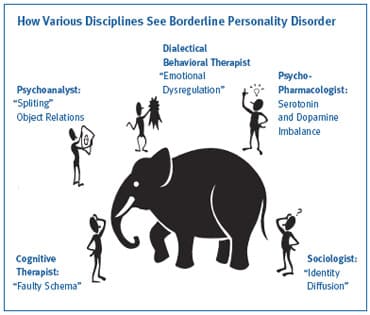
Therapy may include medication either briefly while new behaviors are being trained, or for an extended period of time. Yes, mental health professionals do tend to be prejudiced along the lines of their own comfort zones, per the drawing, above. My personal recommendation is find a good therapist who will work with you as to your comfort level re: meds, exercises to practice at home, diet, exercise.   If you are not making progress, seek out an alternative counselor.

Don't give up! If you blew out your knee, and it was "do physical therapy, or resign yourself to a wheelchair for the rest of your life," you'd probably opt for the physical therapy, hard though it can be. I know people who've made considerable progress in battling their dysfunction. You could be one of them.

Blessings and healing to you, and to your loved ones.


My A-Z theme is Issues related to Mental Health or Mental Illness.


Do you know, or think you know someone with a Personality Disorder?
Have you had any of the therapies, shown above with the elephant? 
Your thoughts?
Enhanced by Zemanta

Monday, April 16, 2012

A-Z: NAMI - Four Letters of Goodness

Who woulda thunk that talking about race, politics, and religion would be the easy conversations?

Well, as far as race goes - whatever race (or combination of races) you are, that's what you are. Not gonna change. Politics and religion - whatever yours are, now, that's by your own choice, and you can choose to stay what you are now, or make a change at any time of your choosing. There's a kind of security in that.

Not so with mental illness. At any moment, mental illness can hijack you and make you sound... like a winner.

Charlie Sheen, via Wikimedia
Most of us find that concept more than a little scary. We want to deny it could ever happen to us. Yet some of the most creative, smart, and funny people in the history of humankind have been mentally ill. Take a look at this very incomplete list:

http://www.nami.org/Images/ECProductImages/famous%5Fpeople%5Flarge%2Egif
I kind of feel sad I do not (yet) qualify to be included. (But maybe my time will come.)

If mental illness does strike, either you or someone in your family, you can't call Ghostbusters.

You can call NAMI (And I bet they'll help hook you up with your local resources if you live outside of the USA.)

About NAMI
NAMI, the National Alliance on Mental Illness, is the nation’s largest grassroots mental health organization dedicated to building better lives for the millions of Americans affected by mental illness. NAMI advocates for access to services, treatment, supports and research and is steadfast in its commitment to raising awareness and building a community of hope for all of those in need.
From its inception in 1979, NAMI has been dedicated to improving the lives of individuals and families affected by mental illness. Financial contributions allow NAMI to offer an array of programs, initiatives and activities in support of the NAMI mission.
 NAMI provides support for local centers that offer programs such as: 
  • Family-to-Family
  • Peer-to-Peer
  • Missing Persons Support
  • Veterans Resources
  • Information, training and support for parents, teachers, and professionals dealing with mentally ill children and adolescents.
They're not all about pushing drugs, but helping to educate families to make choices that work for them.


One of the problems we face in the US (and pretty much, every country all over the world), is when economic times are tough, programs that help the mentally ill and their families are usually among the first to be slashed. It's understandable; it is also penny-wise, pound-foolish. Supporting someone with a manageable mental illness to stay on his/her meds, in counseling and employed, is way cheaper than locking him or her in jail, where a number of mentally ill people end up.

But there's still the perception that if mentally ill people "just tried harder," they could think/will themselves out of their depression or mania or auditory hallucinations. (Dare I say that people who think that are, well, crazy?)

How can you help? Pick any/all of the below:
We can't cure mental illness by willing or wishing it away, but we can work together towards finding its causes, and support those families who deal with this burden. It may be "them, over there," today, but it could be us, tomorrow.


My A-Z theme is Issues related to Mental Health or Mental Illness.

Have you had a personal experience with NAMI?
Ever supported their walks, or donated?
Has mental illness touched your life?
Enhanced by Zemanta

Thursday, April 12, 2012

A-Z: Kindness & Being A Pushover -
Not The Same Thing

We tend to give people not necessarily what they want, but what we would want if we were in their place.

Sometimes we think we are being kind, when in reality, what are we doing? Avoiding confrontation. Being "nice" - because it is much less work to be nice, right at the  moment, than to take a stand and say, "No." "No, that's not what I want; No, I don't want to do that. I understand that you want me to do X, but I choose to do Y."


Whatever your particular "no," is, it will take much energy and effort to maintain your position in the face of the disappointment, manipulation, or tantrum of somebody you do actually care about.

On one of the support boards I belong to, there's a new member, who's realized that she really doesn't want to live with her (untreated) hoarding fiance after all.  He's only partway moved in, and already there are boxes and piles everywhere. She's expressed her dismay, which her fiance has brushed off, and she's being instructed to "just jump over" the piles of books and belongings that already block her route to the bathroom and bed, with his  move less than half complete.

She wants to tell her fiance, "Whoa, wait a minute. Not what I signed up for, not how I want to live. I think you should stay in your own place, after all, or find another place to live." She's hinted at this already, but he's refused to take the hint. Still, she doesn't want to be mean. She thinks perhaps it'll be easier, if she simply goes along with it for a few months, brings it up gradually.  That it'll be kinder that way.

Kinder? Gentler? No, not really.

If you remember this song... you must be ancient.


If your partner would be devastated by something you say today, trust me, s/he will be just as devastated a week, or two, or ten from now. Please also note - if you are involved with a disordered person, and you stand up to him/her, they may throw a tantrum as large as that thrown by a 3 year old in the cereal aisle.  And be just as scarred in the long-term (that is, not at all) as that 3 year old. As the non-disordered person, taking the long-view is something only you can do.

Get help, if you don't have the courage/strength to confront him/her, but don't lie to yourself that you're simply trying to be nice/kind. Honestly? You're being chicken sh-t.

Letting a disordered person walk all over you is not, in the long run, a kindness. Not to them, not to you. Staying in a marriage with someone you have grown to loathe - not seeking counseling, not trying a trial separation, not trying to mend the marriage, or break it apart cleanly, but simply to fake it so you are not too bothered by the other person's distress or grief - you're not being kind. You're being a coward.

Take it from Queen Chickensh-t herself. I did not, in the end, spare my partner (or myself) any pain by dragging it out in hopes something miraculous would happen. The times I let him do something crazy and did not call him on it, out of fear (and sometimes, confusion) on my part, did not magically heal him.

You will have to leave - or stay with - a disordered person who is refusing treatment as long as seems right to you. But please, don't delude yourself that by postponing the issue, you are being kind. You're not. It's like a deferred payment on a credit card - it will come due, and with some rather hideous interest charges.


My A-Z theme is Issues related to Mental Health or Mental Illness.

Have you ever been "cruel to be kind"?
Has someone ever "let your down gradually" in a way that hurt more 
than if s/he'd been truthful straight up? Your thoughts?

Monday, April 2, 2012

A-Z: Borderline - Not Just a Tune You Can Dance To

People think "borderline" means part of this, part of that.  Perhaps the concept of borderline as being on the edge may be helpful in understanding Borderline Personality Disorder.

My A-Z theme is Issues related to Mental Health or Mental Illness.


Unfortunately, the real Borderline Personality Disorder doesn't come with choreography and cute hats.  It also goes beyond "being a little moody" or having PMS.

From NCBI, US National Library of Medicine:

People with BPD are often uncertain about their identity. As a result, their interests and values may change rapidly.
People with BPD also tend to see things in terms of extremes, such as either all good or all bad. Their views of other people may change quickly. A person who is looked up to one day may be looked down on the next day. These suddenly shifting feelings often lead to intense and unstable relationships.
Other symptoms of BPD include:
  • Fear of being abandoned
  • Feelings of emptiness and boredom
  • Frequent displays of inappropriate anger
  • Impulsiveness with money, substance abuse, sexual relationships, binge eating, or shoplifting
  • Intolerance of being alone
  • Repeated crises and acts of self-injury, such as wrist cutting or overdosing

Borderline Personality Disorder AwarenessBorderline Personality Disorder Awareness (Photo credit: Gemma.E.Taylor)


While they offer support and resources to people dealing with all Personality Disorders, the excellent site Out of the Fog was initially created by partners of those suspected or diagnosed with Borderline PD.  (Note: the DSM-V, currently under review and due "out" in 2013, may be renaming this disorder as Emotional Regulation Disorder (ERD) or Emotional Dysregulation Disorder (EDD).)

Suggested treatment includes DBT, Dialectical Behavior Therapy.

As with any mental disorder, your mileage may vary.  For anyone in a relationship with a disordered person, getting help for yourself and keeping the lifeline open to family, friends, and other support is vital.


My A-Z theme is Issues related to Mental Health or Mental Illness.


Do you know someone with Borderline Personality Disorder?
Do you have any good tips for managing a relationship 
with such a person?  Your thoughts?
Enhanced by Zemanta