Using writing, and meditation, and ice cream, and reading, and dreams,

and a whole lot of other tools to rediscover who I am,

after six years living with a man with OCPD.


Showing posts with label anakastic personality. Show all posts

Tuesday, December 4, 2012

Too Perfect Tuesdays - Chap 10 - Recognize
That They May Be Taking Your Quirks Personally


via imagerymajestic
from FreeDisitalPhotos
This post continues with Chapter 10 - Living With the Obsessive: 2 - Recognize That They May Be Taking Your Quirks Personally from Chapter Ten.

This series looks at a small snippet of The book on the Perfectionist Personality, aka The Obsessive Compulsive disordered Personality, aka OCPD, each week. Please follow along, leave your comments, engage more on the FaceBook website... whatever your heart calls you to do.


When Being in Control Gets Out of Control by Allan E. Mallinger, M.D. and Jeanette DeWyze was published by Random House in 1992.  If   you believe you are dealing with OCPD or someone who is "Too Perfect," whether that's you or a loved one, please buy a copy of the book and read it for additional insights that will not all be covered in these excerpts.

2. Recognize That They May Be Taking Your Quirks Personally
When you resist dong things their way, some obsessives may interpret your lack of compliance as evidence that you don't care about them. <snip>

Hank, a forty-five-year-old engineer, and his wife, Sharon, both told me that one of their biggest problems sprang from Hank's terrible temper.  "He doesn't seem to realize when he's being unreasonable," Sharon said. "When he comes home from work, he looks around for things that haven't been done. Then he explodes at the kids [two teenage boys] and me. We're on the defensive so much of the time."<snip>

...all he asked in return was that they do "a few very easy things": attend to certain gardening tasks, for instance, or keep the contents of the silverware drawer straight. Hank saw these and a multitude of similar tasks as being self-evidently important, and he went to some lengths to get the others to agree that they needed to be done; that if one of the knives was pointing the wrong way, for example, someone could get hurt. <snip>

I challenged Hank to reexamine some of his premises. Would the world really end if the yard wasn't free of weeds, or the silverware didn't all point in the same direction? I urged him to acknowledge that he was requesting certain things because they were important to him, and not because it was objectively imperative that they be done. And even if his demands were reasonable, I asked, was being right worth alienating his family?

<snip> Hank finally began to understand that no matter how "right" he was about keeping things in order, all his arguments, lectures, rages, and logical "proofs" of the correctness of his positions were actually counterproductive. He acknowledged that not only were his demands not being met, but his family literally dreaded his presence. It finally struck home that no amount of logical argument could make Sharon experience the world exactly as he did, and that even when she and the boys yielded to his demands, they did so resentfully, and felt more alienated from him.

<snip> She also learned to avoid agreeing to do a task unless she was certain she really could and would do it, <snip>
***

To a certain extent, we all assume that other people see the world much the same way we do. That's why it can be a shock when somebody we love and respect espouses a really bizarre (to us) religious or political viewpoint.

Hank, above, was really bothered by the weeds, and he didn't see the task of weeding as any big deal. He didn't "get" that his wife Sharon, absolutely loathed weeding with a passion, considering it backbreaking drudgery, and secondly, she didn't see all the weeds the same way he did.

Weed Show Display
Via Flickr Creative Commons
Some see weeds and trash, others see art


Recently on one board the topic of "testing" arose - an OCPD'r putting something out of place - a leaf om the floor, a few pennies on the counter, etc., to "test" to see what other family members would do - and then blasting them if they didn't do "the right thing."  Something that came up with my ex, when he was sharing a kitchen with his sister, was a small spot on the counter from some dish she'd prepared.  I'm not sure whether the spot was grease, or gravy, or something else, but it was smaller than a dime.  He was damn well going to leave it there and test how long it took that slovenly sister of his to clean it up, though it bothered him for almost a week, until he couldn't stand it any longer.

via Carlos Porto at FreeDigitalPhotos
I remember reading in one piece of material (if I could remember where it was, I'd link it here) that for one obsessive person, you could go into his closet, and move the tail of ONE shoelace exactly one quarter inch, and not touch anything else in his closet, and he could go in there and immediately tell what was "wrong."  This is one of the ways, for many perfectionists, that this disorder is akin to (or perhaps part of) the autism spectrum; things "out of place" can totally rock their worlds, and not in a good way.

Channeled properly, this kind of superfocus on detail can, in fact, be a great gift. There are professional fields where the tiniest flaw or error can result in huge loss of human life - aeronautics is one field that comes to mind; surgery is another - there are many. The problem is that people with this gift/curse 1) don't realize they see things differently than the average bear, and 2) they don't leave their "gift" at work.

Since they would never leave a leaf on the floor, a grease spot on the counter, or tiny weeds in the flowerbed, they are certain that if someone has left these things out of place, it must be deliberate.  Clearly, we are toying with them, trying to upset them.  If we understand this point of view, it is easier to see how they might take these things personally (though not any easier to be on the receiving end of "arguments, lectures, rages, and logical 'proofs'").

The answer is not to try to follow the "Crazy Rules," because trust me, even if Hank's wife Sharon had done an exemplary job with the weeding, there would've been something else - the gravel bordering the driveway needed to be hosed down more often, something.  This disorder is ego syntonic- when something feels amiss to an OCPD'r, they rarely look internally and ask, "Is this me?" but seek outside themselves for the thing that is out of place/dangerous.  When they find something that is not perfect (and you can always find something, if you're looking hard enough), they have this moment of "Aha, that's what it is/was!"  Often followed by rage or lectures directed at the slob/inconsiderate person who "made" them feel that way.

Unless we actually are toying with them (it's not unheard of for office mates of a "persnickety" co-worker to move things on her desk, for example), we have to take a step back from that, and not accept harsh judgment on ourselves. We may not be able to convince them that their world view is wrong (the assumption that everyone shares the same ability to see detail, for example), and probably shouldn't try, but we can know for ourselves, that just because our disordered partner or friend SAYS we are: selfish, lazy, sloppy, careless, [fill in the blank], t'aint necessarily so.


Your thoughts?

Tuesday, November 27, 2012

Too Perfect Tuesdays - Chap 10 -
Don't Take Their Foibles Personally

via imagerymajestic at
FreeDigitalPhotos
This post continues with Chapter 10 - Living With the Obsessive: 1 - Don't Take Their Foibles Personally from Chapter Ten.

This series looks at a small snippet of The book on the Perfectionist Personality, aka The Obsessive Compulsive disordered Personality, aka OCPD, each week. Please follow along, leave your comments, engage more on the FaceBook website... whatever your heart calls you to do.


When Being in Control Gets Out of Control by Allan E. Mallinger, M.D. and Jeanette DeWyze was published by Random House in 1992.  If   you believe you are dealing with OCPD or someone who is "Too Perfect," whether that's you or a loved one, please buy a copy of the book and read it for additional insights that will not all be covered in these excerpts.

1. Don't Take Their Foibles Personally
Obsessive behaviors usually stems from deep-seated fears, and not from any malice toward you. Yet it's easy to lose sight of this. If hardly a day passes without your spouse criticizing something you do, you may feel he or she regards you in a fairly dim light. Worse, you may start seeing yourself that way.

Try to remember that your mate's finely tuned sensors would find fault with even the saintliest, most infallible person. <snip>

Remember that the obsessive's personality was formed long before he met you, and he would demonstrate this behavior with anyone - especially someone important to him. This understanding can make the obsessive's comments or actions less hurtful.

***

Foibles is such a fun-sounding word, isn't it?  Like fur mated with marbles, round and soft and cuddly.  Dictionary.com defines a foible as: a minor weakness of failing of character; slight flaw of defect: an all-too-human foible.

Some of the behaviors exhibited by a perfectionist personality may feel very personal: the parent who sighs heavily or makes a sarcastic comment about a report card with five A's and a B; the spouse who freaks out when you're driving; the twenty-minute lecture about the toaster left plugged in.

via Ambro at FreeDigitalPhotos
It's very, very hard not to take it personally when the other person employs name calling and "you" language.  I was at the receiving end of some horrific rants that used a lot of nasty, accusatory language, "You don't care about our home; you're such a slob; you can't do anything right..." The issue at hand being something clearly incendiary like forgetting to hang the bathmat over the shower rail when I was done dressing, or bringing home a new kind of food product from the grocery store.

But when you talk to others who live with a person with similar behaviors, or review the "Crazy Rules" or similar stories by spouses, children or siblings of those with these issues, it is easier to see that it is truly not personal.  It ain't you (most of the time), and truly, it ain't them, either, it is the mental disorder which has them "under the influence."

Only you can decide if the benefits of the relationship outweigh the disadvantages, and yes, the pain of living with a person who sees flaws/problems everywhere s/he looks - and never seems to stop looking or pointing them out.  "Foibles" of a Perfectionist Personality aren't generally cute and cuddly.

It's like (I hear) living in Seattle: it rains there, a lot. You can buy wonderful raingear and take frequent trips to sunnier locales, but if you find clouds and frequent rain unbearably depressing, Seattle is probably not a good environment for you.  Others may thrive there.

And please, don't take the distorted vision of a person with a mental disorder as your mirror. You are not a slob if you occasionally leave a towel hanging crooked in the bathroom, or a slacker if you get B's as well as A's on your report card. Do not let him or her shake your faith in yourself as a worthy and lovable person, even if occasionally you do make mistakes or exhibit your own foibles.

Your thoughts?


Wednesday, April 18, 2012

A-Z: Personality Disorders: Not Just Being a Jackhole

from articles about men
If you grew up when I did, you're familiar with the convention, often applied to the fat girl, "but she has such a pretty face, and a wonderful personality."  The girl or boy might be overweight, or poor, or academically challenged, but they've chosen to cultivate a warm speaking voice, a kind attitude, or become the class clown and make everyone laugh.

So, many people, hearing the word "Personality Disorder," associate it with a conscious choice made by the person.  If it's applied to you, it probably feels bad, like people think you have chosen to be a jackhole.

Not so. It's a mental illness, just as much as being bipolar. (Though some with a personality disorder might prefer the jackhole label to that of being mentally ill.)

from Advances in Psychiatric Treatment:
One reason that personality disorders may not be diagnosed is the misconception that they are not mental disorders (see Adshead, 2001 for a discussion of the concepts of disease, illness and disorder as they relate to personality disorder).
The ICD–10 definition of a mental disorder refers to:“the existence of a recognisable set of symptoms and behaviours in most cases associated with distress and interference with social function” (World Health Organization, 1992: p. 5).
The definition of a personality disorder in DSM–IV (American Psychiatric Association, 1994: p. 633). includes the following characteristics:“an enduring pattern of inner experience and behavior that deviates markedly from the expectations of the individual's culture. This pattern is manifested in two or more of the following areas:
  1. cognition (i.e., ways of perceiving and interpreting self, other people and events)
  2. affectivity (i.e., the range, intensity, lability, and appropriateness of emotional response)
  3. interpersonal functioning
  4. impulse control”.
The pattern must be inflexible and pervasive across a broad range of personal and social situations. For a diagnosis to be made, the enduring pattern of inner experience and behaviour (i.e. the symptoms) must lead to clinically significant distress or impairment in social, occupational or other important areas of functioning.
Thus, the term mental disorder applies as much to personality disorder as it does to Axis I disorders such as schizophrenia. Individuals may need help as a result of their distress or because their symptoms are interfering with their everyday functioning. Personality disorders are associated with high levels of dysfunction, comparable to major Axis I disorders (Nakao et al, 1992).
See again "high levels of dysfunction." People with personality disorders tend to have difficult relationships with people over the long term, though in the short term they may be amazingly charming and charismatic.

We don't know why some people develop personality disorders; however, both genetic and environmental factors may contribute. Some of the people I know with OCPD, for example, recall an unloving childhood with strict and undemonstrative parents; feeling like they were never "good enough" to please their parents. Others recall a more loving environment, and recall having meltdowns over making a "mistake" in coloring a picture or some other standard they had set for themselves.

From Listverse on Mental Illness Myths:
Some people think that the name “personality disorders” and the fact that these disorders affect people so thoroughly mean that they are simply a part of the person and are, therefore, incurable. It may not always be possible to cure someone of a personality disorder, but people with personality disorders certainly can go through therapy to learn more useful ways of dealing with themselves and other people. Someone’s personality can change over time, and as is proved by many people who overcame mental illness, it is always possible (even if very difficult) to change patterns of thought and behavior.

If you think you know quite a bit about Personality Disorders, take this test at Discovery Fit & Health and find out.

The DSM-IV lists ten personality disorders:

*Antisocial
*Avoidant
*Borderline
Dependent
Histrionic
*Narcissistic
*Obsessive-compulsive (not to be confused with OCD)
Paranoid
Schizoid
*Schizotypal

The Personality Disorders identified with an *asterisk, above, are currently "keepers" in the DSM-V, currently a Work-In-Progress. There would also be a large residual category of Personality Disorder Not Otherwise Specified.

Chatanika River via Wikimedia

A Personality Disorder may be something like a river. The brain has a pattern of flowing along this way; but rivers can be redirected, and evidence points to the ability of the brain to form new patterns, just like rivers can. A river that's longer or more voluminous may take more work; a person with a personality disorder that is more severe may take more effort, but there is no reason to give up. Change can happen, if it's wanted badly enough.

from schoolworkhelper
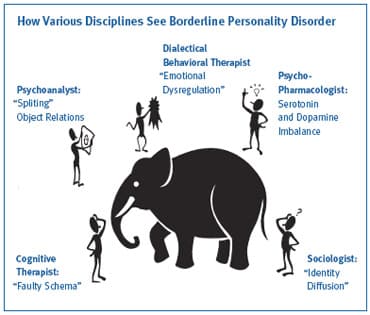
Therapy may include medication either briefly while new behaviors are being trained, or for an extended period of time. Yes, mental health professionals do tend to be prejudiced along the lines of their own comfort zones, per the drawing, above. My personal recommendation is find a good therapist who will work with you as to your comfort level re: meds, exercises to practice at home, diet, exercise.   If you are not making progress, seek out an alternative counselor.

Don't give up! If you blew out your knee, and it was "do physical therapy, or resign yourself to a wheelchair for the rest of your life," you'd probably opt for the physical therapy, hard though it can be. I know people who've made considerable progress in battling their dysfunction. You could be one of them.

Blessings and healing to you, and to your loved ones.


My A-Z theme is Issues related to Mental Health or Mental Illness.


Do you know, or think you know someone with a Personality Disorder?
Have you had any of the therapies, shown above with the elephant? 
Your thoughts?
Enhanced by Zemanta

Sunday, December 25, 2011

OCPD - As Seen on TV!

Bree Van de KampImage via WikipediaUntil a few years ago, I never heard of the term OCPD. 

Sadly, just because people don't know about a mental disorder - or, perhaps, call it by a different name, doesn't mean there aren't a whole bunch of people out there affected by it.

Once I started paying attention, I realized it had been out there, in the general population and portrayed on television, in movies, and in books and plays, for years.

Felix Unger, a fictional clean freak in a play by Neil Simon (later a movie and TV series), was probably OCPD.


Bree Van de Kamp from Desperate Housewives - perfectionist, controlled and controlling... OCPD, even if not officially diagnosed so by the show's writers.
After her mother was killed in a hit and run, Bree cleaned her blood off the road outside the house. She said that once everything was spotless, she felt much better. 


Just read a couple "heartwarming" books by best-selling author Debbie Macomber featuring characters with symptoms of OCPD.  As is one of the most famous poster-children of all, Ebeneezer Scrooge, in a story by Charles Dickens that's been recreated in numerous stage plays and movies.


Scrooge chose the pursuit of money over love, family, friendship... but in one night of ghostly visitations, he realized his mistake and turned his life around 180 degrees.  Macomber's characters, too - once faced with True Love, seemingly cured!

That can happen in novels.  In plays.  In movies.  One big epiphany, the stingy/controlling/perfectionistic person sees the light, and everything is different, from that moment onward.

Real life don't work that way.

In real life, a lifetime's habits, brain patterns, and the distorted thinking that are part of OCPD have never been miraculously cured in one night.  Think of changing the path of even a small creek - it will take long, hard work, to divert the path of the creek into a new direction.

It can be done.  It has been done.  It is being done - and I salute the brave, strong, courageous men and women who've decided to battle their OCPD.  But just like a creek that's been diverted, there's always the strong inclination to revert to the older, more accustomed channel.  It takes constant work to keep the water flowing in the new pattern.

Not meaning to discourage anyone praying for a miracle cure.  Prayer can't hurt.  But while you're waiting for said miracle, the smart money is on rolling up the sleeves and doing the work.

Where have you seen OCPD, in fictional works?

Enhanced by Zemanta

Saturday, September 24, 2011

What's Life Like with an OCPDr?
Cooking With the Anal-Retentive Chef

Sometimes a video is worth a thousand words.  Anal-retentive is what people with OCPD used to be called.

Thanks to SeeSaw at freeforums for sharing this.
- Watch more Funny Videos at Vodpod.

Of course, this is hysterically funny - in a four minute clip, seen once.

It's much less funny at all if you experience this every day, in the kitchen, in the bathroom, in the garage...

I lived with the A-R Chef, who might go into total meltdown mode if he was at the stove, stirring something in a pan, and I dared enter the kitchen and stand at the counter 10 feet away from him, to refill my glass of water.  He would shut off the burners, throw down the towel draped over his shoulder, and storm out.  Then he would sit and smoke and pout, and only when he recovered his equilibrium, could he resume cooking.

If I tried to cook or finish preparing a meal, he usually refused to eat it.  Or he might wait until it was cold, and then complain about how terrible it tasted, cold.  Usually this was coupled with insults to me about what a pig I was, how I seemed to need to eat all the time, and other derogatory remarks about my size and shape.

As I've blogged here before and others have remarked on other sites, sometimes the kitchen reaction seems to be similar to what happens to those with autism who experience sensory overload.  It's not just the person "being picky" or controlling, exactly, it's almost a panic-type response to too much stimuli.

What's impossible for those living with such a person, is knowing what will "set them off."  Sometimes I could go into the kitchen when he was cooking and he would be fine.  He'd make a lovely meal, we'd sit down to eat together, have a pleasant conversation.  Sometimes this would bring tears to my eyes, because it was so nice - why couldn't it be like that all the time?  The feeling of trying to walk on eggshells, of constantly being wary of setting off the next meltdown or tantrum, becomes extremely wearing on the people who share a household with such a person.

I never could remember all the triggers (even if I could, there were always new ones), and so, I was constantly Doing Something Wrong (in his eyes).   It exhausted me - and, I'm sure, it was equally rough on him.  I have friends who are cognizant of their OCPD behaviors, who are courageously battling against them, and I know  they don't like it when they're "that way," either.

Even though I could never go back to that lifestyle, my heart is deeply filled with pity for my ex.  I know he had light bulb moments, from time to time, when he didn't want to be the way he was.

Still, I look forward to the time, when I begin dating again, of having a "normal" kitchen again.  Where I can kiss the cook - or be kissed, if I'm doing the cooking.  Where we can cook together, perhaps even nibble food off one another's fingertips, and if the burners get turned off, it's by mutual consent because we've gone to enjoy some loveplay before returning to eat.  I remember having a happy kitchen like that, once upon a time.

What is your kitchen like?  A happy place, or a minefield?
Has OCPD impacted your kitchen and food prep?


Thursday, June 16, 2011

Bravery and OCPD
Self Discovery Word by Word


Some of the bravest people I know have OCPD.  (And some of the funniest - it was an OCPDr who shared this cartoon.) 


Nobody yet knows what causes OCPD.  Genetics?  Overly strict parenting?  A combination of the two? 

It may well be that like other mental illnesses, OCPD is primarily caused by a chemical imbalance or malformation of the brain.  So that the overwhelming fear, anxiety, and need to control is like sitting behind the wheel of a Toyota with a malfunctioning gas pedal. The question, for those diagnosed and actively battling their condition, may not be "why don't they handle life better?" but "why are they able to function as well as they do?"

Courage is the power to let go of the familiar.  ~Raymond Lindquist

Those with OCPD, brave enough to face a diagnosis, brave enough to commit to medication if necessary (medication is not the answer for everyone, but is very effective in some cases at interrupting OCPD behaviors long enough to allow new coping mechanisms to become habits.); brave enough to commit to regular therapy, are my heroes.

Courage is not the absence of fear, but rather the judgement that something else is more important than fear.  ~Ambrose Redmoon

This post is part of the Self-Discovery
Word by Word Series.  Join in here.
In many cases, the bravery comes about as the result of an ultimatum - get help or get out (or I will get out.)  Sometimes even that is not enough.  The love and possibility of a more fulfilling relationship (with others or oneself) is not rated as more important than the fear of change.

But for some, they do decide love is more important, and it takes bravery and courage to make that choice.  They become strong enough to face their inner lions.

Battling any mental illness is scary.  Telling people you have a mental illness is terrifying, because of the stigma, the perception that people "choose" to be "crazy."  (Or that it'll rub off or something.  This is why I have many more readers than people who openly follow this blog.)


via mharrsch at Flickr
Courage is being scared to death... and saddling up anyway.  ~John Wayne

To me that means, if you think there might be something wrong with you - whether it's OCPD or another mental illness, an eating disorder, a physical illness - saddle up and go get professional help.  Yes, you may not like what you hear.  Yes, you may have to make some uncomfortable changes in your daily routines.

You might even have to shop around until you find a therapist who understands your condition and can help you effectively - so what?

Not taking the steps necessary to be well, to make a better life for yourself and your loved ones, is letting the fear win.

And you don't have to.  Whatever strengths you have been using to push it down, to fight it on your own, those strengths and determination are more than enough to defeat OCPD - or any other condition.  You have the bravery, you just have to let it out.

For those who love somebody with OCPD - every day you prove your bravery.  Some prove it by staying in the relationship, and some prove it by leaving.  Neither is an easy choice, especially when there are children involved.

I salute all the brave people battling OCPD, in one way or another, every day.

(This post is part of the Self-Discovery, Word by Word series.  For more posts on this theme, a link to The Body and the Brood is live HERE .)


Tuesday, May 17, 2011

Too Perfect Tuesdays - Chap 3 - Too Perfect

From A1 Diamonds
This post continues with Too Perfect, from Chapter Three.

This series will look at a small snippet of The book on the Perfectionist Personality, aka The Obsessive Compulsive disordered Personality, aka OCPD, each week. Please follow along, leave your comments, engage more on the FaceBook website... whatever your heart calls you to do.

Too Perfect, When Being in Control Gets Out of Control by Allan E. Mallinger, M.D. and Jeanette DeWyze was published by Random House in 1992.  If you believe you are dealing with OCPD or someone who is "Too Perfect," whether that's you or a loved one, please buy a copy of the book and read it for additional insights that will not all be covered in these excerpts.

TOO PERFECT
Let's say that doing a good job is important to you.  You try to avoid making mistakes.  You pay attention to detail and strive to be thorough.  You value competence, both in yourself and in others.

Does this mean you're a perfectionist?

Not necessarily.  The aspects I described are all aspects of a normal, healthy, will to excel, a personality trait that can help one achieve personal satisfaction, material success, and professional recognition.  But in some people, the will to excel takes on exaggerated proportions.  Some people harbor the unconscious convection that any mistake at all is completely unacceptable.  They are driven to seek not just excellence but perfection.  At an unconscious level, perfectionists believe that mistake-free living is both possible and urgently necessary.

The Perfectionist's Credo says: 
  1. If I always try my best and if I'm alert and sharp enough, I can avoid error.  Not only can I perform flawlessly in everything important and be the ideal person in every situation, but I can avoid everyday blunders, oversights, and poor decisions or choices.
  2. It's crucial to avoid making mistakes because they would show that I'm not as competent as I should be.
  3. By being perfect, I can ensure my own security with others.  They will admire me and will have no reason to criticize or reject me.  They could not prefer anyone else to me.
  4. My worth depends on how "good" I am, how smart I am, and how well I perform.

***

#1 - Has anyone ever accomplished this?   Seriously?  Can any living, breathing, changing organism be "flawless" as a diamond?

We make blunders for a variety of reasons: we were tired; didn't pay close enough attention to the directions given, perhaps paid full attention but the instructions themselves were unclear; we were sick, we were distracted.  No matter how hard we try, a variety of outside factors beyond any human being's control will ensure that we will make blunders.

And, in the case of someone who is OCPD, by trying to control too much, in too many directions, that in itself will ensure that blunders are made.  Even the best jugglers can only keep so many objects in the air at one time for so long, before something drops.


#2 - When I was in school, I was very competitive.  I agonized over every test, every quiz that didn't achieve a perfect score.  Seems to me, now that I've gotten over it, this was a mark of immaturity.  I accept my errors - in business, I actually call them to the attention of my clients and supervisors.  "I've dropped the ball on X; here's how I suggest repairing the damage caused by my mistake."  Because I don't try to hide the fact that I make mistakes, because I openly acknowledge when I've blown it in some way, I actually enjoy greater trust and respect from the people I work with, because they appreciate I'm not playing Cover My A$$ with them.

#3 - People who "appear" perfect annoy the crap out of me.  Ever get one of those holiday letters:  "Looks like Abner will be top of his law school class again.  Brenda still volunteers at the Boys and Girls Club despite her being captain of the cheerleading squad for the third year in a row, plus all the AP classes she's taking.  Chuck and I just celebrated our twentieth wedding anniversary with a romantic trip to Niagra Falls, and this summer we'll be re-landscaping the back yard and adding our own waterfall to the pool area with his huge bonus that we totally were not expecting."

Does your BullShit detector go off, too?  Don't you feel like a) this can't possibly be all true, they have to be hiding something, and b) if it is all true, you hate these obnoxious people?

Since we can't stand "perfect" people, why do we think that by being perfect, we'll win friends and admiration?  They'll just think of us the way we think of Chuck and Doris.

#4  In a way, this is true.  Outsiders judge our worth based on what we offer them.  If we're a "good" employee who consistently performs well, or a student who applies him/herself, we will be valued as "worth more" by our employer or teacher.  If we don't have an internal sense of self, if our sense of self-value is totally based on what others seem to think of us, then we do need to be "good."

Outside sources can be dead wrong.  In high school, I had a creepy teacher in one of my AP classes who was always putting his hand on my arm, my shoulder, leaning a little too close to see my homework...  When I began loudly calling him on it, saying in class, "Mr. Creep, please don't touch me," my grades dropped.  (Pretty much all essay-based, therefore subjective.)

At least in that area, I was strong enough/smart enough to realize that I hadn't suddenly become stupid, and that I shouldn't let Mr. Creep determine how I felt about myself.   If you have a "friend" who's been taking advantage of you for X many years, and you begin using boundaries and refusing to let her take advantage of you any longer; she might tell you you're not a good friend anymore.

We need to learn to get past judging our value based on what outsiders think of us.  Even those outsiders who are our partners - the only person who's inside my head is ME.  We need to develop an internal sense of self based on knowing ourselves, loving ourselves, accepting that we are not perfect, and never will be.

It's a lifelong work, and not easy, but much more attainable than trying to be perfect.

How about you - have you ever confused a will to excel 
with a compulsion to be perfect?

Have you found that admitting flaws actually 
brings about better relations with others?