Using writing, and meditation, and ice cream, and reading, and dreams,

and a whole lot of other tools to rediscover who I am,

after six years living with a man with OCPD.


Showing posts with label Diagnostic and Statistical Manual of Mental Disorders. Show all posts

Wednesday, April 18, 2012

A-Z: Personality Disorders: Not Just Being a Jackhole

from articles about men
If you grew up when I did, you're familiar with the convention, often applied to the fat girl, "but she has such a pretty face, and a wonderful personality."  The girl or boy might be overweight, or poor, or academically challenged, but they've chosen to cultivate a warm speaking voice, a kind attitude, or become the class clown and make everyone laugh.

So, many people, hearing the word "Personality Disorder," associate it with a conscious choice made by the person.  If it's applied to you, it probably feels bad, like people think you have chosen to be a jackhole.

Not so. It's a mental illness, just as much as being bipolar. (Though some with a personality disorder might prefer the jackhole label to that of being mentally ill.)

from Advances in Psychiatric Treatment:
One reason that personality disorders may not be diagnosed is the misconception that they are not mental disorders (see Adshead, 2001 for a discussion of the concepts of disease, illness and disorder as they relate to personality disorder).
The ICD–10 definition of a mental disorder refers to:“the existence of a recognisable set of symptoms and behaviours in most cases associated with distress and interference with social function” (World Health Organization, 1992: p. 5).
The definition of a personality disorder in DSM–IV (American Psychiatric Association, 1994: p. 633). includes the following characteristics:“an enduring pattern of inner experience and behavior that deviates markedly from the expectations of the individual's culture. This pattern is manifested in two or more of the following areas:
  1. cognition (i.e., ways of perceiving and interpreting self, other people and events)
  2. affectivity (i.e., the range, intensity, lability, and appropriateness of emotional response)
  3. interpersonal functioning
  4. impulse control”.
The pattern must be inflexible and pervasive across a broad range of personal and social situations. For a diagnosis to be made, the enduring pattern of inner experience and behaviour (i.e. the symptoms) must lead to clinically significant distress or impairment in social, occupational or other important areas of functioning.
Thus, the term mental disorder applies as much to personality disorder as it does to Axis I disorders such as schizophrenia. Individuals may need help as a result of their distress or because their symptoms are interfering with their everyday functioning. Personality disorders are associated with high levels of dysfunction, comparable to major Axis I disorders (Nakao et al, 1992).
See again "high levels of dysfunction." People with personality disorders tend to have difficult relationships with people over the long term, though in the short term they may be amazingly charming and charismatic.

We don't know why some people develop personality disorders; however, both genetic and environmental factors may contribute. Some of the people I know with OCPD, for example, recall an unloving childhood with strict and undemonstrative parents; feeling like they were never "good enough" to please their parents. Others recall a more loving environment, and recall having meltdowns over making a "mistake" in coloring a picture or some other standard they had set for themselves.

From Listverse on Mental Illness Myths:
Some people think that the name “personality disorders” and the fact that these disorders affect people so thoroughly mean that they are simply a part of the person and are, therefore, incurable. It may not always be possible to cure someone of a personality disorder, but people with personality disorders certainly can go through therapy to learn more useful ways of dealing with themselves and other people. Someone’s personality can change over time, and as is proved by many people who overcame mental illness, it is always possible (even if very difficult) to change patterns of thought and behavior.

If you think you know quite a bit about Personality Disorders, take this test at Discovery Fit & Health and find out.

The DSM-IV lists ten personality disorders:

*Antisocial
*Avoidant
*Borderline
Dependent
Histrionic
*Narcissistic
*Obsessive-compulsive (not to be confused with OCD)
Paranoid
Schizoid
*Schizotypal

The Personality Disorders identified with an *asterisk, above, are currently "keepers" in the DSM-V, currently a Work-In-Progress. There would also be a large residual category of Personality Disorder Not Otherwise Specified.

Chatanika River via Wikimedia

A Personality Disorder may be something like a river. The brain has a pattern of flowing along this way; but rivers can be redirected, and evidence points to the ability of the brain to form new patterns, just like rivers can. A river that's longer or more voluminous may take more work; a person with a personality disorder that is more severe may take more effort, but there is no reason to give up. Change can happen, if it's wanted badly enough.
from schoolworkhelper
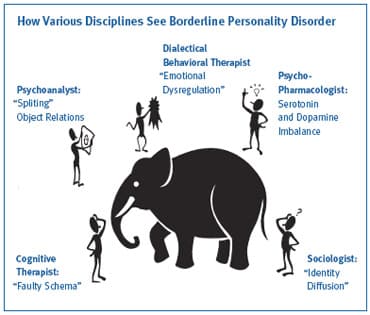
Therapy may include medication either briefly while new behaviors are being trained, or for an extended period of time. Yes, mental health professionals do tend to be prejudiced along the lines of their own comfort zones, per the drawing, above. My personal recommendation is find a good therapist who will work with you as to your comfort level re: meds, exercises to practice at home, diet, exercise.   If you are not making progress, seek out an alternative counselor.

Don't give up! If you blew out your knee, and it was "do physical therapy, or resign yourself to a wheelchair for the rest of your life," you'd probably opt for the physical therapy, hard though it can be. I know people who've made considerable progress in battling their dysfunction. You could be one of them.

Blessings and healing to you, and to your loved ones.


My A-Z theme is Issues related to Mental Health or Mental Illness.


Do you know, or think you know someone with a Personality Disorder?
Have you had any of the therapies, shown above with the elephant? 
Your thoughts?
Enhanced by Zemanta

Wednesday, April 4, 2012

A-Z: DSM - What's a Diagnostic and Statistical Manual -
And Why Should We Care?

When I first heard the phrase DSM, I thought, oh, great, more alphabet soup-y jargon.

However, since most people love or work with someone who suffers from a mental illness at some point in their lives (or perhaps, are the sufferer), it behooves us all to know a little bit about what the DSM is.  Even people in other countries, though they may use a different type of guidebook to reference mental illness (the WHO/World Health Organization uses an ICD-10).

We have one current edition (the DSM-IV), and the Powers That Be are currently at work on the DSM-V, due out in May 2013.


from Kractivist:
The way that we think and talk about psychiatric illness has implications for all of us – not only mental health professionals and their patients, but anyone with affected friends and family members, policy-makers struggling to know what services to provide and pharmaceutical companies considering future profits. So it’s unsurprising that a proposed new edition of the American Psychiatric Association’s Diagnostic and Statistical Manual (DSM), widely described as the “psychiatrists’ bible”, is causing much furore – but slightly more surprising that much of the dissent comes from within psychiatry.  <snip>

But we need to be clear: if someone is unwell, the first step to delivering effective care is to diagnose what the problem is. Making a diagnosis guides evidence-based clinical decisions. In most situations encountered in mental health, some level of diagnosis is essential to ensure effective help is provided (when needed) and that everyone can have some shared understanding of the situation.
For example, there are many reasons why an adult may develop lethargy, lose weight and become less active and interested in life. This could reflect temporary adjustment to a changing life situation (ie, a normal response to life’s difficulties). The person might have cancer. The person might have heart failure. Alternatively, the person may be experiencing a severe depressive episode and be at immediate risk of suicide. The ways of helping are all very different – and not all medical – and diagnosis is needed to distinguish between the possibilities and implement the right help as early as possible. Accurate and prompt diagnosis may be life-saving. 
Light bedtime readingLight bedtime reading (Photo credit: Richard Masoner / Cyclelicious)
Revisions are necessary, because the way we think about what mental illness is, keeps evolving.  Most mental health professionals today agree that homosexuality is not a mental illness, although it was considered so in early editions of the DSM.

Right now, as drafts and ideas have been floated into the mental health community, those with a dog in the fight, so to speak, have been unleashing the hounds.

Because the revisions may now group Asperger's Syndrome in with other autism spectrum disorders, many Aspies are outraged; they see their condition as a benefit, not a disorder.  They are reducing ten categories of Personality Disorders to six.  Depressive disorders will not necessarily exclude grieving.

In spring 2012, comments will again be opened  to the public for the working draft of the DSM-V. If you have fears, concerns, or just curiosity, you might want to follow the course of this process, and add your own two cents.


My A-Z theme is Issues related to Mental Health or Mental Illness.

Are you or someone you know affected by the proposed changes in the DSM?
Your thoughts?
Enhanced by Zemanta