Using writing, and meditation, and ice cream, and reading, and dreams,

and a whole lot of other tools to rediscover who I am,

after six years living with a man with OCPD.


Showing posts with label co-dependence. Show all posts

Friday, September 6, 2013

When The Body Says No


When we have been prevented from learning how to say no, our bodies may end up saying it for us.
Why do some people get sick, become disabled, or even die from diseases like cancer, ALS, Alzheimer's, while others with the same exposure to environmental toxins never get sick? Why do some people get cancer that goes into remission, and others, like my mother, die from it?
Studies at the US National Cancer Institute found that natural killer (NK) cells, an important class of immune cells we have already met, are more active in breast cancer patients who were able to express anger, to adopt a fighting stance and who have more social support.... The researchers found that emotional factors and social involvement were more important to survival than the degree of disease itself.

I am still working to absorb and learn the many lessons this book presents, both for myself as a human being, as a daughter trying to come to terms with the death of my mother and of others I've loved, and (probably least importantly) as a writer trying to create believable characters.

We often treat our bodies as if they are separate from our hearts, minds, and emotions, kind of like a biological automobile. As if a health "breakdown" is a purely mechanical problem that can be fixed by diet, exercise, the right pills, and adjusting air pressure in the tires.

Reality: Emotions affect the body.

Watch a scary movie. Even though you are in no physical danger, doesn't your heart pound, your breath get tight in your chest? Read a sexy novel. If it's good enough, you'll feel rigidity in certain body parts, wetness in others. Receive a gift. From your partner, tickets for a dream vacation may make you feel happy and excited; from your cat, a squirming rat may make you feel queasy.

When the Body Says NO examines studies and examples of psychoneuroimmunoendocrinology: the way the body's nervous system, immune defenses and endocrine or hormonal apparatus all work together. (Called the PNI system in short, because psychoneuroimmunoendocrinology is a mouthful.) It looks at patients for whom Dr. Maté has consulted, as well as more famous case studies, from Stephen Hawking (ALS) to Betty Ford (substance abuse, breast cancer) to Gilda Radner (ovarian cancer, bulimia) to Ronald Reagan (Alzheimer's).


Stress - More Than A Feelin'

Stress consists of the internal alterations – physical or not – that occur when the organism perceives a threat to its existence or well-being.
via inserbia.info
Stress - if a bear appears - can save your life. Stress triggers the PNI system to send, "Let's get the hell out of Dodge!" or "Stand and fight!" messages throughout the body.

Just like circulation to the extremities will shut down in freezing temperatures, because you can survive without a toe, or two, stress (temporarily) shuts down the systems that kill cancer cells or other long-term threats, process food products in the digestive tract, and more. Like Scotty on Star Trek diverting all energies to the warp drive, your body gives "all she's got, Captain" where it thinks it will be needed, on a totally automatic level.
The stress response is nonspecific. It may be triggered in reaction to any attack – physical, biological, chemical or psychological – or in response to any perception of attacker threat, conscious or unconscious. The essence of threat is a destabilization of the body’s homeostasis, the relatively narrow range of physiological conditions within which the organism can survive and function. To facilitate fight or escape, what needs to be diverted from the internal organs and muscles, and the heart needs to pump faster.

Whenever stress occurs, even when we don't consciously feel stressed, changes occur in our bodies.

Stress, as we will define it, it is not a matter of subjective feeling. It is a measurable set of objective physiological events in the body, involving the brain, the hormonal apparatus, the immune system and many other organs. Both animals and people can experience stress with no awareness of its presence.

That whole "with no awareness of its presence" aspect cannot be overemphasized. The physiological effect on the body is the same whether we are aware or unaware of stress. Especially for children who experience recurring stress, the state of being stressed can become the New Normal.
Eventually, having unmet needs or having to meet the needs of others is no longer experienced as stressful. It feels normal. One is disarmed.

Recurring or chronic stress (such as being an abused child, or watching a parent be habitually abused by his/her partner, while being unable to intervene), being neglected, leaves permanent marks, both on the immune system and other bodily defenses (think of the story of the Boy Who Cried Wolf), and in the relationship patterns we form later in life. We are more likely to choose life partners whose behaviors mirror those we knew growing up, whether those behaviors were healthy or unhealthy.
For those habituated to high levels of internal stress since early childhood, it is the absence of stress that creates unease, evoking boredom and a sense of meaninglessness. People may become addicted to their own stress hormones, adrenaline and cortisol... To such persons stress feels desirable, while the absence of it feels like something to be avoided.
Chronic stress actually changes the way our brains function.
In people who’ve experienced chronic stress, the prefrontal cortex and related structures remain in a state of hypervigilance, on the lookout for danger. Pre-frontal activation is not a conscious decision by the individual; rather, it is the result of the automatic triggering of nerves pathways program long ago.
In situations where the body's balance is continually disrupted in response to a perceived threat, the balance of the body is thrown out of whack, And whenever that happens, cancer, or other long-term diseases, have the perfect opening to take over.


Natural Born Killers - The Body's Best Friend


In a healthy body, there are NK cells, which serve as the body's Angels of Death.

Just like in any factory, the body frequently produces cells which which would be labeled abnormal or flawed, but inside the body, there is no TJ Maxx or Nordstrom's Rack to send "irregular" material.

NK cells track down abnormal cells, such as cancer cells and destroys them, so that the majority of cells in the body are healthy and functional.


There have been many cases where the NK cells have caused full remission of cancer, most significantly in cases of melanoma (skin cancer). Why this cancer and not others? Why in some cases and not others? It can't be wholly attributed to DNA, environmental toxins (or lack thereof), but to family systems and work environment systems.

When the Body Says No refers to several studies in which tiny clumps of cancer are often found in an elderly person's body after death from other causes. Perhaps as we age we all have tiny clusters of cancer growing in our bodies, which our NK cells routinely eliminate before they are large enough to be detected.
In short, for cancer causation it is not enough that DNA damage occur: also necessary is failure of DNA repair and/or an impairment of regulated cell death. Stress and the repression of emotion can negatively affect both of those processes.


The Blame Game


On thing that has made me uneasy in reading similar books, such as Louise Hay's You Can Heal Your Life, is my perception (or misperception, perhaps) that the victim was being blamed for his/her own illness. Dr. Maté debunks that idea:
Blaming the sufferer – apart from being morally obtuse – is completely unfounded from a scientific point of view.
He doesn't even jump on the easy way many shrinks do - it's all the mothers' fault. While be acknowledges that hurts/patterns learned during childhood or generationally may have a lasting effect:
Emotionally draining family relationships have been identified as risk factors in virtually every category of major illness, degenerative neurological conditions to cancer and autoimmune disease. The purpose is not to blame parents or previous generations or spouses but to enable us to discard beliefs that prove dangerous to our health.

The point of doing so is that we can recognize and interrupt those patterns, rather than repeat them.

We are not doomed, the helpless victims of our genes and environmental toxins and terrible childhoods, destined to get sick and not be able to do anything about it. I think that's a good message.


Differentiation: Dance Space of Champions


Remember the wonderful rehearsal scene in Dirty Dancing where Johnny (Patrick Swayze) explains to Baby (Jennifer Grey) "This is my dance space, that is your dance space"? Everyone needs good physical and emotional boundaries to be healthy.

When we are born, we have no boundaries. We assume the whole world, including Mother, revolves around US. We don't understand or realize that Mother is a separate being, that she doesn't feel our hunger, wet diaper, tummy cramps at the same instance we feel them.
A fundamental concept in family systems theory is differentiation, defined as “the ability to be in emotional contact with others yet still autonomous in one's emotional functioning.” The poorly differentiated person “lacks an emotional boundary between himself and others and lacks a ‘boundary’ that prevents his thinking process from being overwhelmed by his emotional feeling process. He automatically absorbs anxiety from others and generates considerable anxiety within himself.”
Later, we realize that when we are scared, hurt, cold, etc., Mother doesn't necessarily share our feelings. Just as we don't share her feelings. But in some cases, we will be emotionally enmeshed with Mother (or Father) and take on the role of protecting her:
The child of an unhappy mother will try to take care of her by suppressing his distress so as not to burden her further. His role is to be self-sufficient and not “needy”...

What it all boils down to is a lack of clear boundaries.

Boundaries are that thing that says: 
This is my dance space, this is your dance space. 

When boundaries get confused within the body itself, when the body cannot recognize, "This is ME; this is Other," then we get diseases where the body's immune system doesn't defend against intruders, but is so confused it attacks its own cells, as is the case in MS, ALS, schleroderma, and other auto-immune diseases.

Anger - The Emotion We Love to Hate


Especially as women, we are socially conditioned to think of anger as a "negative" emotion. If we are "nice girls/women," we won't get angry with people.
“I never get angry,” a Woody Allen character says in one of his movies, “I grow a tumor instead.” Throughout this book we've seen the truth of that droll remark in numerous studies of cancer patients.

Here's the problem: we can't control being angry. Anger, according to this and other research, is the natural reaction of an organism to perceived loss, or threat of loss. Picture an angry wild animal warning another off his/her kill (see the bear, above). Usually animals do not fight to the death over a meal or a mate, but the creature with the biggest display of anger wins. "I won't let you take this from me" is the message.

Being angry is not about being a Mean Girl. It is not about going into a rage.
If you ask in physical, physiological terms what they are experiencing in their body when they feel rage, for the most part, people describe anxiety in one form or another.

Allowing oneself to feel angry in the appropriate circumstances can be an empowering experience.
The repression of anger and the unregulated acting out of it are both examples of the abnormal release of emotions that is at the root of disease.... The real experience of anger “is physiologic experience without acting out. The experience is one of a surge of power going through the system along with the mobilization to attack. There is, simultaneously the complete disappearance of all anxiety.”
I had just finished reading When the Body Says No, when in October 2012, my super-kind, beautiful friend Sidney Patrick died of a heart attack, in large part due to cirrhosis of the liver. She was 43.

She epitomized the disease-sufferer profiled within this book; swallowing feelings with food, drugs, or alcohol, always being kind and supportive of everyone but herself.
The inability to process and express feelings effectively, and the tendency to serve the needs of others before even considering one’s own, are common patterns in people who develop chronic illness. These coping styles represent a blurring of boundaries, the confusion of self and non-self on the psychological level.

I remember telling Sid's mother, shortly after Sid passed, "I am so angry." I was hurt, I was grieving, but over all, I felt so angry at the waste, at being deprived of my friend, who I loved and needed.

I remember so many conversations with Sid; whenever the subject would turn to her, she would divert the conversation as swiftly as possible to other people. She was wholly uncomfortable addressing her own needs, hurts, and dreams. Her long-term boyfriend was mentally ill, often called her names and verbally abused her, even when she was in the hospital, yet she did not want to be cruel enough to "abandon" him.

She did, belatedly, realize that something had to change. After being released from the hospital in August 2012, she told me,"If I stay with him, it's going to kill me."

That is the exact same feeling I had, after being diagnosed in 2009 with "unusual" breast lumps and cysts, which spurred me to break with my then-boyfriend in 2010.

Sadly, Sid was right. She left him in September 2012. If only she had left a month or two earlier...


Betty Ford, Betty Koschin Diehl, and Breast Cancer


Betty Ford was, of course, the first Lady of the United States of America, wife of a fairly ambitious politician. My mother, Betty Koschin Diehl was, comparatively, a nobody; eldest daughter in a family of four children. She signed up to serve in the military (Coast Guard) during WWII, as did many women. Besides the name, both women were diagnosed with breast cancer in the same approximate era, and received similar medical treatment.
Research has suggested for decades that women are more prone to develop breast cancer if their childhoods were characterized by emotional disconnection from their parents or other disturbances in their upbringing; if they tend to repress emotions, particularly anger; if they lack nurturing social relationships in adulthood; and if they are the altruistic, compulsively caregiving types.
Betty Ford's mother was a perfectionist; Betty never felt as though she measured up to her mother's standards. Betty Koschin's mother: also harsh and demanding.
The emotional repression, the harsh self judgment and the perfectionism Betty Ford acquired as a child, through no fault of her own, are more than a “good recipe for alcoholism.” They are also a “good recipe” for cancer of the breast.
Both Betty's had husbands whose professional and emotional needs came first. My mother suppressed anger, definitely, though her husband was a "rager." Altruistic, compulsively caregiving - yep. Additionally, in her last year of life, my father decided to transplant our family to another state, away from my mother's supportive network of family and friends.

My mother's breast cancer, which had been in remission, returned, and killed her. She was 49.


Emotional Competence - Who Dat?


The goal of When the Body Says No, and life, isn't to whine about what a raw deal we got (think about that scene in Slumdog Millionaire where the way out is through the outhouse), but figure out what tools we do have, and work toward becoming emotionally competent. Regardless of how we were raised, we can do this.

Emotional competence requires
  • the capacity to feel our emotions, so that we are aware when we are experiencing stress;
  • the ability to express our emotions effectively and thereby to assert our needs and to maintain the integrity of our emotional boundaries;
  • the facility to distinguish between psychological reactions that are pertinent to the present situation and those that represent residue from the past. What we want and demand from the world needs to conform to our present needs, not to unconscious, unsatisfied needs from childhood. If the situations between past and present blur, we will perceive loss or the threat of loss where none exists; and
  • the awareness of those genuine needs that do require satisfaction, rather than the repression for the sake of gaining the acceptance or approval of others.

We may have had little control about what happened to us as children, but we can take control of how we handle our emotions now. By taking control, that doesn't mean pretending life is all kittens and rainbows, or suppressing "negative" emotions like anger or fear, but learning to recognize what we feel, when we feel it.


When the Body Says No closes with seven specific "A" areas of healing:Acceptance, Awareness, Anger:
Since anger does not exist in a vacuum, if I feel anger it must be in response to some perception on my part. It may be a response to loss or the threat of it in a personal relationship, where it may signal a real or threatened invasion of my boundaries. I am greatly empowered without harming anyone if I permit myself to experience the anger and to contemplate what may have triggered it.
Autonomy, Attachment, Assertion, and Affirmation.

This post is reblogged with permission from Writing in Flow.

Have you read this book? What did you think?
How do you deal with anger?
Do you suppress any emotions (that you know of)?


Enhanced by Zemanta

Tuesday, January 1, 2013

Too Perfect Tuesdays - Don't Pressure the Obsessive

Pressure Gauge
via Flickr Creative Commons
This post continues with Living With the Obsessive: 5 - Don't Pressure the Obsessive from Chapter Ten.

This series looks at a small snippet of The book on the Perfectionist Personality, aka The Obsessive Compulsive disordered Personality, aka OCPD, each week. Please follow along, leave your comments, engage more on the FaceBook website... whatever your heart calls you to do.


When Being in Control Gets Out of Control by Allan E. Mallinger, M.D. and Jeanette DeWyze was published by Random House in 1992.  If   you believe you are dealing with OCPD or someone who is "Too Perfect," whether that's you or a loved one, please buy a copy of the book and read it for additional insights that will not all be covered in these excerpts.

5 - Don't Pressure the Obsessive

What about when you want the obsessive to do something - anything from making a simple decision to changing some deeply entrenched pattern?

Be forewarned: any direct confrontation in which you try to force the other person to change is almost certainly doomed to failure. Your request or demand will only increase his inclination to assert his dominance or "rightness," escalating the power struggle.

<snip>He and a fellow lawyer were choosing between two available offices in a building they planned to share. Hal, my patient, was perfectly content to give his associate first choice, but the other man was vacillating, holding up Hall's move into the new quarters. Hal related one of their conversations:

"Once again, I asked him which one he wanted, and he told me he still couldn't decide. Since he'd been leaning toward number two, I told him that he could have it and I would take the other one. But he hit the roof, telling me that he hadn't said he wanted number two, and that the rent was higher. So I said, 'Okay. You take number one, and I'll take number two.'

"'Number one is too small.'

"'Would you rather I choose?'

"'No! I was here first, so I think I deserve first choice.'

"'Do you have any idea when you'll know which office you want?'

"'I don't know'."

workplace_empty
via Flickr Creative Commons

At first, maybe the other man's goal really was, as he consciously believed, to pick the office that best suited his needs; secondarily, he may have enjoyed the sense of control he felt in making Hal wait. But when Hal pressured him, that changed. The associate became more invested in keeping the control, which he did by obstructing Hal.  The more impatient Hal got, the more determined the other was to delay his decision, because by now he as angry. He couldn't show it directly because he had no logical reason for it. So instead he unconsciously retaliated by blocking Hal.

I suggested that Hal try backing off completely - that he tell the associate to take his time and call whenever he had decided. When I saw Hal a week later, he said that given that leeway, his associate had decided instantly.

<snip>Instead of saying, "You must change," for example, make sure you're conveying, "I would like you to do this, for reasons x, y, and z." If you have to know your boss's plans by a certain date, tell him so, but be sure to explain why, so that he doesn't interpret your need to know as an ultimatum, a control play, or manipulation. Your reasons should always reflect your own needs, or your difficulty with the status quo, rather than a judgment about the obsessive's behavior. For instance, say, "If I don't find out your plans by such-and-such a time, I won't be able to obtain a reduced-rate ticket," not, "I hate it when you do this to me. You always make me wait, and it's so inconsiderate!"

<snip> While change in the obsessive must come from within, sometimes healthy, truly unilateral changes in one partner will inspire changes in the other. We aren't truly sure why this happens, but some would say that one person's chronic tardiness and its outcome - the partner's nagging and pushing him - is a recreation of some aspect of a childhood relationship, and that it suits some need in each party. This view says that one one refuses to continue in the role of nagging, disappointed, disapproving parent, the other loses his unwitting collaborator and drops the corresponding role.
***
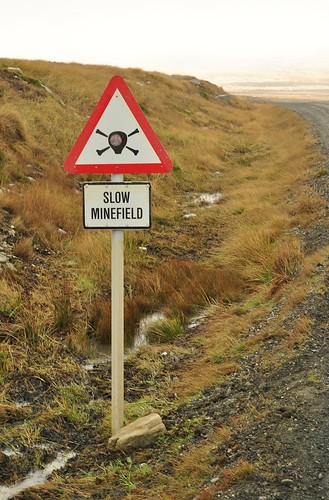
Stanley Road, Falkland Islands
via Flickr Creative Commons

Tiptoeing around The Right Way to approach the Perfectionist Personality can be a minefield.  


While yes, much tact is needed, and Mallinger's excellent suggestions to back off if possible, or to give the reason in a non-judgmental way do work much of the time, sometimes they don't.

My advice is, if you do your best to be tactful and non-pressuring, and your partner or parent blows up anyway, don't take it personally. I've heard of teens (or younger children) getting blasted because they had to get a parent's signature on a field trip permission slip or a report card by a certain date, and they didn't ask in the right way or at the right moment.  Now, perhaps they didn't use ultimate tact or timing, but they're kids - they shouldn't have to.

There are several families I know whose best working solution to time conflicts is to take two separate vehicles to most social events. Maybe the Perfectionist insists on being places twenty minutes early, no matter what, and frets over being asked to wait when he is ready to leave. Maybe the Perfectionist waits until the last minute to do her hair and is always running late.  Maybe one member of the household likes to hang around and socialize after church, and the other wants to head straight home the moment the service ends. By taking two vehicles, the power squabble about when to leave is averted, even if it creates a slightly bigger gasoline bill and a few raised eyebrows from family or friends. (If anyone even notices. Outsiders generally notice less about our internal family dynamics than we think they do, and they care even less, being busy with their own affairs.)

Some things, you have to jump on at the right moment - if you have a plane reservation at XX time, and there's a shuttle picking your family up at XX time to catch that reservation, you'll either make it or miss it, Sweetcheeks.  Other events, like a family car road trip - if your goal is leaving at five a.m., and instead you leave at five-fifteen, or even six, this is not a national disaster.

What is very true about this section of Too Perfect, is the observation when you change your habitual behavior, the dynamic in the relationship will change. Sometimes for better, sometimes for worse, sometimes it's not possible to determine in which direction it is, but it will be different.

When most people discover OCPD, and make an amateur diagnosis of their partner, parent, friend or co-worker, the first question is usually, "How do I change or fix this person?'


The answer, that you can't change other people, only yourself, feels weird, wrong, and counter-intuitive. Hey, they are the people with the problem! Whaddya mean, I have to change myself?

But it's true. First off, just because they (might) have a diagnosable mental disorder, does not mean those of us who chose to partner them, or work with them, or who are unchosen (siblings, children, parents, and so on) are totally disorder-free. We may very well have our own Issues ("Can you say co-dependence, boys and girls?"), and would do well to heed the Bible's advice about removing the beam from our own eye, as a first step.

Second, what we are looking to change is not really the other person, but the dynamics of our relationship with the other person.  Our relationship with this person, about whom we care deeply (or perhaps hate, in the case of the Boss from Hell), is currently very painful, and we want it to be Not Painful. Joyous, even.


There is no fairy wand we can wave and !Poof! The other person is no longer obsessive and perfectionistic.


But when we change the "ballet" we've worked out - and there always is one, when Person A says/does X, Person B replies Y - we are already shaking things up. Doesn't matter if we are Person A or Person B, if we change the way we approach or reply to another person, they are forced to rethink and change the way they interact with us.

Does it work?
Yes and no. It depends on what we are looking for.

If we hope there is some magic formula, that, when applied, will make a relationship with a disordered person (not counting the we ourselves may have disorders of our own) into a quote normal unquote relationship, then no, it doesn't work. What is possible (sometimes) is a relationship that is more tolerable and less painful for us.  Sometimes it may feel like what we consider normal, but we can never let our guard down, never assume that yippee, the problems are all better now. A disordered brain is like a roller skate that always wants to go left - it takes active awareness and effort to make it go right or straight, and the minute you let it go on autopilot, you end up going left again. If we are skating arm in arm with the person with the gimpy skate, we cannot blithely follow their lead.

And sometimes, the other person may become so frustrated and upset that we have chosen to make major changes in the relationship dynamic, that they choose to end it, altogether.  There are no guarantees (and sometimes, the partner of a disordered person might do anything and everything his/her partner requests, and the disordered person STILL ends the relationship).

If you are hurting, and the way your current relationship is "working" is not working, for you, isn't it worth trying a different approach?


Your thoughts?

Tuesday, December 11, 2012

Too Perfect Tuesdays - Chap 10 - Be Consistent and Trustworthy

Consistency
Consistency (Photo credit: Matt Hampel)

This post continues with Living With the Obsessive: 3 - Be Consistent and Trustworthy from Chapter Ten.

This series looks at a small snippet of The book on the Perfectionist Personality, aka The Obsessive Compulsive disordered Personality, aka OCPD, each week. Please follow along, leave your comments, engage more on the FaceBook website... whatever your heart calls you to do.


When Being in Control Gets Out of Control by Allan E. Mallinger, M.D. and Jeanette DeWyze was published by Random House in 1992.  If   you believe you are dealing with OCPD or someone who is "Too Perfect," whether that's you or a loved one, please buy a copy of the book and read it for additional insights that will not all be covered in these excerpts.

3. Be Consistent and Trustworthy
It's tempting to feign agreement with some obsessives just to get them to stop badgering you.  But this can backfire! Obsessives need to be able to feel they can trust you, either to say openly you're not going to comply (giving your reasons), or actually to follow through on your word. Even in the smallest things, most obsessives respond dramatically to any evidence they can't trust you.  They immediately wonder what other things you've been dishonest about. Can they believe you when you say you love them? Can they ever believe you or trust that you'll do what you agree to do?

<snip> One man stated, "I need consistency in my life - to the extent that that's possible. I feel it would be nice if I came home at night and found consistency there. If I'm told dinner will be at six-thirty and I get home to find it's not even started - "

"That only happened once!" his wife protested, <snip>
***
Here's where it gets tricky. I do agree with the author that we should never BS an obsessive partner or friend, "Yes, yes, of course I'll do it your way," when we have no intention of doing it his way.

But, as in the example above, no matter how hard we try, there will almost certainly be one night after 752 nights where he comes home and dinner isn't even started yet.  And that's what he  latched onto, not appreciating or recognizing the 751 nights where dinner was served at six-thirty on the dot.

Because of their own distorted thinking, OCPD'rs may say they want "consistency," but what they truly expect is inhuman perfection.  

And we can drive ourselves crazy trying to deliver it to them.

Being consistent and trustworthy is a great goal, but it is important not to beat up on ourselves when we turn out to be human and fallible from time to time.  (This is not to say that we use that as an excuse, either.)

I would also argue that "giving your reasons" why you're not going to deliver something s/he wants can too easily turn into JADEing (Justifying, Arguing, Defending, and Explaining).  Better to stand your ground, "Yes, I understand you have a preference as to how you like the towels folded, but when I fold them, I'm going to do them my way. Nope, I don't need you to show me 'how to do it right.' When you fold them, you can do them your way; when I fold them, I'll do them my way."

via Suat Eman at FreeDigitalPhotos

I wish I had a dollar for every time my ex patiently explained to me that he couldn't believe I really loved him because... and then listed some tiny fault or task I'd overlooked, often from some years back. I've come to believe that a "non" can never be "consistent and trustworthy" enough to earn the trust of someone who is focused on finding a reason NOT to trust.

Somehow, he or she must come to a position of realizing that even when we do our best in some area, we're going to fail sometimes. That we still love them, and can be trusted, even if we insist on folding the towels the wrong way, or prepare dinner late once in a while.

Somehow, they have to learn that occasionally putting the toilet paper on the roll in the wrong direction is not the same level of betrayal as having an affair.

Your thoughts?
Enhanced by Zemanta

Sunday, October 28, 2012

This Time It's Personal

Right around the time I was leaving my OCPD ex, and voraciously reading everything I could on OCPD and hoarding, I came upon an interesting website called My Mother In Law Is Still Sitting Between Us. In it the author chronicled her boyfriend's efforts to clean out the hoarding house of his mother, who'd recently passed away.

Besides the train-wreck fascination of the pictures, the writing! Snappy, funny, insightful, and never mean-spirited or nasty. I fell in serious girl crush. And after finding that the author lived next door, so to speak, I got in touch with her. Once I convinced Sid I was not a crazy stalker-person, we did meet, and became good friends. I lured her into joining my writers critique group. Her voice and ideas were good for our group, and getting out of the house and talking about writing was good for her.  I frequently commented on her blog, and she was a frequent commenter here.

Her boyfriend is also OCPD, and the unhappy relationship dynamics that so many experience, that *I* experienced, were also part of her experience. He was a drinker/she was a drinker, even after it began to create serious health problems for her. She cut back.

Still, the relationship was eating her up on the inside, especially when, over two years into the clean-up process of the hoarding house, there was no end in sight. And of course, he could neither give it up nor hire someone to help. I tried to support Sid, as best I could, without pushing or telling her what to do.

It frustrated me to watch her spirit get eroded over time, drip, drip, drip, but still, it wasn't MY job to save her. She did have a supportive family. And Sid was the stubborn kind of person who needed to do things in her own way, in her own time. So mostly, I was the listening ear who understood, and who told her what a great person she was.

One of my online friends has pointed many to an excellent book called, "When the Body Says No," about the damaging health effects that accumulated stress may have on a person. See, sometimes if WE don't learn to say no, the body says it for us, by getting sick.  Or we swallow our feelings with alcohol, drugs, food, sex, shopping...


Sid was the kind of caregiving person who poured herself out for others.  She took pride in being STRONG, not asking for help, but giving it to others. She blogged and worked part time and was active in Children of Hoarders. She co-founded a local group called SoCalLady Bloggers. On October 8 she appeared as part of this streaming video chat on hoarding on Huffington Post.


Her ex was not and is not a bad person. In his own way, Greg, too, is heartbroken. He was the reason she was found, still clinging to life, after she missed a scheduled meeting with him and he would not let it go. I am very grateful that her parents and I got to say goodbye to her when she was still technically breathing, rather than after lying dead in her apartment for days. But his own overwhelming anxieties did not allow him to SEE how sick she was, or to help her in any meaningful way.  As she described here when she was going to visit her parents, very sick, and he got hung up on the cheapest train fare.

After another hospitalization this summer following that train trip, during which the b-f was anxious, bossy, "knew" more about what she needed to do than the doctors, and demanded attention and energy she simply didn't have left in her to give him, she realized that though she still loved him deeply, if she stayed with him, it would literally kill her. She'd already been making emotional plans to leave; her parents helped her out financially, and she moved into her own place a month ago.

Sid was SO happy in her new place. She could eat, walk, work on the computer, and breathe, without being criticized. She was so proud, showing off her new place - which had been IMMEDIATELY unpacked, no boxes hanging around for her! She showed me her cool rooftop patio and talked about having a party up there, excited, because her ex never wanted to have people over. She still loved him, and they were friendly, trying to work out the sale of their house amicably. She was taking her meds and NOT drinking and working hard to regain the weight she'd lost during the summer, but she was still so frail...

The damage to her body was too great, her remaining physical resources too low. She had a heart attack just a week ago due to the chemical imbalance in her body, and then another, in the hospital. No alcohol found in her system.

Last Monday I sat with her parents and her ex, in the hospital. Both before and after they turned off the respirator.  Today is her "Celebration of Life."

She was beautiful and vibrant and funny and 43 years old.

I am angry and heartbroken. This did NOT have to happen. For all of you still with a disordered partner - I am not telling or urging you to leave.  Only you can make that call, if or when it is right for you. But please, please, PLEASE, do not pour yourself out entirely for your partner and other people, until there is not enough left for your own body or soul. It may be the hardest thing you will ever have to do, but learn to put yourself FIRST.

Thursday, April 26, 2012

A-Z: Work on Yourself

from styledip.com
When we're in a relationship with a person with a mental illness, we want them to "go get fixed." Am I right?

Here was my personal progression, when my OCPD ex and I moved in together.

1) We're having a very rough transition into this living together business. Surely things will settle down in a few months. After all, I know we love each other deeply.

2) He's having a rough time, but after all, he did just recently lose his parents. He has the right to grieve; I should just be loving and supportive, and with enough time and love on my part, he'll get over it.

3) Self doubt. This is a nightmare. Maybe everything is my fault. Maybe I just don't try hard enough, love enough, give enough. I don't know how I could give/try/love more, but I should find a way.

Or maybe I should just give up, now. *fantasies of slitting my wrists, letting all the blood and pain drain into the sink*

from Unwanted Advice


4) There is something wrong with him. It's not me - or at least, it's not ALL me.

5) Oh! It's OCPD. Now all I have to do is let him in on it, in the Right Way, and he will be eager to get counseling, because I know he deeply loves me, as much as I love him. We will be able to fix this problem and live happily ever after.

6) I join a couple of OCPD support boards, to get the info on the exact Right Way to broach the subject. Because all I need are the magic words, he will have a Light Bulb Moment, and go get himself fixed.

7) Okay, so the Big Reveal isn't a good idea. Still, this is a mental illness. I wouldn't run out on a partner with diabetes or a heart condition, right? If I am loving enough and caring enough, and broach it in exactly the right way, he'll be willing to go get fixed. Maybe I can talk him into getting joint counseling...

8) A year into my individual counseling, and he still isn't willing to even talk to my counselor. Not even though I beg him, as a way of helping me.

9) I realize can't "save" him. I don't doubt, for an instant he loves me, as much and as deeply as he has ever loved anyone. I love him so much it makes my heart ache, but I can't save him. In fact, everything I do is probably enabling his disorder and making him worse. (Two years now after I left, and I still weep as I type these words.)

10) After a fight that is no worse than others, yet which served, for me, as the last straw on the camel's back, I moved out. Began focusing on me, on my pitifully weak boundaries, on figuring out who I am and what I want.

from Brandozin's Weblog


Your path and your journey are undoubtedly different. Yet here is the reality.

We can't save other people 
unless they want to be saved.

I didn't understand that. When I joined the support boards, in the beginning, I was sure there was some magic word/key/answer they were selfishly withholding from me. Or that, perhaps, only I was smart enough to figure out. (Hello, ego!) I would figure out what it was and share it with everyone and I would be acclaimed as this brilliant OCPD monster-slayer.

When everyone kept advising me to "work on yourself," I thought they were smoking crack. "Hello, he is the one with the problem. Just tell me how to convince him that he needs to get fixed, that's what I'm looking for."

I felt like I was asking, "What's 2 + 2?" and I was being answered, "Tangerines and corduroy, with a  splash of Chanel No. 5."  Really, WTF?

The reality of dealing with a loved one with mental illness, is there is nothing an outsider can do to reach inside those distorted thoughts and neurotransmitter imbalances to "fix it" for them. We cannot control other people. What we can do is to take a look at ourselves - our own thoughts, our own behaviors, our own automatic reactions.
funny pictures - I can't sit on top of the TV all day. Stop being so cheap and just get the cable fixed already.

Sometimes, when we address our own behaviors, erect the kinds of healthy boundaries we need for our own sake, there will be a dramatic shift in the way the disordered person behaves.

Sometimes, this will serve as what my OCPD friend LizaJane calls "getting hit in the head with the cosmic 2 x 4" and spur the person with a mental disorder to seek or accept help, and change.

Sometimes, it will not.

One thing is certain. We cannot control, fix, help, adjust, or otherwise move a person who is disordered or troubled when we ourselves are not "coming from" a place of stability and mental healthiness. We just can't. It's like seeing someone drowning and jumping in after them. without a life preserver or even being able to swim, ourselves.

We really and truly have to work on ourselves first. Put on our own oxygen mask first, and all that jazz.

I get it now. They were not smoking crack when they said, "Tangerines and corduroy, with a splash of Chanel No. 5."


My A-Z theme is Issues related to Mental Health or Mental Illness.

Have you ever experienced the
"Work on your own issues first" directive?
How did you react?
What did you learn?

Friday, April 20, 2012

A-Z: Rescuer Syndrome - Put Away the Spandex,
It's Not A Good Look

When we love somebody, when we see them hurting, we want to make things better for them. Whatever we can do, we're gonna do it, not holding back or setting limits, and that's a good thing, right?

Bzzzt! Actually, no.

When we do for others what they are perfectly capable of doing for themselves, we are casting them as Victims, and ourselves as Rescuers.

Not, actually, helpful or healthy. Not even if the others have a mental disorder or addiction; not even if they are a child, should we wrap our entire lives around other people.

Remember Dirty Dancing?   "Lock your frame, lock your frame; this is my dance space, this is your dance space."  It's crucial, both for ourselves, and for others, we remember where we end and "the other" begins.

via Wikimedia Commons

From Out of the Fog:
Examples of Fixers & Rescuers:
  • A fiance whose future spouse explodes in a fit of rage, but who chooses to go ahead with the wedding thinking "I can change him/er after the wedding"
  • A husband in an abusive relationship who decides to "love her through the pain"
  • An abused wife who decides not to seek out professional help, preferring to "try harder to work on herself".
  • A partner in a relationship who tries to keep the peace through making everything "perfect" for their partner at home.
  • A parent with a personality-disordered child who seeks solutions by being a better parent.
  • A child of a personality-disordered parent who tries to win their favor through academic performance

There's two problems with the above scenarios.

#1 - It never, ever works. (Oh, sometimes it does, for a few minutes.) But in the long run, after the wedding, he is even more explosive; no matter how much love the husband demonstrates, he doesn't move his wife past her pain; no matter how hard she works the abused wife can't keep from provoking her husband; the 'better parent approach' still doesn't soothe or heal the child; and the straight A  student will have his/her efforts taken for granted, and chided for an A- or a B+.

#2 - By taking another's person's problems onto ourselves, by trying to "fix" them through our efforts, we deprive them of the opportunity to solve their own problems. Yep, they might not do them exactly the way would. Yep, they might fail.  But when we fix/help/rescue others constantly, the message we are sending is, "I don't think you are smart enough/strong enough/resourceful enough to do this on your own. So let me just do it for you."


From Relationship Rescue: Exploring the Dynamics Behind Being a Rescuer

Rescuing is a core dynamic found in most relationships.
A rescuer is some who takes responsibility for fulfilling the needs of others in an attempt to feel valuable.
Whether conscious of it not, a rescuer believes that by taking care of others, their own needs will be met.
However, the irony is that instead, rescuers end up feeling more insecure, taken for granted, unappreciated, unfulfilled and ultimately worn out.

RESCUERS CHECKLIST
Completing this checklist can help you become aware of ways you may be rescuing people without realizing it.
1. Is it hard for you to take time for yourself and have fun?
2. Do you supply words for someone else when she/he hesitates?
3. Do you set limits for yourself that you exceed?
4. Do you believe you are responsible for making (keeping) someone else happy?
5. Do you like to lend a shoulder for someone else to "cry" on?
6. Do you believe that the other person is not sufficiently grateful for your help?
7. Do you take care of someone else more than you take care of yourself?
8. Do you find yourself interrupting when someone else is talking?
9. Do you watch for clues for ways to be helpful to someone else?
10. Do you make excuses, open or mentally, for another person?
11. Do you do more than your share, that is, work harder than someone else does?
12. When someone else is unsure or uncomfortable about doing something, do you do it for him or her?
13. Do you NOT do things you would like because someone else wouldn't like your doing so?
14. Do you find yourself thinking that you really know what is best for someone else?
15. Do you think someone else would have grave difficulty getting along without you?
16. Do you use the word "we" and then find you don't have the other person's consent?
17. Do you stop yourself by thinking someone will feel badly if you say or do something?
18. Is it hard for you NOT to respond to anyone who seems to be hurting or needing help?
19. Do you find yourself being resented when you were only trying to be helpful?
20. Do you find yourself giving advice that is not welcome or accepted?
(Instructions: Record 5 points for each YES and 0 points for NO! If you have 10 or more points, you may be a Rescuer. That is, a CO-DEPENDENT)
(I'm not sure I agree 100% with the scoring system, above - I think, for example, that #17 can be healthy or taken to extremes, depending on the circumstances. Likewise #18, wanting to help isn't necessarily bad, especially if we're talking about a child, as long as we resist that urge to take it over and do it for him/her. But it is easy enough to see where the questions are going, and what the pattern might be.)

I would like to think of myself as a co-dependent in recovery. I felt so terrible for my poor, (probably) mentally ill boyfriend that I made a ton of excuses for him. My heart ached for him (still does) and I did everything I could to Save Him from the ravages of his disease. In the end, he wasn't one bit mentally, physically, or emotionally healthier, and I was a burned out wreck.

Cover of Cover via AmazonSince then, I've found Charles Whitfield's book Boundaries and Relationships a helpful resource, as well as Melody Beattie's Codependent No More! Also found much help in in a very old book, Manuel J. Smith's When I Say No, I Feel Guilty.

If you are co-dependent, therapy may be a good step for you, to help you to break the old patterns. AlaNon or Co-Dependents Anonymous meetings may also be helpful.

Being a Rescuer or Co-Dependent came about because we care about people so very much - and that feeling in itself is very admirable. But our behavior may be harming the people we love, with the very acts we intend to help them. If we are parents, we are modeling unhealthy behavior. If we are partnered with an emotionally unhealthy partner, we are adding to the toxic dynamic.

Remember, always put on your own oxygen mask, first. 


My A-Z theme is Issues related to Mental Health or Mental Illness.

Are you now (or have you ever been) a Rescuer?
Do you know Rescuers - and can you see how unhealthy it is?
How did you get past this (if you have)
Enhanced by Zemanta

Saturday, December 10, 2011

Hurt People... Hurt People

I came across this video on Single Dad Laughing.

Get tissues - you'll need 'em.


This 14 year-old kid's pain is so raw it not only made me cry, I felt a huge, aching hole in my middle.

In the aftermath of this video, which Jonah eventually posted on his FaceBook page went viral (over 7 million hits), what's been going on?

First off, Jonah is doing okay.  He's still in contact with his friends who moved on to high school he's made a lot of new friends at middle school.  His parents now know that he is gay, and love him anyway.  He's made a couple more videos that show a happy, goofy, normal kid.

And some other videos have surfaced, made prior to the "What's Goin On" video, some that show him making fun of kids with learning disabilities, and others, and there have been accusations that the whole video was a fake.

I watched it again.  Cried some more.  The range of emotions displayed by this kid, as he made this video... well, if it's fake, this 14 year old kid is a better actor than Meryl Streep.  I believe, as he recorded it, Jonah was truly scared and hurting.

Does that rule out the possibility of him being (for the most part) okay now?  Or that he might have not just been bullied, but been a bully himself in the past? Of course not.  People - especially teenagers - can be anywhere on a whole roller-coaster of emotions.  If we're 500 feet high now, and ground level two seconds later, doesn't mean we've gotten off the roller-coaster.

When we think of bullies, emotional abusers, victims, bystanders and the (rare but not unknown) heroes in the abstract, we tend to put them into neat little boxes.  Everybody has to fit into one category, and there can be no cross-over.

Yet... that's not the way life works.  In real life, there is cross-over.

One of my friends is fond of saying, "Hurt people... hurt people."  That is, oftentimes people who are themselves hurting or bullied will find someone else to pick on.  There's a long-standing cultural meme where the boss yells at the employee, who comes home and yells at her  spouse, who yells at the kid, who kicks the dog.

One of the things that makes an abuser so hard to leave is that those of us in such a relationship often witness their pain.  We know they are genuinely hurting.  We imagine, if we could only find the key, say the right thing, do the right thing, then they wouldn't feel so hurt, and they wouldn't feel the need to hurt us.  We make excuses for them, because even if everybody else says, "He's an abusive a$$hole - why don't you LEAVE?" we are the only ones who "get" that small, hurting part inside them.  Which is part of why they are so desperate to keep and control us.

Yet that doesn't work.  Repeat after me, "I cannot control others.  I can only control my own actions."  (And those only imperfectly, but that's another post.)

First, we must make certain we are not perpetuating the chain of emotional violence.  Regardless of who is mistreating us, we don't have the right to call people names, or seek to make them feel bad about themselves.  Get help, if necessary, but STOP being a bully.

Second - don't passively enable bullying as a bystander.


Third - don't put up with physical or emotional abuse.  Whether that's walking into another room, going away for the night, or leaving for good, make it clear that we won't put up with it.

This can be difficult if you are a minor.  And emotional abuse is not, "Johnny, if you don't clean your room, you'll be grounded," when the floor is ankle deep in dirty clothing and empty soft drink bottles.  Yet, even if the floor is that bad, "Johnny, you're a disgusting pig and I wish I'd never had you," is unjustified.  If you're a minor, talk to a counselor at school and work out strategies for how to cope with a parent who may be emotionally abusive.

If you're an adult, and not disabled, take back the power.  Yes, you may have bills and kids and 1001 excuses, but you don't have to stay and put up with such behavior.  You may choose to stay, at this time, or for many more weeks/months/years. but if so, know it is your choice.

Only you know if/when it is right to leave.  But know this: verbal and emotional abuse is never okay.  Not from a kid who might also be a victim of bullying; not from a boss, not from a parent, not from a partner.  There is no excuse for physical or emotional abuse.

Enhanced by Zemanta

Have you been bullied? Or bullied others, in the past?
Please share, below.

Tuesday, July 12, 2011

Too Perfect Tuesdays - Chap 3 - Rising Above Perfectionism
Perfectly Human & Overcoming the Fear of Embarrassment

This post continues with Rising Above Perfection: PERFECTLY HUMAN & OVERCOMING THE FEAR OF EMBARRASSMENT, from Chapter Three.

This series will look at a small snippet of The book on the Perfectionist Personality, aka The Obsessive Compulsive disordered Personality, aka OCPD, each week. Please follow along, leave your comments, engage more on the FaceBook website... whatever your heart calls you to do.

Too Perfect, When Being in Control Gets Out of Control by Allan E. Mallinger, M.D. and Jeanette DeWyze was published by Random House in 1992.  If you believe you are dealing with OCPD or someone who is "Too Perfect," whether that's you or a loved one, please buy a copy of the book and read it for additional insights that will not all be covered in these excerpts.


Rising Above Perfectionism

The ultimate irony - and tragedy of perfectionism is that it simply doesn't work.  It's supposed to earn you rave reviews and exempt you from criticism.  Instead it damages both your work and your relationships, and puts you under an unrelenting pressure.  If you've concluded that your perfectionism is hurting you, you can make changes.

PERFECTLY HUMAN

Part of the Perfectionist's Credo is the notion that other people won't like you as well if you make a mistake, or you don't know things, or you allow your faults to show through.  In fact, the opposite is true.  Your need to be right all the time often repels friends and associates.

Nobody will ever feel empathy for you, love you, or enjoy being close to you simply because you are right or because you hardly ever make mistakes.  <snip>

And the next time you're wrong about something, just admit it.  Don't explain why you made the mistake.  Don't show how anyone would have made that mistake under the circumstances.  Don't insist that your answer actually was correct but was misunderstood.

Just confess, "I was wrong about that."  Then start counting the people who shrink away from you. I'm exaggerating, of course.  But when you start letting your fallibility show, when you let go of your need to know everything and to show how smart you are, you'll feel a burden being lifted.  You'll feel more relaxed.  It will be easier to smile.  You'll be free!  And these changes will occur the very first time you suppress your perfectionistic need to be infallible.

OVERCOMING THE FEAR OF EMBARRASSMENT

If you find yourself shrinking from certain activities because you dread being embarrassed, ask yourself two questions: Are your social fears and inhibitions preventing you from reaching your full potential or enjoying life?  And are you willing to endure a certain amount of anxiety to overcome the problem?

<snip> For example, if you dread giving oral presentations, start by asking questions as an audience member.  Don't wait until you have something brilliant to say.  Say anything.  <snip>

Follow the same gradual approach in other frightening situations.  Take classes that force you to perform in front of others.  Join walking groups,  Give parties.  Tell yourself that it won't be awful if your nervousness shows, or if you make a silly blunder.  When these things do happen, and they will, refuse to allow yourself to feel humiliated.  Concentrate on the fact that these missteps make you more attractive, not less so.  You come through as a genuine, vulnerable human being.  People can connect with you.

***


I wanted to show the karaoke clip from My Best Friend's wedding, but all the ones that had been posted online have been removed, per Sony.  If you've seen it, forgive me for the short explanation.

Julianne (portrayed by Julia Roberts) has decided to recapture the love of her best friend, who's engaged to marry Kimmy (Cameron Diaz).  She finds out that Kimmy, who has a terrible singing voice, also has a horrible fear of singing in public and exposing this.  So Julianne maneuvers the group to a karaoke place and pressures Kimmy to get onstage and sing, figuring that either a terrible performance, or an emotional meltdown will destroy Michael's (Dermot Mulroney) respect and admiration for this girl.

Kimmy is, in fact, woefully bad.  Bring-on-the-howling-dogs bad.  But Julianne's plan backfires, because Michael (Dermot Mulroney) finds Kimberly's courage and willingness to look bad in front of a crowded room just one more reason to love her.

Okay, this is Hollywood.  And I'm not suggesting that all the bad singers out there (you know who you are!) start crowding karaoke bars.  (Please don't!)  But I can testify that similar things have happened in my own life.  Whenever I have gone out on a limb in some way, I get more admiration and approval than if I'd just hung back and taken the safe route.  

Take writing.  Besides this blog, I've completed a couple of novels, and am working on another one.  I sent umpteen queries (70+) and pages before getting an agent.  (And I've gotten dozens more rejections via said agent, but still.)  I plan to be, I expect to be, a published writer in the not too distant future.  But even if that never happens, I know I'm a lot further along that goal than somebody who writes and secretes her writing in a box on the closet shelf, even if she's twenty times better a writer than I am.  Because I was willing to take that chance.

You'll always miss 100% of the shots you don't take.
~Wayne Gretzky

I'm also trying to tone down my own tendency towards Know-It-All-Ism.  Yes, I'm a fairly intelligent woman, and I've learned a lot at the School of Hard Knocks.  There's still more that I don't know, than I do.  Maybe I can win some respect, and admiration for being a Know-It-All, but love?  Close connection with other flawed human beings?  Not happening.

Nobody will ever feel empathy for you, love you, or enjoy being close to you simply because you are right or because you hardly ever make mistakes.  That phrase should be embroidered on a pillow or perhaps tattooed on my forehead, backwards, so I can see it every morning when I look in the mirror.

So many times I watched my OCPD ex launch into Know-It-All mode and begin lecturing our friends and family, seeing their eyes glaze over, seeing him ignore all their efforts to change the subjects.    My heart would ache, because I could see how very badly he wanted the admiration and approval of others - and how what he was doing had the exact opposite effect.  I felt horribly embarrassed and sad for him.  (Which, of course, is textbook co-dependence on my part - I should not have "imported" embarrassment or sadness on behalf of another person.  I'm workin' on it.)

There's only one Mr. Know-It-All people really appreciate.


Let me recommend, if you're a perfectionist yourself, another way of fighting your lions.

Have you ever gone out on a limb, and been glad you did?  
Please share, in the comments, below.

Thursday, June 23, 2011

Walking A Mile in Their Moccasins -
Developing Empathy

Photo by Paul Martin Eldridge
at FreeDigitalPhotos
One of the most painful aspects in my relationship with my ex was his expectation that I did - or should - see the world through his eyes.  At best, he would act hurt; at worst, he would be in a towering rage if  I didn't enjoy the foods he liked, appreciate the same TV shows and movies, have the same views on politics, religion, housecleaning... the list went on and on.

The problem wasn't that we never saw eye to eye on anything.  We had many likes and beliefs in common.  It wasn't that I couldn't see and understand his point of view in areas where we differed, because I could and did.  It was that I (stubbornly, to his point of view) refused to be him.  He was unable to understand and appreciate that I was a separate person with different ideas, thoughts, and feelings, which were as equally valid and logical as his own. 

It seemed as surprisingly outrageous for me to express a different opinion as if his own hand had turned around and said, "Hey You!  From now on, I'm not gonna zip up your pants or press buttons on the remote anymore.  I've decided to go into archaeology.  See ya!"

from rebeccaselah at Flickr
Even if I was standing in front of him, telling him, "Here's how I feel, and here's why I think I feel that way," he couldn't put himself into my moccasins, as the old saying goes, and understand what I felt.  He could only go as far as to imagine how he would feel in such a situation.  It was like he expected me to walk in his moccasins, rather than him attempting to walk a mile in mine.

He lacked empathy.

Too often when we talked, he would launch into OCPD in rant/lecture/rambling mode, in which I did not even get an opportunity to speak.  (After all, if you're not really a separate person, what do you possibly have to say?)

Possibly he didn't mean to devalue me as a person, or to ignore my feelings or experiences.  However, whether he meant to or not, that's what his actions did.  To be treated as a non-person - OCPD or non, adult or child - as if one does not have (or is not entitled to have) separate thoughts, dreams, likes and dislikes, and feelings, is one of the most painful and dehumanizing experiences possible.  (And one that many with OCPD themselves experienced as children at the hands of a possibly OCPD parent.)

These and similar behaviors have been related time and again, not only by many partners and children of those with OCPD, but also by those who struggle with a loved one with  Asperger's Syndrome or autism.

Part of the problem seemed to be lack of listening, and part of it seemed to be not hearing.  Human beings communicate not just verbally, but with facial expressions, body language, gestures, tone, even odor (fear-stink, ovulating pheromones, etc.).  Even if one hears and processes every single word (which my ex did not), there's still a whole lot of information that gets missed, if the facial expressions and body language are either skipped or misinterpreted.

Does OCPD perhaps fall under the umbrella of SEPD - Socio-Emotional Processing Disorder?
...people with SEPD may have normal or even superior verbal skills, yet may still have a lot of trouble with social communication. Conversations may often be one sided. The person with SEPD may carry on a monologue on a favorite subject and not be aware of attempts of his/her listener to interject comments. At the same time, they most likely do not recognize the frustration or other emotional response their listener is showing. Consequently, it is difficult for them to develop emotional relationships, friendships, and even normal interactions with coworkers. 
Is the empathy center (if there is such a thing) which comes naturally to most people missing?  Or perhaps present, but underdeveloped or damaged?   Recent research points to drug abusers also having difficulty recognizing emotion from facial expressions.


How Do We "Grow" Empathy?

from Salvatore Vuono
at FreeDigitalPhotos
First, make sure we always allow our conversational partner adequate time to speak.  If we know we tend to monopolize a conversation, use an egg-timer, a stopwatch, or allow our partner to do so, but don't allow ourselves to run on for more than 2-3 minutes at a stretch.  FYI, allowing someone time to speak means giving them time to say more than Uh-huh, You're right, or Okay.  They are even allowed to change the subject!

Ask, don't tell others how they feel.  Listen without judgment.   Instead of "I can't believe you don't love my chile rellenos.  I think you do and just don't want to admit it," try "Thanks for trying them.  What was it about them that you didn't care for?"

Try not to take things personally.  I didn't like my ex's chile rellenos.  That doesn't mean I didn't like him, as a person, nor that I didn't truly appreciate all the time and energy that went into preparing them. (Goodness knows, I would lavish compliments and thanks on him for every meal he prepared.)  I'm a supertaster; I don't like spicy food, I have never liked anybody's chile rellenos.  My ex seemed to take every difference of opinion as a personal criticism of him, and be crushed by it.

Our spouses, our parents, our children, our boss, our dog - nobody is ever going to love every single thing we do and say.  We need to find a way to be okay with that, and to not plunge into fear/panic mode if somebody expresses disapproval or dislike of one thing we have done or said.

Ask follow-up questions, without passing judgment.  "I'd never have picked Animal House as one of the best movies ever made, but am curious as to why you think so.  Tell me more."

Ask open-ended questions.  "I'm trying to do a better job of listening to you.  Is there something else I can do that I'm not doing?"

Go for the five-to-one rule.  For every single criticism or negative remark, try to find and say at least five things about the person that we like, admire, or respect.

eHow thinks we can even build up our skills at reading facial expressions.

Read as much fiction as possible, to stretch our imaginations and to glimpse inside other people's minds and motivations.  Consider empathy and imagination not as some ethereal gift - we're born with X much and that's all, folks! - but as flabby muscles, which can be exercised and built up.

From Azar Nafisi's Reading Lolita in Tehran  (bolding is mine):
"...This carelessness, a lack of empathy, appears in Jane Austen's negative characters: in Lady Catherine, in Mr.s Morris, in Mr. Collins or the Crawfords.  The theme recurs in Henry James's stories and Nabokov's monster heroes: Humbert, Kinbote, Van and Ada Veen.  Imagination in these works is equated with empathy; we can't experience all that others have gone through, but we can understand even the most monstrous individuals in works of fiction.  A good novel is one that shows the complexity of individuals, and creates enough space for all these characters to have a voice; in this way a novel is called democratic - not that it advocates democracy, but that by nature it is so.  Empathy lies at the heart of Gatsby, like so many other great novels - the biggest sin is to be blind to others' problems and pains.  Not seeing them means denying their existence."
We all want people to "see the real me."  The only way people can see us, and we see them, is through empathy.


One caveat - for those who tend to err on the side of co-dependence, rather than not enough empathy, it's important not to dive too deeply into the pool of feeling for and understanding others.  We need to reserve a healthy amount of time and energy for ourselves.

Got an empathy story?