Using writing, and meditation, and ice cream, and reading, and dreams,

and a whole lot of other tools to rediscover who I am,

after six years living with a man with OCPD.


Showing posts with label backsliding. Show all posts

Wednesday, April 18, 2012

A-Z: Personality Disorders: Not Just Being a Jackhole

from articles about men
If you grew up when I did, you're familiar with the convention, often applied to the fat girl, "but she has such a pretty face, and a wonderful personality."  The girl or boy might be overweight, or poor, or academically challenged, but they've chosen to cultivate a warm speaking voice, a kind attitude, or become the class clown and make everyone laugh.

So, many people, hearing the word "Personality Disorder," associate it with a conscious choice made by the person.  If it's applied to you, it probably feels bad, like people think you have chosen to be a jackhole.

Not so. It's a mental illness, just as much as being bipolar. (Though some with a personality disorder might prefer the jackhole label to that of being mentally ill.)

from Advances in Psychiatric Treatment:
One reason that personality disorders may not be diagnosed is the misconception that they are not mental disorders (see Adshead, 2001 for a discussion of the concepts of disease, illness and disorder as they relate to personality disorder).
The ICD–10 definition of a mental disorder refers to:“the existence of a recognisable set of symptoms and behaviours in most cases associated with distress and interference with social function” (World Health Organization, 1992: p. 5).
The definition of a personality disorder in DSM–IV (American Psychiatric Association, 1994: p. 633). includes the following characteristics:“an enduring pattern of inner experience and behavior that deviates markedly from the expectations of the individual's culture. This pattern is manifested in two or more of the following areas:
  1. cognition (i.e., ways of perceiving and interpreting self, other people and events)
  2. affectivity (i.e., the range, intensity, lability, and appropriateness of emotional response)
  3. interpersonal functioning
  4. impulse control”.
The pattern must be inflexible and pervasive across a broad range of personal and social situations. For a diagnosis to be made, the enduring pattern of inner experience and behaviour (i.e. the symptoms) must lead to clinically significant distress or impairment in social, occupational or other important areas of functioning.
Thus, the term mental disorder applies as much to personality disorder as it does to Axis I disorders such as schizophrenia. Individuals may need help as a result of their distress or because their symptoms are interfering with their everyday functioning. Personality disorders are associated with high levels of dysfunction, comparable to major Axis I disorders (Nakao et al, 1992).
See again "high levels of dysfunction." People with personality disorders tend to have difficult relationships with people over the long term, though in the short term they may be amazingly charming and charismatic.

We don't know why some people develop personality disorders; however, both genetic and environmental factors may contribute. Some of the people I know with OCPD, for example, recall an unloving childhood with strict and undemonstrative parents; feeling like they were never "good enough" to please their parents. Others recall a more loving environment, and recall having meltdowns over making a "mistake" in coloring a picture or some other standard they had set for themselves.

From Listverse on Mental Illness Myths:
Some people think that the name “personality disorders” and the fact that these disorders affect people so thoroughly mean that they are simply a part of the person and are, therefore, incurable. It may not always be possible to cure someone of a personality disorder, but people with personality disorders certainly can go through therapy to learn more useful ways of dealing with themselves and other people. Someone’s personality can change over time, and as is proved by many people who overcame mental illness, it is always possible (even if very difficult) to change patterns of thought and behavior.

If you think you know quite a bit about Personality Disorders, take this test at Discovery Fit & Health and find out.

The DSM-IV lists ten personality disorders:

*Antisocial
*Avoidant
*Borderline
Dependent
Histrionic
*Narcissistic
*Obsessive-compulsive (not to be confused with OCD)
Paranoid
Schizoid
*Schizotypal

The Personality Disorders identified with an *asterisk, above, are currently "keepers" in the DSM-V, currently a Work-In-Progress. There would also be a large residual category of Personality Disorder Not Otherwise Specified.

Chatanika River via Wikimedia

A Personality Disorder may be something like a river. The brain has a pattern of flowing along this way; but rivers can be redirected, and evidence points to the ability of the brain to form new patterns, just like rivers can. A river that's longer or more voluminous may take more work; a person with a personality disorder that is more severe may take more effort, but there is no reason to give up. Change can happen, if it's wanted badly enough.
from schoolworkhelper
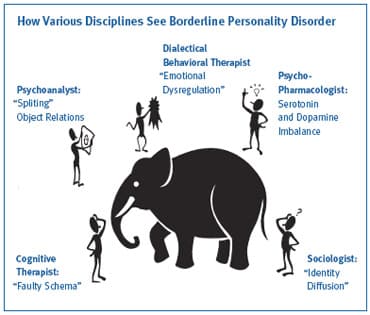
Therapy may include medication either briefly while new behaviors are being trained, or for an extended period of time. Yes, mental health professionals do tend to be prejudiced along the lines of their own comfort zones, per the drawing, above. My personal recommendation is find a good therapist who will work with you as to your comfort level re: meds, exercises to practice at home, diet, exercise.   If you are not making progress, seek out an alternative counselor.

Don't give up! If you blew out your knee, and it was "do physical therapy, or resign yourself to a wheelchair for the rest of your life," you'd probably opt for the physical therapy, hard though it can be. I know people who've made considerable progress in battling their dysfunction. You could be one of them.

Blessings and healing to you, and to your loved ones.


My A-Z theme is Issues related to Mental Health or Mental Illness.


Do you know, or think you know someone with a Personality Disorder?
Have you had any of the therapies, shown above with the elephant? 
Your thoughts?
Enhanced by Zemanta

Thursday, April 12, 2012

A-Z: Kindness & Being A Pushover -
Not The Same Thing

We tend to give people not necessarily what they want, but what we would want if we were in their place.

Sometimes we think we are being kind, when in reality, what are we doing? Avoiding confrontation. Being "nice" - because it is much less work to be nice, right at the  moment, than to take a stand and say, "No." "No, that's not what I want; No, I don't want to do that. I understand that you want me to do X, but I choose to do Y."


Whatever your particular "no," is, it will take much energy and effort to maintain your position in the face of the disappointment, manipulation, or tantrum of somebody you do actually care about.

On one of the support boards I belong to, there's a new member, who's realized that she really doesn't want to live with her (untreated) hoarding fiance after all.  He's only partway moved in, and already there are boxes and piles everywhere. She's expressed her dismay, which her fiance has brushed off, and she's being instructed to "just jump over" the piles of books and belongings that already block her route to the bathroom and bed, with his  move less than half complete.

She wants to tell her fiance, "Whoa, wait a minute. Not what I signed up for, not how I want to live. I think you should stay in your own place, after all, or find another place to live." She's hinted at this already, but he's refused to take the hint. Still, she doesn't want to be mean. She thinks perhaps it'll be easier, if she simply goes along with it for a few months, brings it up gradually.  That it'll be kinder that way.

Kinder? Gentler? No, not really.

If you remember this song... you must be ancient.


If your partner would be devastated by something you say today, trust me, s/he will be just as devastated a week, or two, or ten from now. Please also note - if you are involved with a disordered person, and you stand up to him/her, they may throw a tantrum as large as that thrown by a 3 year old in the cereal aisle.  And be just as scarred in the long-term (that is, not at all) as that 3 year old. As the non-disordered person, taking the long-view is something only you can do.

Get help, if you don't have the courage/strength to confront him/her, but don't lie to yourself that you're simply trying to be nice/kind. Honestly? You're being chicken sh-t.

Letting a disordered person walk all over you is not, in the long run, a kindness. Not to them, not to you. Staying in a marriage with someone you have grown to loathe - not seeking counseling, not trying a trial separation, not trying to mend the marriage, or break it apart cleanly, but simply to fake it so you are not too bothered by the other person's distress or grief - you're not being kind. You're being a coward.

Take it from Queen Chickensh-t herself. I did not, in the end, spare my partner (or myself) any pain by dragging it out in hopes something miraculous would happen. The times I let him do something crazy and did not call him on it, out of fear (and sometimes, confusion) on my part, did not magically heal him.

You will have to leave - or stay with - a disordered person who is refusing treatment as long as seems right to you. But please, don't delude yourself that by postponing the issue, you are being kind. You're not. It's like a deferred payment on a credit card - it will come due, and with some rather hideous interest charges.


My A-Z theme is Issues related to Mental Health or Mental Illness.

Have you ever been "cruel to be kind"?
Has someone ever "let your down gradually" in a way that hurt more 
than if s/he'd been truthful straight up? Your thoughts?

Sunday, December 25, 2011

OCPD - As Seen on TV!

Bree Van de KampImage via WikipediaUntil a few years ago, I never heard of the term OCPD. 

Sadly, just because people don't know about a mental disorder - or, perhaps, call it by a different name, doesn't mean there aren't a whole bunch of people out there affected by it.

Once I started paying attention, I realized it had been out there, in the general population and portrayed on television, in movies, and in books and plays, for years.

Felix Unger, a fictional clean freak in a play by Neil Simon (later a movie and TV series), was probably OCPD.


Bree Van de Kamp from Desperate Housewives - perfectionist, controlled and controlling... OCPD, even if not officially diagnosed so by the show's writers.
After her mother was killed in a hit and run, Bree cleaned her blood off the road outside the house. She said that once everything was spotless, she felt much better. 


Just read a couple "heartwarming" books by best-selling author Debbie Macomber featuring characters with symptoms of OCPD.  As is one of the most famous poster-children of all, Ebeneezer Scrooge, in a story by Charles Dickens that's been recreated in numerous stage plays and movies.


Scrooge chose the pursuit of money over love, family, friendship... but in one night of ghostly visitations, he realized his mistake and turned his life around 180 degrees.  Macomber's characters, too - once faced with True Love, seemingly cured!

That can happen in novels.  In plays.  In movies.  One big epiphany, the stingy/controlling/perfectionistic person sees the light, and everything is different, from that moment onward.

Real life don't work that way.

In real life, a lifetime's habits, brain patterns, and the distorted thinking that are part of OCPD have never been miraculously cured in one night.  Think of changing the path of even a small creek - it will take long, hard work, to divert the path of the creek into a new direction.

It can be done.  It has been done.  It is being done - and I salute the brave, strong, courageous men and women who've decided to battle their OCPD.  But just like a creek that's been diverted, there's always the strong inclination to revert to the older, more accustomed channel.  It takes constant work to keep the water flowing in the new pattern.

Not meaning to discourage anyone praying for a miracle cure.  Prayer can't hurt.  But while you're waiting for said miracle, the smart money is on rolling up the sleeves and doing the work.

Where have you seen OCPD, in fictional works?

Enhanced by Zemanta

Thursday, February 24, 2011

The Progress of Boundary Betty

I hope it means progress when you can read something, laugh, and hang your head sheepishly and think, OMG, I could have written this!

From Eat Pray Love by Elizabeth Gilbert 
Moreover, I have boundary issues with men.  Or maybe that's not fair to say.  To have issues with boundaries, one must have boundaries in the first place, right?  But I disappear into the person I love.  I am the permeable membrane.  If I love you, you can have everything.  You can have my time, my devotion, my ass, my money, my family, my dog, my dog's money, my dog's time - everything.  If I love you, I will carry for you all your pain, I will assume for you all your debts (in every definition of the word), I will protect you from your own insecurity, I will project upon you all sorts of good qualities that you have never actually cultivated in yourself and I will buy Christmas presents for your entire family.  I will give you the sun and the rain, and if they are not available, I will give you a sun check and a rain check.  I will give you all this and more, until I get so exhausted and depleted that the only way I can recover my energy is by becoming infatuated with someone else.
She wrote this as an explanation as to why she chose to be celibate in Italy, of all places.  Where rampant sensuality vibrates off every fountain and marble edifice - and you can't turn around in Italy without bumping your nose (or other body part) on an edifice of some sort.

from Flickr Creative Commons
by xinem
Still, it makes perfect sense to me, as I have also embarked on a year of none.  Or nun, however you want to look at it.

Because I know for a fact, I'm too f#&ked up to even think about another relationship right now.  I'm working on my boundaries, and in some places they're pretty good, and in others they're better than they used to be, and in others... well, if they were a stone wall, a dachshund with a limp could hop over without scraping his belly.

Every self-help book and site and guru says: You need to learn to love yourself.

I get it.  In theory.  In practice... well... I'm taking baby steps.

I'm learning about intuitive eating, and not punishing myself with diets anymore.

I'm working on understanding my own "permeable membrane" issues when it comes to men, and "normal" boundary issues when it comes to family, friends, and co-workers.  Realizing I don't have to figuratively throw myself on the train tracks every time, in order for people to like me.

I can set limits for what I am and am not willing to do for someone, and that doesn't make me a bad person.  

Photo from Wikimedia Commons

Of course, to set limits, that means I have to explore what my own thoughts and feelings are.  This means a fair amount of solitude and reading and meditation, which is just not real do-able when one is involved with a new lover (or even an old one.)

I'm trying to be kind and patient with myself.  That means goals, but not harsh ones.  I'm doing things I enjoy, but also do stuff I have to, like household cleaning.  Because I truly can't take as much delight in my wonderful own apartment with all my favorite things around me, if I am up to my ankles in cat hair.  (Mind you, the things I have left out of place, the dirty dishes I have occasionally left in the sink, would curl OCPD ex-bf's hair.  He-he-he.)

Speaking of OCPD, I did create a list for self-help (do I need Frontline for my fleas?):
  1. Figure out there's a problem.
  2. Research how to deal with it.
  3. Implement a solution - and if one doesn't work, tweak it or try something else, or a combination of things.  (Hey, if a combo plate works in a Mexican restaurant, why not in my head?)  
  4. Practice the solution over and over until it becomes habit.
The one thing that throws me is, seems like there is so much to work on.  And I can't just do 1-2 things, compartmentalized and completed separately, before moving on to the next "thing."  I need to integrate mindful eating and better boundaries and learning my limits and a whole bunch of other things, because I need to become a whole, integrated person.

Or at least, a person on her way to becoming a whole, integrated person.  Not thinking I will ever reach the finish line and be done, in this lifetime.

What goals are on your combo plate?
And how are your boundaries today, hmmm?
Leave a Comment or Reaction and let me know.

Sunday, February 20, 2011

Wolf Woman or Hungry Hungry Hippo?

There's such a difference between knowing something in your head and feeling it in your heart. 

I know that my ex b-f had distorted thinking - about a lot of things, but particularly about food, diet, exercise, body image.  When last I saw him, he was obsessing over being "fat," having put on a few extra pounds around his middle, though at over 6' tall and 160 pounds, no one would accuse him of being overweight.

He would talk with longing in his voice for his teenage days, when he'd gotten down to 95 pounds.  (Of course, he was living off speed and cigarettes then, and it landed him in the hospital, but still...)  Not in the beginning, but after I moved in with him, he made constant derogatory comments about anyone he saw who was overweight - whether he saw them while we were driving, on TV, etc. ( if never to the actual face of an overweight person who happened to be friend or family.)  They were disgusting, they had no self-control (this from someone who would drink to passing out), they looked revolting, all fat people should be shot...

Mind you, when we met, this is how we looked as a couple. 
from Nighthawk News
I was in a "very big girl" stage, and while that didn't matter to him at all during the "honeymoon" period, when we were courting, before that ended I had begun dieting and stepped up my exercising - for me, not for him - and he was very pleased. 

Of course, it wasn't enough.  I got down to within five pounds of my high school weight, and while he would join in the praise around others who would tell me how great I looked, in private, he'd tell me I would look great - if I lost another 10-15 pounds.

Well.  And then his OCPD began rampaging in full about 101 different things, and I became stressed, depressed.  I stopped exercising as much, because he was so jealous of the time it took away from "us," I stopped being as careful about what I ate.  He rationed my food and rode me constantly, at home, about what I should or shouldn't "pig out" on, and I began binging at work during the day.

No surprise, the weight began creeping back up.  I haven't yet regained all that I had lost, over that two years I worked so hard to lose it; but I've regained a lot of it.  And I hate it.  I hate the way my body looks and the way my clothes don't fit and the fact I had to buy another pair of "fat" jeans today because my thunder thighs are about to bust out the sidewalls of my other fat jeans.


I gave myself permission (mentally if not emotionally,) to gain a little weight since the split, but I think now...  part of me didn't think it would really happen.  At first I gobbled up all kinds of "forbidden foods," a natural reaction, I knew (mentally!) to being starved of them/for them for the years I lived with ex b-f.  Like in the story told by Clarissa Pinkola Estes, a wolf that has been starved in the winter will go on a rampage when spring comes.

I figured once I got used to the fact that I could eat these foods, any time I wanted, and nobody was going to take them away from me, my cravings for them would stop, as Geneen Roth said, and for the most part that's happened.

So I'm trying to be kind to myself and I'm trying to be patient.  I've been learning about mindful eating and taking baby steps towards putting it into practice, the past few months.  


from Master Isolated Images at FreeDigitalPhotos
  I still am enjoying foods I wasn't "allowed" to have, then, but not in huge amounts.  I am not binging at work any more.  I am learning to recognize when I am approaching fullness and stopping then, not eating to the point of being overfull.  I am eating lots of broccoli and salads - because I actually enjoy them, and because I feel good about giving my body foods that are healthy for it.  I'm drinking lots of water and very little (though still some) soda.  I'm still doing regular exercise.  (Though I could be doing more - one can always be doing more exercise - I'm not doing less.)  I'm learning to recognize the pull of emotional hunger and to sit and breathe and acknowledge my feelings, instead of stuffing them down with food.

I know, calorie-wise, even if I'm not counting calories or points or carbs, I'm giving my body less of 'em.

So why am I still gaining weight?!?  I know, in my head, that I am taking the right approach.  I know, from bitter experience, that "regular" diets don't work, long-term.  Been there, done that, got the T-shirts - sized XL to L to M, and back again.  Twice.

But I'm scared.  I think I had this unrealistic vision in my mind, that I would start my baby steps of mindful eating, and as a reward, the Skinny Fairy would come bonk me on the head and I'd magically wake one morning, twenty pounds thinner overnight.  And I still hear my ex b-f's voice inside my head, telling me I'm a disgusting fat pig.

I don't want to be patient with myself.  I want results right now!!  And I want all those horrible, negative messages that I've introjected into my brain, from ex b-f, from magazines, from pop culture, to STFU already.

<Sigh.>  I'm just gonna have to do this the long, hard way, aren't I?  One positive affirmation, one baby step, one STFU to the negative messages, at a time.

Have you ever had to struggle with an issue like this?  Where you knew something, in your head, but it wasn't making it down into your heart where you really felt like you believed it? 

Tell me how you did it (please!) in the comments.