Using writing, and meditation, and ice cream, and reading, and dreams,

and a whole lot of other tools to rediscover who I am,

after six years living with a man with OCPD.


Showing posts with label people-pleasing. Show all posts

Tuesday, January 1, 2013

Too Perfect Tuesdays - Don't Pressure the Obsessive

Pressure Gauge
via Flickr Creative Commons
This post continues with Living With the Obsessive: 5 - Don't Pressure the Obsessive from Chapter Ten.

This series looks at a small snippet of The book on the Perfectionist Personality, aka The Obsessive Compulsive disordered Personality, aka OCPD, each week. Please follow along, leave your comments, engage more on the FaceBook website... whatever your heart calls you to do.


When Being in Control Gets Out of Control by Allan E. Mallinger, M.D. and Jeanette DeWyze was published by Random House in 1992.  If   you believe you are dealing with OCPD or someone who is "Too Perfect," whether that's you or a loved one, please buy a copy of the book and read it for additional insights that will not all be covered in these excerpts.

5 - Don't Pressure the Obsessive

What about when you want the obsessive to do something - anything from making a simple decision to changing some deeply entrenched pattern?

Be forewarned: any direct confrontation in which you try to force the other person to change is almost certainly doomed to failure. Your request or demand will only increase his inclination to assert his dominance or "rightness," escalating the power struggle.

<snip>He and a fellow lawyer were choosing between two available offices in a building they planned to share. Hal, my patient, was perfectly content to give his associate first choice, but the other man was vacillating, holding up Hall's move into the new quarters. Hal related one of their conversations:

"Once again, I asked him which one he wanted, and he told me he still couldn't decide. Since he'd been leaning toward number two, I told him that he could have it and I would take the other one. But he hit the roof, telling me that he hadn't said he wanted number two, and that the rent was higher. So I said, 'Okay. You take number one, and I'll take number two.'

"'Number one is too small.'

"'Would you rather I choose?'

"'No! I was here first, so I think I deserve first choice.'

"'Do you have any idea when you'll know which office you want?'

"'I don't know'."

workplace_empty
via Flickr Creative Commons

At first, maybe the other man's goal really was, as he consciously believed, to pick the office that best suited his needs; secondarily, he may have enjoyed the sense of control he felt in making Hal wait. But when Hal pressured him, that changed. The associate became more invested in keeping the control, which he did by obstructing Hal.  The more impatient Hal got, the more determined the other was to delay his decision, because by now he as angry. He couldn't show it directly because he had no logical reason for it. So instead he unconsciously retaliated by blocking Hal.

I suggested that Hal try backing off completely - that he tell the associate to take his time and call whenever he had decided. When I saw Hal a week later, he said that given that leeway, his associate had decided instantly.

<snip>Instead of saying, "You must change," for example, make sure you're conveying, "I would like you to do this, for reasons x, y, and z." If you have to know your boss's plans by a certain date, tell him so, but be sure to explain why, so that he doesn't interpret your need to know as an ultimatum, a control play, or manipulation. Your reasons should always reflect your own needs, or your difficulty with the status quo, rather than a judgment about the obsessive's behavior. For instance, say, "If I don't find out your plans by such-and-such a time, I won't be able to obtain a reduced-rate ticket," not, "I hate it when you do this to me. You always make me wait, and it's so inconsiderate!"

<snip> While change in the obsessive must come from within, sometimes healthy, truly unilateral changes in one partner will inspire changes in the other. We aren't truly sure why this happens, but some would say that one person's chronic tardiness and its outcome - the partner's nagging and pushing him - is a recreation of some aspect of a childhood relationship, and that it suits some need in each party. This view says that one one refuses to continue in the role of nagging, disappointed, disapproving parent, the other loses his unwitting collaborator and drops the corresponding role.
***
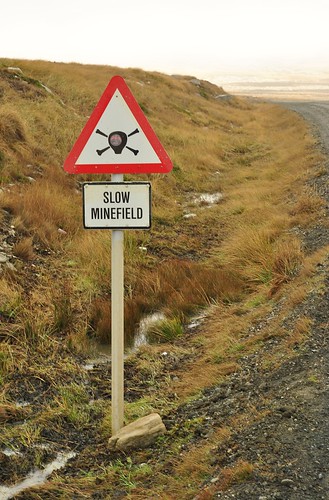
Stanley Road, Falkland Islands
via Flickr Creative Commons

Tiptoeing around The Right Way to approach the Perfectionist Personality can be a minefield.  


While yes, much tact is needed, and Mallinger's excellent suggestions to back off if possible, or to give the reason in a non-judgmental way do work much of the time, sometimes they don't.

My advice is, if you do your best to be tactful and non-pressuring, and your partner or parent blows up anyway, don't take it personally. I've heard of teens (or younger children) getting blasted because they had to get a parent's signature on a field trip permission slip or a report card by a certain date, and they didn't ask in the right way or at the right moment.  Now, perhaps they didn't use ultimate tact or timing, but they're kids - they shouldn't have to.

There are several families I know whose best working solution to time conflicts is to take two separate vehicles to most social events. Maybe the Perfectionist insists on being places twenty minutes early, no matter what, and frets over being asked to wait when he is ready to leave. Maybe the Perfectionist waits until the last minute to do her hair and is always running late.  Maybe one member of the household likes to hang around and socialize after church, and the other wants to head straight home the moment the service ends. By taking two vehicles, the power squabble about when to leave is averted, even if it creates a slightly bigger gasoline bill and a few raised eyebrows from family or friends. (If anyone even notices. Outsiders generally notice less about our internal family dynamics than we think they do, and they care even less, being busy with their own affairs.)

Some things, you have to jump on at the right moment - if you have a plane reservation at XX time, and there's a shuttle picking your family up at XX time to catch that reservation, you'll either make it or miss it, Sweetcheeks.  Other events, like a family car road trip - if your goal is leaving at five a.m., and instead you leave at five-fifteen, or even six, this is not a national disaster.

What is very true about this section of Too Perfect, is the observation when you change your habitual behavior, the dynamic in the relationship will change. Sometimes for better, sometimes for worse, sometimes it's not possible to determine in which direction it is, but it will be different.

When most people discover OCPD, and make an amateur diagnosis of their partner, parent, friend or co-worker, the first question is usually, "How do I change or fix this person?'


The answer, that you can't change other people, only yourself, feels weird, wrong, and counter-intuitive. Hey, they are the people with the problem! Whaddya mean, I have to change myself?

But it's true. First off, just because they (might) have a diagnosable mental disorder, does not mean those of us who chose to partner them, or work with them, or who are unchosen (siblings, children, parents, and so on) are totally disorder-free. We may very well have our own Issues ("Can you say co-dependence, boys and girls?"), and would do well to heed the Bible's advice about removing the beam from our own eye, as a first step.

Second, what we are looking to change is not really the other person, but the dynamics of our relationship with the other person.  Our relationship with this person, about whom we care deeply (or perhaps hate, in the case of the Boss from Hell), is currently very painful, and we want it to be Not Painful. Joyous, even.


There is no fairy wand we can wave and !Poof! The other person is no longer obsessive and perfectionistic.


But when we change the "ballet" we've worked out - and there always is one, when Person A says/does X, Person B replies Y - we are already shaking things up. Doesn't matter if we are Person A or Person B, if we change the way we approach or reply to another person, they are forced to rethink and change the way they interact with us.

Does it work?
Yes and no. It depends on what we are looking for.

If we hope there is some magic formula, that, when applied, will make a relationship with a disordered person (not counting the we ourselves may have disorders of our own) into a quote normal unquote relationship, then no, it doesn't work. What is possible (sometimes) is a relationship that is more tolerable and less painful for us.  Sometimes it may feel like what we consider normal, but we can never let our guard down, never assume that yippee, the problems are all better now. A disordered brain is like a roller skate that always wants to go left - it takes active awareness and effort to make it go right or straight, and the minute you let it go on autopilot, you end up going left again. If we are skating arm in arm with the person with the gimpy skate, we cannot blithely follow their lead.

And sometimes, the other person may become so frustrated and upset that we have chosen to make major changes in the relationship dynamic, that they choose to end it, altogether.  There are no guarantees (and sometimes, the partner of a disordered person might do anything and everything his/her partner requests, and the disordered person STILL ends the relationship).

If you are hurting, and the way your current relationship is "working" is not working, for you, isn't it worth trying a different approach?


Your thoughts?

Tuesday, April 24, 2012

A-Z - Unchosen Relationships - When You Can't Get Away

Sibling!
Sibling! (Photo credit: Gus Dahlberg)
We can choose our friends, but we can't choose our family. For the letter U today, I'm going to excerpt and comment upon the excellent piece from Out of the Fog.
Unchosen relationships are relationships with family members who suffer from personality disorders.
 And other mental illnesses.
Unchosen is a term used to describe those of us who did not choose their relationship to a person with a personality disorder. Some of us have parents with this disorder; others have a sibling, in-laws, or other familial relationships. We did not choose this relationship the same way a person chooses a relationship to a partner with or a friend with a personality disorder. 
With a spouse, love partner, neighbor, boss, co-worker, we can choose to leave the relationship, to move, to change jobs. It might be painful and very difficult, but we can get away. It's harder to get away from family, or to abandon a family member (sibling, parent, child) who has married a dysfunctional person; however, in those cases, we are normally dealing with the unpleasant in-law from an adult, rather than a child's, perspective.
For instance: someone who grew up with a personality disordered parent will have had a vastly different struggle than someone who had a relatively normal childhood, but ended up with a disordered partner. That doesn't mean the "Unchosen" person's pain is any greater or any less than the "Chosen" person's pain, but very often, the abuse and inappropriate behaviors modeled during his or her formative years will have deeply affected the Unchosen Non child's core sense of being (and well-being), and may have long-lasting impacts on trust, self-esteem and the ability to form or maintain healthy relationships in adulthood.
In the paragraph above, "non" refers to a child without a personality disorder.  Being a "non" as compared to a person with a personality disorder does not mean everything is a-ok with us. In fact, a non may have many other Issues, and behave inappropriately and harmfully to self and others, too.

I can personally testify that it is really hard to choose a healthy love relationship, when you have no friggin' clue how to recognize it. If there are no models in your family of origin, how do you even know what one looks like? TV and movies? Books?  

cast of Leave It To Beaver
I know that my own relationship with my OCPD ex was in large part an attempt to heal wounds left by my relationship with my narcissistic, alcoholic father. Sadly, my ex was just f---ed up in a different way. In large part because I was used to dysfunction, I missed the red flags, and when I did see them, I thought, well, now, with my adult skills, I could fix him.
When the personality disordered individual is a child, the pain and disruption is experienced by the entire family. Adults feel responsible, trapped, frustrated and depressed. Non-personality-disordered siblings feel fearful and neglected as their parents focus on the problems created by the disordered individual. 
Partly because of poor understanding of where mental disorders come from, there is the guilty assumption by parents that if only one had loved the child enough, been patient enough, done the right thing, his/her mental disorder would not be so severe. Or, possibly, there may be guilt for passing down defective genes or eating or drinking the wrong thing during pregnancy. Siblings may have very mixed feelings, especially as teenagers; sometimes loving their troubled sibling to pieces, other times perhaps even wishing s/he were dead. 
The Unchosen Relationship
To be in an unchosen relationship is difficult and often traumatizing. We are told repeatedly by society and well-meaning people that we "must," "should," "have to" (fill in the blank) because they - the personality disordered - are family. 
"After all, he is your father." Boy, if only I had a dollar for every time someone said that to me!
We are often asked to overlook continued abuses because the person is ill. In other instances we are expected to “be the bigger person” and stuff our emotions so as not to upset the ill family member. We are asked to parent our parent while still trying to have a life of our own. 

People who haven’t been where we have been truly have no idea what we live with. Some of us are constantly torn between trying to protect and heal ourselves and trying to have some sort of relationship with our families, however dysfunctional they may be. Others have decided that they no longer want a relationship with the ill family member. Many of us have been subjected to a lifetime of emotional, verbal, physical, and sometimes sexual abuse. These abuses do not disappear just because time has passed or because we are adults. Sometimes the worst scars cannot be seen.

In this section, you may see terms like NC (no contact) or LC (limited contact). Many people choose one or the other, or drift back and forth between them trying to find a balance with which they are comfortable. Some choose to try and tolerate what they can, when they can, knowing they are unable to completely remove themselves from a parent or other relative. Understand that what works for one simply does not work for everyone.
After decades of trying to begin a new relationship with my father, as an adult, which efforts were ignored and/or abused by him, I decided upon LC. It was the best way for me to forgive his past offenses and remember the good things about him (which I could count on my fingers). For myself, I couldn't "deal" with fresh offenses and his constant attempts at emotional manipulation.

My oldest sister chose to become more involved, supervising his finances and getting him placed in a good veteran's home facility, but even she drew the line at bring him into her home, or even into our state. Our other sister's choice was similar to mine, LC. When our father died last year, our middle sister chose to attend the memorial service, in support of our oldest sister. I chose to stay away - also in support of our oldest sister. Because once people began spouting the usual post-death BS about what a great guy the man was, I would probably have lost it and spoken up. This would have hurt my sister to no good purpose.

So I don't judge people who don't visit their parents or mentally ill siblings; don't call them, or make other efforts to avoid contact. It may show an admirable amount of restraint that they don't accidentally-on-purpose poison the person who's brought so much pain into their lives.

An Unchosen Perspective on Boundaries
It can be difficult to maintain or define boundaries when you are involved in a familial or otherwise unchosen relationship. Often, we are taught as children "not to make waves" or to “just get along;” that is, to not assert or define our own boundaries. As children we want to please our disordered parent and get along with a disordered sibling or relative; however, a personality disordered individual lacks appropriate personal boundaries of their own. This can result in inappropriate affectionate gestures and lack of personal privacy for the child. 
 This is why we should never "make" children kiss Aunt Clara, or sit on Santa's lap.
When our own personal boundaries are routinely broken, the message we learn is that our own needs and feelings don’t count - we are required to accept how others treat us without question. As we grow into adults, these lessons can become our way of life. We often feel taken advantage of, feel used or feel that our desires are unimportant. We become frustrated and angry that our boundaries are violated yet we are unable to express what, exactly, our boundaries are. 
In a healthy relationship, there are always boundaries. Children should be able to have their own special toys that they are not expected to share, for example, especially if they have a "special" sibling who tends to break or destroy much of what s/he plays with.


Constant yielding to a parent, sibling or relative becomes second nature. We lose our own sense of self and often find ourselves in unhappy relationships, jobs and life situations. The early lessons - that our feelings, views and opinions don’t count - continue to dominate our lives, sometimes subconsciously. 
We may feel we are only worthy if/when we are pleasing someone else. If we're doing something purely for ourselves - reading a book, watching a movie that nobody else in the household wants to watch, getting a massage - we may feel selfish, weird. 
This can result in poor life choices, from entering into careers or occupations that are a poor fit for us, to marrying the person we “should” rather than the person we love. The yielding to others we were taught as children can spill over into every relationship we have as adults. The consequences can be disastrous and painful. It sometimes feels as if we are living someone else’s life. 
Because we don't have our own sense of self, we may Rescue others and follow the pattern assuming responsibility for how we "make" others feel. I know people who keep themselves quite busy being problem scouts - spotting and "helping" other people's potential problems before they even have a chance to notice and take care of the issue, themselves.

Then the problem scout wonders why her adult children don't seem to show any initiative, or make poor decisions on the rare occasion they do decide something for themselves.
Learning to enforce boundaries takes practice and patience. Yet it can be done - and lead us to a healthier, happier life. You can read some more ideas on setting healthy boundaries in our boundaries section.
And here: Boundary Betty.  Boundaries are different than walls, but it may help to think of them as castle walls. Something from the outside is stopped on the other side of the moat. After thorough examination, either the drawbridge is let down and it's invited in, or it's turned away.

When we have weak or no boundaries, anything someone says to us, does to us or even does around us gets hustled right in. We arrange our universe around what we think is gong on. Somebody makes a strange face - we must have done something to annoy him. (When the reality is, maybe he's just suppressing a fart. It's not always all about us.)
Types of Unchosen Relationships
There are distinct categories of non-personality-disordered individuals who call themselves “Unchosen”:
Children forced to live in an environment where someone else is abused.
Please take note of the last. Even if the child is not him or herself battered, sexually or verbally abused, it is not healthy for children to live in an environment where they regularly witness one member of the household abuse another. Perhaps Grandpa has come to live with the family and he's a raging a-hole to his adult daughter, the child's mother. Perhaps the mother is personality-disordered and regularly tears the father a new one.

Yes, "splitting the household apart" might be painful and quite difficult. But please, consider that you may be training the child up to recreate a household just like the one s/he grew up in.

I get that leaving is not always possible. I know my mother wanted to leave my father, but when you have a young child, and are terminally ill with cancer, your options are limited. Besides which, that was the early 1970's, and women had only a fraction of the legal rights in divorce they have today.

Still, there were avenues she could have explored: moving in with friends or family members, perhaps. If she had the physical and emotional strength to pursue them. I don't blame her; I understand that when you live with someone whose view of the world is black-or-white, your own thinking tends to become that way as well. You fail to see there are not two choices; there are probably two dozen choices.

There are always options.  Please, please, please, do not bring children into the world when you are in a dysfunctional relationship, thinking that a baby will make everything better and help your partner heal. And if you already have children, please consider whether continuing in a household where a severely dysfunctional person lives is healthy for them. Leaving or throwing out the disordered person are not the only choices; I know a woman who actually sent her children away, to live with some family friends who acted as guardians for them. It broke her heart, and yet, was probably much better for them than continuing in that household.


My A-Z theme is Issues related to Mental Health or Mental Illness.

Are you in any unchosen relationships 
with a mentally disordered person?
Is this a new thing, or did it begin when you were a child?
How has it affected the way you see the world and relationships?
Enhanced by Zemanta

Tuesday, January 17, 2012

Too Perfect Tuesdays - Chap 6 - Guarded with Money & Guarded Against Spontaneity

International Money Pile in Cash and CoinsImage by epSos.de via FlickrThis post continues with Guarded with Money and Guarded Against Spontaneity  from Chapter Six.

This series looks at a small snippet of The book on the Perfectionist Personality, aka The Obsessive Compulsive disordered Personality, aka OCPD, each week. Please follow along, leave your comments, engage more on the FaceBook website... whatever your heart calls you to do.

Too Perfect, When Being in Control Gets Out of Control by Allan E. Mallinger, M.D. and Jeanette DeWyze was published by Random House in 1992.  If you believe you are dealing with OCPD or someone who is "Too Perfect," whether that's you or a loved one, please buy a copy of the book and read it for additional insights that will not all be covered in these excerpts.


GUARDED WITH MONEY
I find that many obsessives harbor a fear of being exploited financially - one component of an overall tendency to be guarded with money.  Frugality may take many forms, including the following: 
  • A reluctance to spend money on anything but true necessities.
  • The need to get the very best buy - regardless of how much time and effort are expended in shopping for it.
  • A reluctance to disclose how much was spent for something - either because someone might judge that the buyer was "taken," or think that he had a lot of money and an easy life, or that he had been unduly extravagant.
  • A refusal to make personal loans - or, if a loan is made, the lender tracks it vigilantly - even if only in his own mind.
  • Feelings of utter outrage if some product or service purchased turns out to be flawed.
  • Pride in making one's possessions last a long time.
More than just the fear of being taken inspires the obsessive's tendency to be guarded with money.  Many people learn early in childhood that saving is a virtue; they may come to associate it with out "good" characteristics such as self-denial and the postponement of pleasure for long-term rewards.  <snip>


GUARDED AGAINST SPONTANEITY

Another form of interpersonal guardedness is the inability to act spontaneously.  By definition, spontaneity means an absence of planning, anathema to most obsessives.  "I'm not even sure how to take a risk," said fifty-year old Jim.  "Before I do anything, I think about it every which way.  before I buy something, I've gotten prices at five different places.  I get things all figured out so I know which way to go, no matter what happens.  I don't like to get anywhere close to situations where I don't have a lot of control; I can never just be."
<snip> When there aren't any guidelines, they feel uncomfortable.  Many complain that they aren't good at small talk, and they may even avoid parties for that reason.  Instead they choose their words slowly and carefully; even their casual conversations may seem scripted.  One patient declared that unpremeditated talk scared her because of the possibility that "some kind of real feelings - weak feelings - may come out." <snip>

***
Ahh, frugality.  I am still struggling to overcome the training whereby one kept one's paper napkin as clean as possible, so it could be repeatedly reused.

Almost everyone who's lived with an OCPD'r has some horror story of the couch/car/mattress That Could Not Be Bought until we had checked thirteen kajillion places, and then dithered over the decision SO long that the process had to begin again.  Burning up three gallons of gas to drive to BF Nowhere to save twenty-five cents on a gallon of milk or loaf of bread.

And nothing could be thrown out.  "We might need that some day!" It took several years and bitter fighting to get rid of the non-functional TV sitting on the bedroom floor.  After the TV in the living room went out, I said, "Okay, now's the time to take the spare TV and get it fixed."
"I'm not sure it's worth getting fixed."
"Well, take it in and find out."
"I don't want to waste the money."
"Dude.  The reason it is here (along with a second "spare" TV, in storage) is as a spare if we need one.  Now we need one.  It's time to either fix it and use it, as a spare, or if we're not going to do that, it needs to go away.  I am tired of vacuuming around it."
He conceded there was nothing wrong with my logic, but it still took another six months of agonizing before he was able to junk it.  And he bitterly resented my "making" him get rid of the old TV.  (While I resented having to live for 3 years with a broken TV on the floor of the bedroom and another one in storage.)


There's nothing wrong with saving money.  I was raised in a household where gift wrap was carefully peeled off presents and reused repeatedly.  Where we recycled everything - even jar labels were carefully soaked off and included in the stacks of newspapers to go for paper recycling - and of course, the jars themselves were sorted and turned in: clear, brown, and green glass.  I still am big on recycling, but those with OCPD...

And the spontaneity.  My ex told me in the beginning he didn't like surprises.  I assumed (wrongly) he meant stuff like people jumping up and saying "Boo!" (which is actually quite mean, IMO) or birthday surprise parties, stuff like that.  No.  Anything unexpected freaked him out.  Like me coming home from the grocery store with a different kind of meat to try, or a package of Hawaiian sweet rolls  (which he liked) - the horror!  "Where are we going to put those?"

Forget about friends just stopping by (except his single best childhood friend) and hanging out.  Although, oddly enough, we were able to take a road trip that was largely unplanned, the idea being drive up the coast as far as we felt like, then get a hotel wherever we wanted to spend the night.  We had some minor meltdowns along the way, but for the most part, had a good time.  Some others with OCPD'rs report on vacation, it's like they've left the OCPD behind. (Where for others, the obsessive behavior and meltdowns are greatly magnified.)
 
 His fear/loathing of spontaneity carried over into things like loveplay in the kitchen.  There was no "surprise" affection, no kisses just because you happen to be passing the other person in the hall - at least from him to me, and I soon learned that those from mine to him upset him terribly.

Makes me sad because while I could say, okay, we're different people, whatever makes him happy... But it didn't make him happy.  I was lonely, not getting the kind of affection I wanted, being discouraged from giving the kind of affection I wanted to give - and he was lonely, too.  After the "honeymoon" period, I became painfully aware he didn't believe I loved him, didn't trust that my love would last.  For so long I struggled to show him in every way I could how much I did love him, thinking surely some how, some way, I would break through, and he would feel secure in my love, and then things would get better.

If he could have accepted (not simply tolerated, but appreciated, enjoyed) spontaneous loveplay or passing kisses, would he have felt more loved?


Your thoughts?

Enhanced by Zemanta

Thursday, March 10, 2011

Learning to Recognize You're Being Played

So, as I move along this journey to rediscovering myself, I realize that OCPD ex-bf, in many ways, was one of my easier relationships.  The confrontation and tantrums were usually right in my face.

But, I've had other relationships in which I also played Ms. Co-Dependent to the Max, because, after all, I'm nice.  I'm a people pleaser (and if you're thinking, she's saying that like it's a bad thing - you may be one, too.)

Being kind and flexible is wonderful.  However, we can get so wrapped up in pleasing others, in trying to make others happy, that we forget all about us; our needs, wants, and best interests. 

We need to be able to say no (or, Hell no!) if someone tries to manipulate us into doing something that crosses our boundaries.  In my life, I've been pressured/manipulated by those who wanted me to:

  • Eat something when I was already full, or which contained ingredients that I don't like
  • Join them in the practice of particular religious beliefs
  • Perform sexual acts that I'd rather not
  • Go to certain parties, or stay longer when I wanted to leave
  • Take over someone else's job duties
  • Favors

Mind you, there is nothing wrong with someone asking, "Would you like to try doing it on a trapeze, while wearing a Batman mask?"  (Okay, maybe something a lot wrong with that.) 

An open, honest question or offer contains the implied freedom to say "No thank you."   If we feel that saying no is not an option - we're probably being played.    


Cats playing piano - awesome.
People being played by manipulators - NOT so awesome.

The only way we can have real, honest, fulfilling relationships, is if we are coming from our True Selves.  And that means, kindly, gently, but firmly, refusing to be manipulated.

Or, we can channel our Inner Bitch and say, "I don't think so."

Here's some good info from Wikihow:   
Understand the characteristics of a manipulative personality.  They're not always obvious because they play a silent game of building up obligations toward them, that end up with you feeling guilty, pressured, and obliged to carry out things for their sake even though you're still wondering how things got to this point.  Some of the characteristics of a manipulative personality include:   
  • A martyr style personality. This personality type behaves as if he or she is being considerate toward others but is actually messing up considerateness with a need to be significant to you. By "martyring" themselves, they are doing things nobody has asked of them or wants them to do but in the process creates a bind when they do them. In "doing you a favor", their expectation increases that you have to return the favor. They may also complain constantly about all the things they do for you and wonder rhetorically when you're going to return this favor...    
  • Excessively needy and dependent personalities. People who feel uncomfortable in their own skin, putting forth their own opinions and ideas can often hide behind manipulative behavior so that it seems as if you are responding on your own accord even though they've set up everything to have you respond directly to their neediness.  
  • Narcissists. This is the archetypal manipulative personality and it's very hard to deal with this master manipulator.  
  • You. Seriously, at one time or other, every single one of us practices manipulative behaviors in one form or other. It is just that for most people, manipulative actions tend to be one-off or only occasional instances rather than a purposeful map for daily living and interaction with others.
Note the possible types of ways in which people try to manipulate one another. There are some key behaviors that can end up in manipulation, and it's helpful to know how to spot them before walking right into them. The behaviors are set out briefly here, with the following steps providing more details along with suggestions for healthy ways to respond:

  • The guilt trip – this manipulative behavior seeks to make you feel guilty and is aimed at sending you into the land of "should" rather than standing up for your own values.   
  • The assumption statement – this manipulative tactic seeks to turn your behavior into what the beholder perceives it as, whether or not their interpretation is accurate. Soon leads to a guilt trip because no matter what, your refutation is proof of the assumption.   
  • He said, she said – this manipulative ploy is pseudo-sociology in action. The manipulator takes it upon themselves to tell you what someone else said was the right thing to do. It's a handy way of pushing aside the responsibility from themselves while loading it all onto you.  
  • The confronting statement – this manipulative approach is about causing an argument. That way, the provoker will end up making you feel terrible over something you didn't do or say but for which you ought to feel guilty anyway and they'll get a huge chunk of sympathy with which to manipulate you all over again.  
  • Self-pity: "But I'm so unloved/sick/victimized, etc." – At times each one of us has times when we're really in need of some tender self-care but long-term manipulators can make a habit of being the victim or the one needing special attention.
Go HERE for the rest of this great article for tips on how to respond to each technique.

Boy, have I suckered in to the martyrs in my life!  They're so kind, considerate, self-sacrificing, surely I should appreciate them more.  Of course, OCPD ex b-f used this technique too.  "I've been slaving all day to grow tomatoes" or make spaghetti sauce or some other thing he'd chosen to do, martyr-style, not even stopping to have lunch, that I never asked him to do in the first place, let alone suggest he work at such a pace that he didn't take reasonable breaks.  All his own choices.  Then he'd pick a fight because I wasn't sufficiently grateful, in his opinion.  And then the next time he asked for something, I would usually give in, whether I wanted to or not, because I felt guilty about "making him feel bad."

Good grief, Charlie Brown!  <Shaking my head to clear out the cobwebs>

Photo by -just-jen- at Flickr
But, as I said, I am recognizing he wasn't the only one to pull my strings.  That with good boundaries and better connection with my authentic self, I will have healthier relationships with everyone in my life.

Frankly, I'm beyond tired of guilt trips.  They're not a lot of fun, and I already know the boring scenery by heart.

The next trip I take, I want to pack a bag and stay in a gorgeous hotel.  Maybe get a massage.  I like the massage-type of manipulation.

How about you?  Have you been played like a cheap guitar too many times?  What do you do to recognize the manipulators and take care of you?