Using writing, and meditation, and ice cream, and reading, and dreams,

and a whole lot of other tools to rediscover who I am,

after six years living with a man with OCPD.


Showing posts with label perfectionism. Show all posts

Tuesday, January 1, 2013

Too Perfect Tuesdays - Don't Pressure the Obsessive

Pressure Gauge
via Flickr Creative Commons
This post continues with Living With the Obsessive: 5 - Don't Pressure the Obsessive from Chapter Ten.

This series looks at a small snippet of The book on the Perfectionist Personality, aka The Obsessive Compulsive disordered Personality, aka OCPD, each week. Please follow along, leave your comments, engage more on the FaceBook website... whatever your heart calls you to do.


When Being in Control Gets Out of Control by Allan E. Mallinger, M.D. and Jeanette DeWyze was published by Random House in 1992.  If   you believe you are dealing with OCPD or someone who is "Too Perfect," whether that's you or a loved one, please buy a copy of the book and read it for additional insights that will not all be covered in these excerpts.

5 - Don't Pressure the Obsessive

What about when you want the obsessive to do something - anything from making a simple decision to changing some deeply entrenched pattern?

Be forewarned: any direct confrontation in which you try to force the other person to change is almost certainly doomed to failure. Your request or demand will only increase his inclination to assert his dominance or "rightness," escalating the power struggle.

<snip>He and a fellow lawyer were choosing between two available offices in a building they planned to share. Hal, my patient, was perfectly content to give his associate first choice, but the other man was vacillating, holding up Hall's move into the new quarters. Hal related one of their conversations:

"Once again, I asked him which one he wanted, and he told me he still couldn't decide. Since he'd been leaning toward number two, I told him that he could have it and I would take the other one. But he hit the roof, telling me that he hadn't said he wanted number two, and that the rent was higher. So I said, 'Okay. You take number one, and I'll take number two.'

"'Number one is too small.'

"'Would you rather I choose?'

"'No! I was here first, so I think I deserve first choice.'

"'Do you have any idea when you'll know which office you want?'

"'I don't know'."

workplace_empty
via Flickr Creative Commons

At first, maybe the other man's goal really was, as he consciously believed, to pick the office that best suited his needs; secondarily, he may have enjoyed the sense of control he felt in making Hal wait. But when Hal pressured him, that changed. The associate became more invested in keeping the control, which he did by obstructing Hal.  The more impatient Hal got, the more determined the other was to delay his decision, because by now he as angry. He couldn't show it directly because he had no logical reason for it. So instead he unconsciously retaliated by blocking Hal.

I suggested that Hal try backing off completely - that he tell the associate to take his time and call whenever he had decided. When I saw Hal a week later, he said that given that leeway, his associate had decided instantly.

<snip>Instead of saying, "You must change," for example, make sure you're conveying, "I would like you to do this, for reasons x, y, and z." If you have to know your boss's plans by a certain date, tell him so, but be sure to explain why, so that he doesn't interpret your need to know as an ultimatum, a control play, or manipulation. Your reasons should always reflect your own needs, or your difficulty with the status quo, rather than a judgment about the obsessive's behavior. For instance, say, "If I don't find out your plans by such-and-such a time, I won't be able to obtain a reduced-rate ticket," not, "I hate it when you do this to me. You always make me wait, and it's so inconsiderate!"

<snip> While change in the obsessive must come from within, sometimes healthy, truly unilateral changes in one partner will inspire changes in the other. We aren't truly sure why this happens, but some would say that one person's chronic tardiness and its outcome - the partner's nagging and pushing him - is a recreation of some aspect of a childhood relationship, and that it suits some need in each party. This view says that one one refuses to continue in the role of nagging, disappointed, disapproving parent, the other loses his unwitting collaborator and drops the corresponding role.
***

Stanley Road, Falkland Islands
via Flickr Creative Commons

Tiptoeing around The Right Way to approach the Perfectionist Personality can be a minefield.  


While yes, much tact is needed, and Mallinger's excellent suggestions to back off if possible, or to give the reason in a non-judgmental way do work much of the time, sometimes they don't.

My advice is, if you do your best to be tactful and non-pressuring, and your partner or parent blows up anyway, don't take it personally. I've heard of teens (or younger children) getting blasted because they had to get a parent's signature on a field trip permission slip or a report card by a certain date, and they didn't ask in the right way or at the right moment.  Now, perhaps they didn't use ultimate tact or timing, but they're kids - they shouldn't have to.

There are several families I know whose best working solution to time conflicts is to take two separate vehicles to most social events. Maybe the Perfectionist insists on being places twenty minutes early, no matter what, and frets over being asked to wait when he is ready to leave. Maybe the Perfectionist waits until the last minute to do her hair and is always running late.  Maybe one member of the household likes to hang around and socialize after church, and the other wants to head straight home the moment the service ends. By taking two vehicles, the power squabble about when to leave is averted, even if it creates a slightly bigger gasoline bill and a few raised eyebrows from family or friends. (If anyone even notices. Outsiders generally notice less about our internal family dynamics than we think they do, and they care even less, being busy with their own affairs.)

Some things, you have to jump on at the right moment - if you have a plane reservation at XX time, and there's a shuttle picking your family up at XX time to catch that reservation, you'll either make it or miss it, Sweetcheeks.  Other events, like a family car road trip - if your goal is leaving at five a.m., and instead you leave at five-fifteen, or even six, this is not a national disaster.

What is very true about this section of Too Perfect, is the observation when you change your habitual behavior, the dynamic in the relationship will change. Sometimes for better, sometimes for worse, sometimes it's not possible to determine in which direction it is, but it will be different.

When most people discover OCPD, and make an amateur diagnosis of their partner, parent, friend or co-worker, the first question is usually, "How do I change or fix this person?'


The answer, that you can't change other people, only yourself, feels weird, wrong, and counter-intuitive. Hey, they are the people with the problem! Whaddya mean, I have to change myself?

But it's true. First off, just because they (might) have a diagnosable mental disorder, does not mean those of us who chose to partner them, or work with them, or who are unchosen (siblings, children, parents, and so on) are totally disorder-free. We may very well have our own Issues ("Can you say co-dependence, boys and girls?"), and would do well to heed the Bible's advice about removing the beam from our own eye, as a first step.

Second, what we are looking to change is not really the other person, but the dynamics of our relationship with the other person.  Our relationship with this person, about whom we care deeply (or perhaps hate, in the case of the Boss from Hell), is currently very painful, and we want it to be Not Painful. Joyous, even.


There is no fairy wand we can wave and !Poof! The other person is no longer obsessive and perfectionistic.


But when we change the "ballet" we've worked out - and there always is one, when Person A says/does X, Person B replies Y - we are already shaking things up. Doesn't matter if we are Person A or Person B, if we change the way we approach or reply to another person, they are forced to rethink and change the way they interact with us.

Does it work?
Yes and no. It depends on what we are looking for.

If we hope there is some magic formula, that, when applied, will make a relationship with a disordered person (not counting the we ourselves may have disorders of our own) into a quote normal unquote relationship, then no, it doesn't work. What is possible (sometimes) is a relationship that is more tolerable and less painful for us.  Sometimes it may feel like what we consider normal, but we can never let our guard down, never assume that yippee, the problems are all better now. A disordered brain is like a roller skate that always wants to go left - it takes active awareness and effort to make it go right or straight, and the minute you let it go on autopilot, you end up going left again. If we are skating arm in arm with the person with the gimpy skate, we cannot blithely follow their lead.

And sometimes, the other person may become so frustrated and upset that we have chosen to make major changes in the relationship dynamic, that they choose to end it, altogether.  There are no guarantees (and sometimes, the partner of a disordered person might do anything and everything his/her partner requests, and the disordered person STILL ends the relationship).

If you are hurting, and the way your current relationship is "working" is not working, for you, isn't it worth trying a different approach?


Your thoughts?

Tuesday, December 11, 2012

Too Perfect Tuesdays - Chap 10 - Be Consistent and Trustworthy

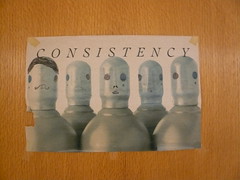
Consistency
Consistency (Photo credit: Matt Hampel)

This post continues with Living With the Obsessive: 3 - Be Consistent and Trustworthy from Chapter Ten.

This series looks at a small snippet of The book on the Perfectionist Personality, aka The Obsessive Compulsive disordered Personality, aka OCPD, each week. Please follow along, leave your comments, engage more on the FaceBook website... whatever your heart calls you to do.


When Being in Control Gets Out of Control by Allan E. Mallinger, M.D. and Jeanette DeWyze was published by Random House in 1992.  If   you believe you are dealing with OCPD or someone who is "Too Perfect," whether that's you or a loved one, please buy a copy of the book and read it for additional insights that will not all be covered in these excerpts.

3. Be Consistent and Trustworthy
It's tempting to feign agreement with some obsessives just to get them to stop badgering you.  But this can backfire! Obsessives need to be able to feel they can trust you, either to say openly you're not going to comply (giving your reasons), or actually to follow through on your word. Even in the smallest things, most obsessives respond dramatically to any evidence they can't trust you.  They immediately wonder what other things you've been dishonest about. Can they believe you when you say you love them? Can they ever believe you or trust that you'll do what you agree to do?

<snip> One man stated, "I need consistency in my life - to the extent that that's possible. I feel it would be nice if I came home at night and found consistency there. If I'm told dinner will be at six-thirty and I get home to find it's not even started - "

"That only happened once!" his wife protested, <snip>
***
Here's where it gets tricky. I do agree with the author that we should never BS an obsessive partner or friend, "Yes, yes, of course I'll do it your way," when we have no intention of doing it his way.

But, as in the example above, no matter how hard we try, there will almost certainly be one night after 752 nights where he comes home and dinner isn't even started yet.  And that's what he  latched onto, not appreciating or recognizing the 751 nights where dinner was served at six-thirty on the dot.

Because of their own distorted thinking, OCPD'rs may say they want "consistency," but what they truly expect is inhuman perfection.  

And we can drive ourselves crazy trying to deliver it to them.

Being consistent and trustworthy is a great goal, but it is important not to beat up on ourselves when we turn out to be human and fallible from time to time.  (This is not to say that we use that as an excuse, either.)

I would also argue that "giving your reasons" why you're not going to deliver something s/he wants can too easily turn into JADEing (Justifying, Arguing, Defending, and Explaining).  Better to stand your ground, "Yes, I understand you have a preference as to how you like the towels folded, but when I fold them, I'm going to do them my way. Nope, I don't need you to show me 'how to do it right.' When you fold them, you can do them your way; when I fold them, I'll do them my way."

via Suat Eman at FreeDigitalPhotos

I wish I had a dollar for every time my ex patiently explained to me that he couldn't believe I really loved him because... and then listed some tiny fault or task I'd overlooked, often from some years back. I've come to believe that a "non" can never be "consistent and trustworthy" enough to earn the trust of someone who is focused on finding a reason NOT to trust.

Somehow, he or she must come to a position of realizing that even when we do our best in some area, we're going to fail sometimes. That we still love them, and can be trusted, even if we insist on folding the towels the wrong way, or prepare dinner late once in a while.

Somehow, they have to learn that occasionally putting the toilet paper on the roll in the wrong direction is not the same level of betrayal as having an affair.

Your thoughts?
Enhanced by Zemanta

Tuesday, November 20, 2012

Too Perfect Tuesdays - Chap 10 - Living With the Obsessive

This post continues with Living With the Obsessive from Chapter Ten.

This series looks at a small snippet of The book on the Perfectionist Personality, aka The Obsessive Compulsive disordered Personality, aka OCPD, each week. Please follow along, leave your comments, engage more on the FaceBook website... whatever your heart calls you to do.


When Being in Control Gets Out of Control by Allan E. Mallinger, M.D. and Jeanette DeWyze was published by Random House in 1992.  If   you believe you are dealing with OCPD or someone who is "Too Perfect," whether that's you or a loved one, please buy a copy of the book and read it for additional insights that will not all be covered in these excerpts.

Living with the Obsessive
Living with an obsessive can be challenging. Although I've mostly been describing how their behavior causes them to suffer, it can be equally painful to be on the receiving end of such traits as the following:

Pickiness: You feel as if you can never do anything right. You may begin to wonder if the critical obsessive likes anything about you.

Demand-resistance: You often can't obtain the simple cooperation that oils the wheels of daily living.

Guardedness: You may never feel as if you really know the obsessive, or achieve a sense of intimacy with him. In the face of his or her aloofness, you may (mistakenly) feel unloved.

Rigidity: You can never count on obsessives to accept even minor changes. Instead, they're likely to be annoyed whenever you do something a little differently. And once they make up their mind about something, it's practically impossible to persuade them to change it.

Excessive orderliness: You may be made to feel guilty if you don't share the same level of orderliness. If they insist you meet their standard for neatness, this many put you under a lot of pressure, creating resentment on your part, or a sense of oppression.

Infallibility: You can never win an argument with an obsessive, or point out any errors. So you may chronically get the message that you're wrong.

Workaholism: You may resent how little time and energy the other person devotes to your relationship. His or her chronic absence or preoccupation may make you feel unimportant.

Indecisiveness or inability to commit: You may be unable to make plans because of his or her waffling; you may be unsure where your relationship stands.

If you have an obsessive spouse, friend, co-worker, or relative, you may have only one of these complaints or all of them, or you may have others I haven't listed. <snip>
***

I had all of these, in my relationship with my ex. Plus hoarding issues, which used to be included with OCPD, and will now have its very own category in the upcoming DSM-V.

At the beginning, most of these issues were hidden, or masked by the happy, "we're in love" hormones coursing through both of us. Yes, he was extremely neat and particular about his person, but I liked that, because so many men can be slobs in that area.

I don't believe he was deliberately trying to deceive me. And stars know I have plenty of my own faults. Problem was, he never let me forget any of them, but constantly pointed them out, until I did, indeed, wonder what he had ever liked about me in the first place.


He was super-guarded about his own inner feelings - those were not to be shared. I had always thought a relationship was about two people who trusted each other with their weaknesses, and helped each other. He tried never to let me see a weakness, and turned mine against me.

Now, as far as I could tell, my ex was at the very extreme end of being a Perfectionist Personality. There's a test called a Cammer, not widely used, but which is one way to rate how compulsive a person is.  I tried to trick my ex into taking it - I got him to take the first 8-9 questions, to which he rated himself 4's on all of them, and felt those were the Right Answers, then he got pissy and stopped. I tried answering for him on repeated occasions, hoping perhaps I had been too judgmental, but the lowest I could ever rate him was a 93, and mostly I rated him as a 95/96 (out of 100).

I now don't believe a "non" can have even a relatively tolerable relationship, long-term, with a severely obsessive person, unless that person is:
  1. aware of the issue, and that it is his/her issue, not the partner's, and
  2. working very hard to combat his/her perfectionist behaviors, ideally with professional help

Not all people are as severe as my ex seemed to be. His behavior was not improved by excessive drinking, either. YMMV. (Your Mileage May Vary.)

But the first step, if you are involved with such a person, is understanding, despite being told it's your fault, over and over again, that it is not your fault. It's an actual, diagnosable mental illness, and while your partner may not be to blame, either, you cannot fix him/her. What you can do is learn about the condition, learn some coping techniques, and later, re-evaluate as to whether this is the way you are willing to live.

Do you recognize the above behaviors?
Which ones are hardest for you to live with?
Your thoughts?

Tuesday, December 27, 2011

Too Perfect Tuesdays - Chap 6 - Fear of Dependency &
Keeping A Distance

Foto de Tiago Nicastro e Juliana RosenImage via WikipediaThis post continues with Fear of Dependency and Keeping A Distance from Chapter Six.

This series looks at a small snippet of The book on the Perfectionist Personality, aka The Obsessive Compulsive disordered Personality, aka OCPD, each week. Please follow along, leave your comments, engage more on the FaceBook website... whatever your heart calls you to do.

Too Perfect, When Being in Control Gets Out of Control by Allan E. Mallinger, M.D. and Jeanette DeWyze was published by Random House in 1992.  If you believe you are dealing with OCPD or someone who is "Too Perfect," whether that's you or a loved one, please buy a copy of the book and read it for additional insights that will not all be covered in these excerpts.


FEAR OF DEPENDENCY
Besides the fear of exposure and the fear of trusting, intimacy poses another threat.  The closer you get to someone, the more you come to need him or her.  And this in itself unnerves many obsessives.
<snip> But there's another aspect to dependency that also bothers most obsessives.  Dependency requires some sacrifice of autonomy, some loss of control over one's life.  <snip>
In other words, dependency, like trust, creates vulnerability.  Moreover, the obsessive's all-or-nothing thinking magnifies the threat perceived in any amount of dependency:  What if it were to lead to more and more dependency? <snip>
Keeping A Distance

To protect themselves from the vulnerability of intimacy, many obsessives shy away from it in a variety of ways.  For one thing, they tend to give other people as much physical space as possible.  <snip>

A few have told me they feel trapped or smothered if their mates sleep too close to them.  One patient said she wasn't totally comfortable when her husband hugged her.  <snip>  For some, the aversion to being touched is so strong it may cause them to shun physical therapists or doctors.  Obviously, anxiety about physical closeness also can seriously impair one's fulfillment in sexual relationships.

Many obsessives do participate eagerly in the mechanics of sex, but avoid an emotional connection during physical intimacy.  <snip>
***
The idea that we - as human beings - can be totally independent of others and still survive is a LIE. 

First off, we didn't. However indifferent, sporadic, and abusive their care of us might have been, somebody fed, clothed, and sheltered us when we were infants and small children.  There are several myths/stories of children raised with only those bare necessities - and no more - who died as a result.
"foster-mothers and nurses to suckle and bathe and wash the children, but in no ways to prattle or speak with them; for he would have learnt whether they would speak the Hebrew language (which had been the first), or Greek, or Latin, or Arabic, or perchance the tongue of their parents of whom they had been born. But he laboured in vain, for the children could not live without clappings of the hands, and gestures, and gladness of countenance, and blandishments."
There is horrifying evidence now of the majority (if not all) children who languished in Romanian orphanages bearing long-term medical, mental, and emotional problems.

I just finished reading Jean Auel's The Land of the Painted Caves.  While fictional, the work is extensively researched and checked as to probable social interactions among peoples in hunter-gatherer societies, based both on archaeological finds, and on anthropological research among modern hunter-gatherer societies.  No man is an island.  Most people in a primitive culture have at least rudimentary general skills at recognizing edible foods, hunting, fishing, garment and shelter-making, but if a clan-group is to survive, all must work together.  Skills are traded; a large fish that is caught is shared with others who contribute roots and vegetables.

Modern man is even more dependent on others.  If you're reading this on a computer, I'm positive you didn't manufacture it yourself from minerals you personally mined from the earth using only your hands and your flint digging tools.  I'm almost as certain you're not generating your own electricity.

The Amish and other agricultural societies who live by choice without electricity and "modern inconveniences," are very much centered around not just the family, but the community. Barn-raisings, church functions - again, everyone helps one another.

Even if you choose to live solo in a shack, Unabomber hermit style, you're going to use money (bank accounts, or currency printed/minted by somebody else) to buy materials (hammers, nails, saws) to build said shack.  You might transport to your shack how-to books (written and printed by others) on how to catch fish, tan hides, and build latrines.

And didn't somebody, somewhere along the way, teach you to read?

So, give it up with the delusion "I can get along fine without other people."

You may choose not to have a partner, or children, or to socialize with your co-workers.  You may cut yourself off from family (often with good reason).  You may fight with your neighbors and not have any friends.  You may decide that, because you have OCPD or bipolar disorder or chronic bad breath or whatever your excuse is, it is just too damn much work to get along with others, to make small talk or to risk asking for help or admitting vulnerability.

This is not a sign of strength, but of weakness.  It is as weak to be unable to stand being with other people as it is to be unable to spend a few hours of solitude.

As healthy human beings, we must learn to be INTERdependent upon one another. To help others, to ask for help when we need it.


In the beginning, my ex was quite physically demonstrative.  He brushed my hair, for hours.  Massaged lotion into my feet.  Held hands, lots of touching and kissing, but not cloyingly so.  Later, as his OCPD tendencies worsened, the affectionate touching evaporated.  He barely touched me - except when he wanted to have sex.  He wouldn't allow me to give him a back massage - and outright refused to give me one, even when I begged because I was in pain.

Being kept physically and emotionally at a distance, and then used as a periodic sexual outlet does not build closeness.

Your thoughts?
Enhanced by Zemanta

Tuesday, October 4, 2011

Too Perfect Tuesdays - Chap 4 - Making Decisions -
A Commonsense Approach


This post continues with Making Decisions - A Commonsense Approach from Chapter Four.

This series will look at a small snippet of The book on the Perfectionist Personality, aka The Obsessive Compulsive disordered Personality, aka OCPD, each week. Please follow along, leave your comments, engage more on the FaceBook website... whatever your heart calls you to do.

Too Perfect, When Being in Control Gets Out of Control by Allan E. Mallinger, M.D. and Jeanette DeWyze was published by Random House in 1992.  If you believe you are dealing with OCPD or someone who is "Too Perfect," whether that's you or a loved one, please buy a copy of the book and read it for additional insights that will not all be covered in these excerpts.

 Making Decisions - A Commonsense Approach
<snip> observe the problem as it is happening and label it: "This is a chronic problem for me."  Don't let it be automatic anymore.
<snip> Dig for the specific fears.
  • It would be awful to overlook some flaw in this car, and then buy it, only to see the flaw surface later.
  • If I wait long enough, facts will accumulate and I'll be assured of making the "right" decision.
  • I couldn't bear it if anyone saw that I made a wrong choice.
  • If I make this date, I might not feel like going when the time comes, and then I'll regret the decision.  And good people don't cancel or change their minds, so once I make the date, I'm really trapped.
  • Once I make this purchase, I'm stuck with it forever.
  • My life would be ruined if I got engaged - or worse, married! and later had some regrets.
  • It would be terrible to have committed myself to an appointment if something preferable came along later for the same time.
  • I can't take a stand because I'm not sure I'll feel the same way later, and changing my mind would make me look like a fool.

Once you've uncovered the particular thoughts that plague you, think about them one by one.  For the most part, they are either inaccurate statements, exaggerations, or arbitrary assumptions badly in need of revision.  And they are damaging you terribly.  You may have hosted such beliefs for a long time, but that doesn't make them true, and you need not hold onto them.  <snip>

How true is it, for instance, that you're stuck with that shirt or even that car "forever"?  And even if you did have to keep it for a while, would that necessarily be "awful"?  Chances are, the only thing that makes it awful, rather than inconvenient or uncomfortable, is your labeling it as such and then stubbornly dwelling on that idea.

<snip> it's crucial to your happiness that you learn to distinguish between temporary discomfort and something intolerable.  So take the time to think about it now and every time this opportunity arises.  Don't let old, untested, irrational thinking habits continue to dictate what you are going to feel.  Think as a person who truly wants to be happier, someone who will do everything possible to make his or her life better.

***
IMO, two things here can't be repeated enough: 


1)  Don't let it be automatic.  Become aware of your knee-jerk responses, take a step back, and ask yourself, is this really what I want to do?  Pro-active, rather than re-active.  Which is good advice whether somebody is OCPD or not.  It's all about becoming mindful.  We may not be able to choose how we feel, but we can choose how we behave.


2) it's crucial to your happiness that you learn to distinguish between temporary discomfort and something intolerable.

We know, with our reasonable, logical brains, that it's not "intolerable" if a child - or an adult - spills a glass of milk.  Or forgets all nine billion steps of the Sacred Shower Protocol, or even if we make a mistake at work and our boss sees it.  Mistakes are part of belonging to the human race.

What is intolerable - and this is why I had to leave my ex - is living with someone who rides us like the Lone Ranger rode Silver, seeking to make sure we don't spill milk or omit a step of the Shower Protocol or make a mistake - any mistake.  Ever.

Can you learn to observe your problems, instead of just reacting?
How about being able to "be" with a little discomfort?

Tuesday, August 23, 2011

Too Perfect Tuesdays - Chap 4 - Avoiding Decisions &
Living in One's Head

This post continues with Avoiding Decisions and Living in One's Head from Chapter Four.

This series will look at a small snippet of The book on the Perfectionist Personality, aka The Obsessive Compulsive disordered Personality, aka OCPD, each week. Please follow along, leave your comments, engage more on the FaceBook website... whatever your heart calls you to do.

Too Perfect, When Being in Control Gets Out of Control by Allan E. Mallinger, M.D. and Jeanette DeWyze was published by Random House in 1992.  If you believe you are dealing with OCPD or someone who is "Too Perfect," whether that's you or a loved one, please buy a copy of the book and read it for additional insights that will not all be covered in these excerpts.

Avoiding Decisions
<snip> Waffling is typical of the behavior of many obsessives faced with a decision.  They see all the pros and cons of any choice, all the while hoping that enough facts will file up on one side to tip the balance and spare them the responsibility for deciding.  They weigh and think, think and weigh.
Just as they start to lean one way, they notice an unreckoned drawback.  Then an overlooked option appears and pulls them toward that direction.  But they soon discover a new shortcoming of that plan and start back towards the original scheme.

After agonizing for a while, they may resort to an "objective" method, such as making exhaustive lists of the pros and cons.  If it's a draw, they may weight each item according to importance, and even apply a complex tie-breaking formula - anything to avoid having to take personal responsibility for the outcome.  Alas, the balance never seems to tip, and their torment continues.

LIVING IN ONE'S HEAD
Postponing decision-making until they get enough facts to guarantee the "right" decision is another way obsessives avoid action and its attendant risk of error.  <snip>  When she realized she needed to buy a new car, she spent months gathering brochures, test-driving possible alternatives, reading Consumer Reports, getting advice from friends, and contrasting features and prices.  She contended that all of this activity was simply reasonable preparation for an intelligent decision, and of course there is truth to this position.  But Annette remained unaware of the greater truth: that her main goal was to avoid error, even at the cost of making no decision at all.

Cars Available from Orlando Cars Online

She finally narrowed her options to a few final items - the financing terms, the color, the model - but she somehow couldn't choose.  Each answer evoked a new set of doubts.  One dealer was closer to her home but didn't have the car in blue.  One had it in blue but was charging more.  To an outsider, it was clear that any of the alternatives could be lived with, but Annette stubbornly resisted this conclusion.

<snip> Action always carries with it the danger of error.  No sooner is she ready to make a move than she starts doubting and stalling for more time.  Doggedly she resists seeing that her indecisiveness is actually an unconscious decision not to choose.  Her hidden agenda is to avoid the risk of being wrong and contradicting the Credo.

<snip> People who typically make decisions in a healthier, less painful manner... may well seek some facts to supplement this subjective starting ground, but their goal throughout the process is to act, as quickly and as reasonably as possible, and they accept implicitly that there is no way to do so in a fail-safe manner.  Furthermore, they trust that they usually won't make awful blunders.  They know that they occasionally risk mistakes, regrets, and dangers, but they also accept that risk is part of life. So they decide and move on.

<snip> For obsessives like Annette, in contrast, action is the enemy.  <snip> Consciously this sort of person honestly thinks she wants to take action.  In fact, she will often complain, "I just hate this indecisiveness."  But another part of her wants to live mainly in her fantasy.
 The section concludes with how, when Annette's car broke down and she was forced to buy a new car, no dealers had her first choice, so she ended with a model much farther down on her list.

***


If you choose not to decide, you still have made a choice.

This is one of the manifestations of OCPD that drive partners barking mad, as my Brit friends might say.  Because life doesn't stand still.  Cars and refrigerators and couches do need to be replaced, periodically, and the search for said item with an OCPD partner can turn into The Quest for the Holy Fuckin' Grail.  And it doesn't have to be that way.

About a year after OCPD ex and I were living together, we decided to take a small table and chairs out of storage and place it in a nook in the living room for our meals, instead of eating at the coffee table.  (No room in the actual kitchen for said table & chairs, because of the masses of stereo equipment he hoarded stacked against the wall.)  Then he began freaking out, because food bits and beverages  occasionally splattered on the surface of the table, as happens to any surface people use to eat from.

I didn't know about OCPD then.  Three weekends, eight stores later, we finally found placemats he didn't absolutely hate.  Though I thought several choices we found in the very first store would have worked just fine, until we found others we liked better.  "Good enough for now" doesn't seem to be an acceptable phrase for those with severe untreated OCPD.

from Salvatore Vuono at Free Digital Photos
The Search for a New Couch made the placemat saga seem like a walk in the park.  Three years, uncountable stores visited, many more than once, and in meantime, the current couch grew more miserably uncomfortable every day.  You could actually get bruised if you sat in the wrong spot - and we did.


I am grateful for the blessing that we were not married, because I was able to make my own new car decision fairly painlessly.  In 2006 I decided I wanted a hybrid.  Read the reports on and drove several models.  Decided I liked the Civic best, and white, because they are most reflective and so require the least use of air conditioning.  In fall 2007, as the dealerships were getting the 2008 models in, I drove one of those, then a 2007 model again.  With no discernible difference in handling, I went with the sweet deal they were able to offer me on the older model they were trying to get rid of.  Not a hasty decision, but not an agonizing one, either.

I could second guess it a thousand times - possibly the new models get even better gas mileage.  Maybe if I'd waited I could have gotten a Ford hybrid.  Or, or, or.  But I don't need to play that game - I needed a new car, I got one, we've been very happy together so far.  Some day, this car will no longer meet my needs for whatever reason, and I will get another car.  Making a mistake, even one that's potentially thousands of dollars "wasted," is not a tragedy.

Just making a decision and letting it go, like a soap bubble, allows me to turn my mind to more important things, to things I enjoy more, to life.


Did you make endless pro & con lists to avoid making an actual decision?
How did you get past that - or are you still stuck?
Prove that you can at least make a decision on which Reactions button to click, below.  :-)

Tuesday, July 19, 2011

Too Perfect Tuesdays - Chapt 3 - Rising Above Perfectionism
Confronting Your Inner Saboteurs & Getting Your Work Done

from Dru Bloomfield at Flickr 
Is it better to run the "perfect" race, or to finish a great one?

This post continues with Rising Above Perfectionism: CONFRONTING YOUR INNER SABOTEURS & GETTING YOUR WORK DONE, from Chapter Three.

This series will look at a small snippet of The book on the Perfectionist Personality, aka The Obsessive Compulsive disordered Personality, aka OCPD, each week. Please follow along, leave your comments, engage more on the FaceBook website... whatever your heart calls you to do.

Too Perfect, When Being in Control Gets Out of Control by Allan E. Mallinger, M.D. and Jeanette DeWyze was published by Random House in 1992.  If you believe you are dealing with OCPD or someone who is "Too Perfect," whether that's you or a loved one, please buy a copy of the book and read it for additional insights that will not all be covered in these excerpts.


Rising Above Perfectionism


CONFRONTING YOUR INNER SABOTEURS
Whether you're writing a paper, painting a living room, or preparing a dinner for guests, if you're a perfectionist you tend to be haunted by such unconscious assumptions as: 
  • "I couldn't stand it if my work wasn't as good as X's."
  • "It's got to be great!"
  • "It would be intolerable for them to see me make a mistake."

You may be entirely unaware you're saying such things to yourself; they may sound completely foreign.  But from their silent place within such enduring, submerged beliefs govern many people's more visible behaviors and conscious concerns.

If you're such a person, what you need to know right now is: 
  • You are choosing to think these thoughts.
  • They are obliterating your chances at happiness.
  • You can start making significant changes right this minute, even with little or no "insight" into your obsessiveness.
For example, let's say you're writing a report or a paper.  Maybe you've always thought that a good written report includes every possible angle on the subject, answers every conceivable question, and reflects as much research as humanly possible.

Well, that's wrong.  And it's just that kind of thinking that will prevent you from reaching your creative and productive potential.

In most situations, the best report is the one that's done as well as possible within the given time limits.


GETTING YOUR WORK DONE
If getting work done in a timely manner invariably proves to be difficult or painful, you've got to recognize that your way (perfection) isn't working.  So try this: every time one of those irrational beliefs ("It's got to be done flawlessly!") starts pushing in on you, push back.  Tell yourself, "No, it's got to be completed!" and keep moving.  Focus on how good it feels to make progress on the task.  Refuse to judge whether or not you are doing a terrific piece of work.  The beauty of finishing on time (or even ahead of schedule) is that you can go back and fine-tune later.  Think in terms of movement.

Give serious attention not just to doing the work, but scheduling it realistically.  Perfectionists tend to schedule their time as if they will perform ideally and can anticipate perfect conditions.  They assume, for example, that nothing will interrupt them, that fatigue won't hamper their efficiency, that they'll be able to move along at top speed.  <snip>  Accept that your project won't be, cannot be, as "perfect" as it could be if you had no deadline and no other responsibilities.  <snip>

Photo by horizontal.integration at Flickr
Imagine yourself swimming down a river, with the current, toward a goal.  You have to arrive there before dark, or it will be too late.  Whenever you get sidetracked by details or fine points, envision yourself losing the current and drifting slowly out of the main river into smaller streams.  They are seductive and interesting, but you lose momentum when you investigate them.  Get back into the main river and move into the central current again!

Do the finest piece of work you can, given the limitations of deadlines and the legitimate requirements of your health, family, social life, and leisure pursuits.  Remember that all of these dimensions are crucial to your enjoyment of life.

***
For me, too, part of me wants every page I write, every report I complete, to not just be good, or even excellent, but the best thing anyone has ever seen.

My ego needs to take a chill pill.  In the first place, that's simply not an achievable goal.  Even if somehow, I magically accomplished such a feat, and my work was perfect in my own eyes, the people doing the judging are subjective.  Always.  Even trained Olympic judges have differing opinions.

photo by RHColo_General at Flickr
There are long lists on the internet of books that were panned by critics and later adored by the general public.  Likewise movies, and art, and music... The one thing that is assured about any endeavor, is that everyone will have a different opinion about it.

You are choosing to think these thoughts.

The need/compulsion to be "the best ever" in every single endeavor is a thought that is chosen.

There is no Gold Medal awarded for the perfect grocery list.  Unless we are moving to the jungles for six months and forgot malaria medicine, leaving something off the list... not a tragedy.  Just stop by the store again later that day, or even later that week.

I would much rather have had the garage half-cleaned out than put off till it could be done "perfectly."  (In other words, postponed forever.)  When people at work need a report, getting it done on time is significantly more important than getting it done perfectly.  Maybe some numbers would change slightly, but when you need those figures for a budget, delay costs much more money than a slight variance.

I've heard of people with ironing baskets with baby clothes at the bottom of them - and the "babies" are now applying to college.  Yet they aren't willing to donate or store the baby clothes until they iron them... because?  This is distorted thinking, folks.

Forward movement, keep swimming, git'r done - whatever slogan works for you, apply it.  For most projects in life, a horseshoes & hand grenades (close enough is good enough) approach, rather than treating everything as if it's brain surgery, works best.  In tests, reports, cross-stitch, manuscripts - what's most effective is the broad strokes, first, then going back to fine-tune and add details, later.

That may not be the way you want to work.  It probably doesn't come naturally; it may take considerable effort to change your approach.  But it is the way to get things done.

Do you have inner saboteurs?  
Do you get so hung up on the details you can't finish things?

Tuesday, June 28, 2011

Too Perfect Tuesdays - Chapt 3
Not So Perfect Relationships
Social Inhibititions & Being Right

This post continues with Not So Perfect Relationships, from Chapter Three.

This series will look at a small snippet of The book on the Perfectionist Personality, aka The Obsessive Compulsive disordered Personality, aka OCPD, each week. Please follow along, leave your comments, engage more on the FaceBook website... whatever your heart calls you to do.

Too Perfect, When Being in Control Gets Out of Control by Allan E. Mallinger, M.D. and Jeanette DeWyze was published by Random House in 1992.  If you believe you are dealing with OCPD or someone who is "Too Perfect," whether that's you or a loved one, please buy a copy of the book and read it for additional insights that will not all be covered in these excerpts. 

Not So Perfect Relationships

The most serious effects of perfectionism can be seen in personal relationships.  Such problems spring from
  • the fear of having other people see one's flaws
  • the need to be right about everything
  • a constantly critical attitude

SOCIAL INHIBITIONS
Let's look first at the fear of letting other people see one's shortcomings.  This fear is responsible for a variety of social inhibitions that can range in intensity from slight apprehension to full blown terror, complete with pounding heartbeat, weakness, upset stomach, and other symptoms.

<snip> While the form of the specific fear may vary widely, most socially inhibited people harbor distorted fears of being noticed and having their flaws exposed.  The vast majority feel themselves to be under scrutiny much more than is the case, and they believe that others will reject them or will respect them less if any slips or imperfections show through.  <snip>

BEING RIGHT - AT ALL COSTS
A different way in which perfectionism can damage personal relationships stems from the perfectionistic need to be right -about everything.  Errors are anathema to the perfectionist, but everyone is wrong sometimes.  (After all, perfectionism is a myth.  Human existence cannot be mistake-free.)  Lots of obsessives will admit in abstract terms that they make mistakes.  Being able to recognize one's shortcomings is, after all, part of being "the perfect person."  However, perfectionistic obsessives tend to avoid owning up to specific errors, particular in important matters, and this often alienates other people.

It's simply unpleasant to be around someone who always has to show he was right.  <snip>

Perfectionists often try to talk their errors away.  In a discussion, they gently hammer away at their opponents' position until the others back down, if just from fatigue.  Or they will explain how their position was misunderstood.  They nimbly dodge admitting their own culpability.

Should a mistake be absolutely undeniable, they may still have trouble calmly acknowledging their error.  Often they will become defensive, tossing off so many buts, howevers, and other qualifications that their listeners can barely hear the admission within the verbal thicket.  Even in admitting error, perfectionists seem to be saying they they were... semi-right.  Somehow they make it seem that, given the circumstances, being slightly in error was the most intelligent position to have taken.  Throughout, they fail to notice how repelled others can be by this stubborn pretense at infallibility.

<snip>perfectionistic obsessives may even try to convince a hurt or angry friend that his feelings are inappropriate or "wrong."  <snip>  One person will blurt out to the other, "You shouldn't feel that way!"  In each case the obsessive may be surprised when the other person feels alienated still further after being proved "wrong" for feeling a certain way.  The obsessive fails to see the damage done by trying to transform a sharing of feelings into a debate: all too often it pushes the other person into keeping future complaints to himself while smoldering under the surface.  <snip>

***
When I was in my teens, and early twenties, when buying feminine hygiene products at the grocery store I would seek out a female cashier and bagger.  It was simply too humiliating to have a man handle such intimate items, because if they did, they would know that I used them.  They might even think I was menstruating right at that very moment.  The horror!

Well.  I got over it.  I realized that even the male cashiers and baggers handled such items dozens of  times a day, and gave it no more thought than if I was buying tomatoes or shampoo.  They.  Couldn't.  Care.  Less.  If they were thinking about anything while handling my purchases, it was probably about what time they got off work, or how they were going to spend their paycheck, or that cute girl (or guy) that just got hired.

Somehow, those with OCPD are stuck into "they're all thinking about me, they're all looking at me" mode, which becomes self-fulfilling.  If you feel particularly self-conscious and act that way, people will look at you more.  I'm not sure if it's egotism, or immaturity, but mostly, just as in my tampon example, above, we all need to realize that people care a lot more about their own affairs than about us.

I think everybody, perfectionist or not, tends to be at least somewhat defensive about making mistakes.  I don't like finding that I've made a mistake, but I've learned to accept that I do.  I even call attention to my mistakes at work.  "I forgot to do X, I filled out this form the wrong way; I missed picking up the message; now here's how I suggest correcting it."  I work at devising systems, for myself and others in my department, not that prevent mistakes from being made, but that will detect them quickly. My bosses appreciate that I'm more focused on making things work, than trying to deflect blame or Covering My A$$.

Ex was the dinner-preparer, and on rare occasion, he would over or undercook something.  He did learn to joke about that (somewhat), but his attitude towards most mistakes was defending the pass at Thermopylae (think The 300).  Nothing was going to get through or be admitted without a long and bitter battle.

shirt available from Spreadshirt.com
As noted above, that kind of stance is highly detrimental to a relationship.  I experienced all of the defensive tactics noted above: the wall of argument, the admission buried in a pile of qualifications, being told my feelings were wrong, being told I shouldn't feel what I felt...  It's emotionally exhausting, and it erodes trust. 

I had one friend who was actually (somewhat) supportive of our relationship, and who was liked by the ex and welcome in our home ( a very short list), until... she offended him (in his eyes.)  She and I had gone out somewhere, it was a hot summer day, and when she dropped me off, she got out of the car to greet him.  She was a very fastidious person, and he'd been working outside, with no shirt on.  He wanted to hug her hello/goodbye, in all his sweaty glory.  She insisted on shaking hands, instead, which I believe wounded his vanity tremendously.  He couldn't forgive her for the "insult," and nothing I could say would convince him otherwise.

From then on, she was a horrible snob, no longer welcome in our home, and I met bitter resistance to going out to do girly things with her (which was perhaps every other month.)  If I even mentioned her name, I met with petty complaints and ugliness, which encouraged me to keep my feelings to myself.  There was an ever-growing list of Unmentionables.  I don't think he ever sat down and thought about how that kind of behavior did not bring us closer together, but drove us apart.  He would pay lip service to "better communication" being essential to our relationship, he would even bring it up, but how can you communicate with someone who can't accept your feelings or admit being wrong?

Have you lived through the Debate that Wouldn't Die?
Are you more likely to find a winning lottery ticket on the sidewalk 
than have your Perfectionist admit having made a mistake?

Tell about it in the comments.

Tuesday, June 21, 2011

Too Perfect Tuesdays - Chap 3 - Physical Clutter

illustration from Wikimedia 
Dragon Hoards are jewels and gold
OCPD hoards are old boxes and spoiled food
This post continues with Physical Clutter, from Chapter Three.

This series will look at a small snippet of The book on the Perfectionist Personality, aka The Obsessive Compulsive disordered Personality, aka OCPD, each week. Please follow along, leave your comments, engage more on the FaceBook website... whatever your heart calls you to do.

Too Perfect, When Being in Control Gets Out of Control by Allan E. Mallinger, M.D. and Jeanette DeWyze was published by Random House in 1992.  If you believe you are dealing with OCPD or someone who is "Too Perfect," whether that's you or a loved one, please buy a copy of the book and read it for additional insights that will not all be covered in these excerpts.


Physical Clutter

Just as some perfectionists' speech is cluttered with too much detail, others have trouble discarding things in their lives.  They are crippled by the fear that they may make an irreversible error in throwing something away, and by their inability to prioritize.

<snip> When I met him, Karl had been living in his apartment for almost two years, yet boxes and packing crates were piled four to six feet high, filling most of the living space.  Though Karl had arranged a neat path between them to connect the various rooms, so little space was left that he had almost no furniture.  He even slept on the floor.

He told me that the boxes contained newspapers, magazines, and books he planned to read, "as soon as I get the time."  Nor could he discard old letters, broken tools, or empty containers because "you never know when something will come in handy."  Of course, Karl couldn't invite people to his apartment, where they would see the appalling clutter, so his social life foundered.  Yet each time he decided that he had to discard something, he was overwhelmed by the pressure of prioritizing; somehow everything seemed equally important.  <snip>

As we'll see in chapter 8, some obsessive go to the opposite extreme; they're too orderly.  But milder variations of Karl's disorderliness are common in obsessives.  They might generally be sloppy, or the disorder might be confined to one area of their lives - to their car, say, or to one particular closet.  In many cases the ironic underlying cause of the mess is perfectionism.  Cleaning up would require scrubbing every surface, removing every molecule of dust, finding a place to store every possession, a task so herculean that it would daunt anyone.

***

We've discussed the hoarding, a few (billion) times.  To those not involved with a hoarder, there's a train-wreck style fascination - how can you possibly let it get that bad?


It gets that bad because people with a hoarding partner either put up with it, hoping/praying they will get better and eventually be prepared to get rid of the clutter. The hoarder promises s/he will, "soon," but "soon" never arrives for them.  You have a better chance of standing in the yard waiting to get struck by lightning, than of a hoarder voluntarily deciding today is the day to start decluttering.

In some cases, the hoarding will break up the relationship.  This is largely why I left my ex, because he was not willing to address  the issue and get help.  (Yes, he had other issues, and became emotionally abusive, but much of the time he would "go off" in defense of the hoard when I would press the issue.)

There is every excuse in the world - I'll get to it later, there's still a use for it, do you know how much I could sell that for?  (Then why don't you, sell it?  Another excuse comes up.)

Many hoarders end up living alone (after all, there's not much room for anybody else.)

Some hoards include heaps of garbage and old clothes, some have neatly stacked boxes and goat paths, but a hoard is no way to live.  For a fascinating graphic & statistics, click here.

Yes, people who are hoarders are truly mentally ill.  But if you love them, if they totally refuse help, and you don't want to live as consort to the King or Queen of Empty Boxcity, what can you do but leave?

Your thoughts?

Tuesday, June 14, 2011

Too Perfect Tuesdays - Chapter 3: The Completion Complex

This post continues with Performance Pitfalls: The Completion Complex, from Chapter Three.

This series will look at a small snippet of The book on the Perfectionist Personality, aka The Obsessive Compulsive disordered Personality, aka OCPD, each week. Please follow along, leave your comments, engage more on the FaceBook website... whatever your heart calls you to do.

Too Perfect, When Being in Control Gets Out of Control by Allan E. Mallinger, M.D. and Jeanette DeWyze was published by Random House in 1992.  If you believe you are dealing with OCPD or someone who is "Too Perfect," whether that's you or a loved one, please buy a copy of the book and read it for additional insights that will not all be covered in these excerpts.


THE COMPLETION COMPLEX

A trait related to the need to be flawless is the need to be thorough.  Bowing to this pressure when preparing a presentation of written report, the perfectionist will include far more information than necessary.  He can't draw the line between what is and isn't important, and he can't risk leaving something out for  fear someone will think he wasn't fully informed.  <snip>

Among countless examples of this behavior, one is provided by the teacher who feels driven to give the perfect lecture.  She fastidiously  presents reams of background information, but then finds herself having to rush through the very issues to which she was building.  In fact, her students often can't follow her increasingly frantic lectures and walk out without having absorbed the main point.

<snip> However, the obsessive's chief motive in covering topics in such fine detail is usually his exaggerated fear of omitting something that will turn out to be important.  This fear blinds the person to the fact that too much detail can dull the impact if his main points, boring and confusing listeners rather than clarifying.  If every base has to be touched and all pros, cons and caveats acknowledges, communication is sterile.  It lacks color, force and focus.  Perfectionism once again winds up detracting from overall performance, rather than enhancing it.

***

One thing I want to say about my beautiful, self-aware OCPD friends - they do know how to laugh at themselves.   The photo joke above was posted on one of my support boards by somebody who has OCPD, and many of the aware OCPDrs joined it to laugh at it, and, ruefully, at themselves.

Nobody wants to be on the receiving end of a massive info-dump.  Again, I think this goes back to my analogy of a malfunctioning or over-sealed filter - those with OCPD really don't know how to filter what's A level important, B level important, C level important.  So everything is included, in one big pile o' crap.  With the result that nothing makes sense.

They did not get the show biz memo: Always leave the audience wanting more.

When I ask what's wrong with my car, for instance, what I really want to know is just three things: 1) How long is it going to take you to fix it, 2) How much is it going to cost, and 3) Is it my fault the whatever-it-is broke, so I can avoid breaking it again in the future?  I don't want to know about the entire history of the internal combustion engine, or how my whatever-it-is works compared to twenty other models of cars.  That makes you happy to know these things, good for you, but I. Don't. Care.

Sometimes I battle the TMI (Too Much Information) tendency in myself, but mostly, people (at least who do not have OCPD) tell me I do a decent job communicating, both verbally and via writing.

How about you?

Tuesday, June 7, 2011

Too Perfect Tuesdays - Chap 3 - Performance Pitfalls
Deadly Deadlines

This post continues with Performance Pitfalls: Deadly Deadlines, from Chapter Three.

This series will look at a small snippet of The book on the Perfectionist Personality, aka The Obsessive Compulsive disordered Personality, aka OCPD, each week. Please follow along, leave your comments, engage more on the FaceBook website... whatever your heart calls you to do.

Too Perfect, When Being in Control Gets Out of Control by Allan E. Mallinger, M.D. and Jeanette DeWyze was published by Random House in 1992.  If you believe you are dealing with OCPD or someone who is "Too Perfect," whether that's you or a loved one, please buy a copy of the book and read it for additional insights that will not all be covered in these excerpts.

Performance Pitfalls
Besides putting many obsessives under enormous pressure, the Perfectionist's Credo an cause other insidious damage.  It often propels obsessives into self-defeating behaviors that far outweigh the rewards of avoiding errors.

DEADLY DEADLINES 

Many perfectionists chronically have trouble getting their work done, or even started.  They tend to procrastinate because all tasks loom large when they have to be done flawlessly.

<snip> Once a task is undertaken, the perfectionist always finds room for improvement.  No matter how much time he spends on a project, there's always the chance someone will catch an incomplete or erroneous detail.  So he holds on to it, spending far more time than necessary.  In his mind, the danger is in letting go of something before it is truly perfect.  Under this pressure, some perfectionists actually miss their deadlines, while others meet them but pay a terrible personal cost.

<snip> This patient wanted every sentence to be profound, and she couldn't write down a single word until she was absolutely certain it was the right word.  Ironically, the longer the writing took, the higher she felt others' expectations would be, so the self-imposed pressure mounted with each passing
month.

Over and over, I've heard patients describe being frozen into inaction by the awesome imperative to do a task not just perfectly, but in a way that truly impresses or astounds - in other words, to be "great."  I have to stress that most of the time the obsessive doesn't walk around consciously thinking that he or she must tower above other people; acknowledged consciously, it sounds pretentious.  But whenever I question, point by point, why she can't stand an oversight in her presentation or why he can't stand to be seen as an average attorney (or designer, or chef, or teacher), a submerged desire to astound people with his or her knowledge emerges.

Not only can the imperative to be great inhibit one's day-to-day functioning, but it can also, paradoxically, discourage one from developing one's talents - sometimes at a tragically early age.  I think of Janine, a gifted twenty-seven-year-old architect who consistently had trouble undertaking important projects because she as convinced she had to "produce a design so innovative that it stands everyone on their ears."  Even sadder was Janine's' outlook for her future.  "I had to many plans, so many fantasies," she told me.  "But because my work has to be incredibly good, it takes infinitely longer to execute somethng than to simply think of doing it.  I feel like I've wasted the last two years.  Anything I do now will be less than what I fantasized I would do.  So now it feels like there's no use."


***

The "everything-including-the-kitchen-sink" thinking, is, I think, one of the markers of this condition - the lack of working filter.  On a report, say, those with OCPD really can't sort out which things are most important,  which things are less important, and which things are frills to throw in, if there's time, or as an illustrating anecdote.  Everything ever known about the subject must be included.  Which means a confusing mess, much of the time. 

Then, of course, if a task is never finished, it can never be criticized, because, of course, it's not finished.  (Like my current novel - though I am getting critique on the unfinished bits.)  And you don't have to start on any new projects, because the old project isn't done, are you crazy?

This was why my ex could rarely be persuaded to start some new project.  His favorite excuse being the garden - and when there's a big yard, you can always find trees and bushes that could use a trim, weeds that need pulling...  The yard was never perfect enough to move on to something else.

I find that I tend to procrastinate on things I don't enjoy doing.  Like filing.  Housecleaning.  I find ways to get around that, like playing some "get up and move" music, but still, sometimes it's hard beating the inertia.

So I can empathize, to a certain extent, how much harder it must be for those with OCPD to get the ball rolling.  And yet, part of me just wants to scream:


Because if one just pitched in and got-er-done, it would take so much less time and energy than all the excuses.

Anybody with me on that?