Using writing, and meditation, and ice cream, and reading, and dreams,

and a whole lot of other tools to rediscover who I am,

after six years living with a man with OCPD.


Showing posts with label filter. Show all posts

Monday, April 23, 2012

A-Z: Therapy Is Not A Dirty Word

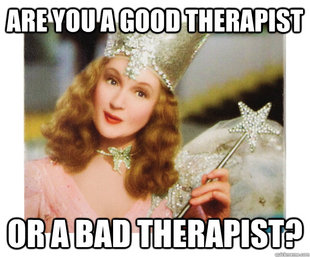
IMO, more people are afraid of a bad therapist than a bad marriage. Generally those who've experienced a disastrous love relationship will be willing to try again with a new partner, but if they've had a bad therapy experience...!

Besides which, there's a huge stigma factor.

When we hear that someone has been "in therapy" for an extended period of time, our initial reaction is not, "Oh, what a brave and courageous person. Kudos to her/him for facing her/his issues head on and getting the help s/he needs." It's more along the lines of, "Wow, that person must be really f---ed up."Am I right?

I am ashamed to admit, I tend to think that way - and I know better! I've had long term counseling myself, and I'd do it again tomorrow.

Sometimes people get stuck in a rut, whether that rut is grief, PTSD, or choosing bad relationships. If our car is stuck in a rut, would we feel ashamed or embarrassed to need a little push getting out of the ditch? (Okay, maybe a little embarrassed, depending on how we got into that ditch.)

But if we'd been in a car accident, and needed physical therapy to recover the use of, say, an arm, wouldn't we commit to it for as long as it took to get the maximum use of our arm back?

Yes, there are personality clashes, and sometimes, despite any number of impressive degrees, we may have hit on a "bad" therapist, but mostly, therapy fails because:
  • We aren't seeing the right kind of therapist.
  • We aren't getting the right kind of therapy.
  • We aren't committed to the very hard emotional homework of being honest with our therapist, and working on the exercises or changes s/he suggests.
Here's the different types of therapists:
  • Psychotherapist
  • Psychologist
  • School Psychologist
  • Psychiatrist
  • Mental Health Counselor
  • Marriage & Family
  • Social Worker
  • Psychiatric Nurse
  • Pastoral Counselor
The amount of education and training required for each varies, from none to a substantial amount. A psychiatrist is actually an M.D. and can write prescriptions for medications (in a few states, so can a psychologist), but generally a psychiatrist will refer any ongoing therapy work to a psychologist.

Because someone is "lower on the food chain," does not necessarily mean he or she will be an ineffective therapist. For some problems and disorders, medication is not indicated.  For others it may be helpful on a short-term basis in conjunction with CBT or other brain retraining exercises; and for some people, long-term medication may be necessary. In yet others inpatient care may be required. A nutritionist may add needed support.

A good therapist will recognize when a client needs more help than s/he can provide, and be eager to steer her/his client to the right kinds of additional help.

Different types of therapy include:

  • Psychoanalysis
  • Cognitive Behavior Therapy (CBT)
  • Dialectic Behavior Therapy (DBT)
  • Antipsychotic and/or antidepressant medications, and/or mood stabilizers

A treatment once promoted, which fell into some disrepute, and now gaining some proponents is ECT (Electroshock Therapy) as a treatment for bipolar disorder and depression. Diet modification, music therapy, group therapy, yoga and mindfulness exercises; all can form an integral part of helping a person become as whole and mentally healthy as possible.


The most important factor in therapy success is being committed to it. If we are not willing to embrace the process and say, "Yes, this area of my life is causing me and my loved ones too much pain. I will do whatever it takes to make it better for everyone I love - including me," then no matter how experienced and skilled the therapist, no matter how effective the treatment, it's not going to work.

Changing lifelong behaviors and thinking patterns is hard, hard work. In an earlier post, I compared it to shifting the course of the river - the river tries to flow along the same channels it always has. This is where medication in partnership with therapy often works well, interrupting the old patterns long enough for new ones to form (they say about 90+ days is the minimum time frame to quit an old habit or form a new one).


I know people who are diagnosed as mentally ill who religiously follow their medication, exercise, diet, and therapy regimes. I know others diagnosed as mentally ill who are willing to try certain therapies but not others. I know some who refuse to see any kind of counselor, under any circumstances, even if it means being fired from a job or losing a spouse or partner, using the excuse of, "I saw a therapist once, and it didn't help." They believe all it takes is willpower and determination to not be disordered.

Guess which group is most successful at managing their condition?


My A-Z theme is Issues related to Mental Health or Mental Illness.

Have you ever had good or bad therapy?
Would you be willing to try it again?
Why or why not?
Enhanced by Zemanta

Monday, April 9, 2012

A-Z: Everything Gets Under Your Skin
If You've Got Hyper-Sensitivity


Nails on a chalkboard.  Every (hearing) person knows and loathes that sound.  Nobody is very fond of the scratchy clothing tag at the back of our necks, either.

But what if many of the sounds, smells, and sights that other people enjoy, or at least, tolerate with seemingly little distress, set your teeth on edge?


You may be a Highly Sensitive Person.

Being highly or hyper-sensitive is not the same thing as actually being allergic to fragrances, foods, etc.  They simply really, really bug the HSP person.

From Being Highly Sensitive on Holistic Healing:

Porous Systems

As we have come to know, Highly Sensitive People's systems are very porous, meaning that external stimuli seems to be more directly absorbed into their bodies. (It has been said that it is as if HSP "have no skin" to protect them from these outside stimuli.) Non-HSP generally are less porous and have natural defenses which defuse external stimuli thereby not directly impacting and overloading their nervous systems.

Another way to think about this is to visualize the curve on a chart: At the point where the Non-HSP would have little or no stimulation, the HSP would be somewhat stimulated. Where Non-HSP would be somewhat stimulated, the HSP would be pretty well stimulated. And, where the Non-HSP is well stimulated, the HSP may be reaching, or might have already reached, a state of being over stimulated, over aroused and overwhelmed, which may manifest itself in Highly Sensitive People as getting upset, frazzled or even angry, needing to get away, or possibly "shutting down" and becoming unable to function.

From The Highly Sensitive Person: 
In defining the Highly Sensitive Person, Dr. Aron provides examples of characteristic behaviors, and these are reflected in the questions she typically asks patients or interview subjects:
  • Are you easily overwhelmed by such things as bright lights, strong smells, coarse fabrics, or sirens nearby?
  • Do you get rattled when you have a lot to do in a short amount of time?
  • Do you make a point of avoiding violent movies and TV shows?
  • Do you need to withdraw during busy days, into bed or a darkened room or some other place where you can have privacy and relief from the situation?
  • Do you make it a high priority to arrange your life to avoid upsetting or overwhelming situations?
  • Do you notice or enjoy delicate or fine scents, tastes, sounds, or works of art?
  • Do you have a rich and complex inner life?
  • When you were a child, did your parents or teachers see you as sensitive or shy?
from Wikipedia on Sensory defensiveness:
Common symptoms of sensory defensiveness include intolerance of high-pitched noises, intolerance of chewing sounds, intolerance of overhead lights (especially fluorescent lighting); experiencing a feeling of being attacked upon being touched (especially from light touch or sudden touch); intolerance of certain types of fabrics in contact with the skin; becoming nauseated upon smelling something that does not smell bad to neurotypical individuals; difficulty maintaining eye-contact; severe intolerance of foods due to taste, texture, or temperature; and generally becoming overwhelmed when exposed to a lot of sensory stimuli at once.

Intolerance in this context should not always be taken as unwillingness to be subject to the sensory stimuli in question; rather, intolerance is an inability to process the sensory stimuli in any way other than as over-stimulating, because the sensory stimuli provokes a fight-or-flight reaction. This is also known as sensory overload.
High or  hyper-sensitivity has been linked to autism, Asperger's Syndrome, ADD/ADHD, and at least via anecdotes, to OCPD. My ex was offended by my cologne, by the sounds of children playing, by too much light, and he hated being touched by me unexpectedly, whether it was a kiss, gentle touch on the arm, butt-pat in passing. (Yes, this did not have a healthy impact on our relationship.)  I've read dozens of accounts of others with OCPD partners who recount similar experiences.

I've blogged before on the analogy that people can be compared to vacuum cleaners.  We're "sucking in" about two million bits of sensory data every moment.

But we don't process anywhere near that amount, more like 40,000 bits (subconsciously), even less than that consciously.


from Internet of the Mind- How Thought Creates Reality
But what if our filter is damaged, like a vacuum cleaner with a missing bag, or one which is too tightly sealed? We might be taking in too little or too much data. We might be overwhelmed by it.

Many women (myself included) report increased sensitivity to odors during pregnancy, and at different points in our menstrual cycle.  Likewise, the sensitivity to light and other stimuli that often precedes a migraine can also be tied to bodily cycles or consumption of certain foods. This points to the possibility that some chemical imbalance in the brain can be responsible for triggering migraines.

What becomes ever clearer, is the more we learn about the brain, the more we realize there is much we don't know.


My A-Z theme is Issues related to Mental Health or Mental Illness.

Have you had times in your life when you were super-sensitive 
to external stimuli? How did/do you handle it?
Your thoughts?
Enhanced by Zemanta

Tuesday, January 24, 2012

Too Perfect Tuesdays - Chap 6 - When the Guards Come Down &
Becoming Less Guarded

This post continues with When the Guards Come Down and Becoming Less Guarded from Chapter Six.

This series looks at a small snippet of The book on the Perfectionist Personality, aka The Obsessive Compulsive disordered Personality, aka OCPD, each week. Please follow along, leave your comments, engage more on the FaceBook website... whatever your heart calls you to do.

Too Perfect, When Being in Control Gets Out of Control by Allan E. Mallinger, M.D. and Jeanette DeWyze was published by Random House in 1992.  If you believe you are dealing with OCPD or someone who is "Too Perfect," whether that's you or a loved one, please buy a copy of the book and read it for additional insights that will not all be covered in these excerpts.


When the Guards Come Down
Though most obsessives have trouble trusting, depending upon, and revealing themselves to other people, no one ever completely avoids any of those things.  No matter how capable we are, modern life forces us to depend upon one another for such necessities as food, education, medical care, and much more.  Some dependencies are so inescapable and routine (e.g., having to get water from the city water supply or bottled water vendors) that most people, obsessives included, don't think much about them.  However, when circumstances arise that persuade one to acknowledge dependency in a new area - to consult a doctor, for example, or seek help from an accountant - anxieties may arise.  Discomfort also results when some normally suppressed feeling, such as anger, suddenly surfaces.  <snip>
Guarded obsessives commonly view any betrayal of their trust as conclusive "proof" that their original guardedness was justified.  "If I have a friend, and he tells even a small white lie or is even slightly dishonest, I say 'Aha!  He lied!  That proves I can't trust him.'  I subject him to unreasonable standards.  He has to be one-hundred-percent trustworthy of I don't feel I can trust him at all."

Becoming Less Guarded

Becoming less guarded is not something that can be "worked on" all alone, in the privacy of one's study.  For all the pain it can cause, a pattern of interpersonal guardedness is extremely difficult to change, and such change must take place within living, breathing relationships.

  • Remind yourself that no one and nothing can be one-hundred-percent dependable.  Other people - less obsessive people - understand this and still manage to trust and depend upon one another.  Do you tell yourself that's because they just aren't as smart as you, that they simply don't see the risks or appreciate the dangers?  Do you think they'll all be sorry someday?  It's not that these people don't don't see the risks of opening themselves to others.  Instead they know that many of the best things in life - such as a send of connection and closeness with other people - are worth the risks.  

  • Don't be tripped up by your tendency to think in extremes.  No one is suggesting you should share intimate confidences with every stranger that you meet.  A reasonable amount of discretion will provide you with some protection from hurt, rejection, and exploitation.  But when it comes to guardedness, there is a middle ground, and people who find it are less lonely and isolated than those whose protective shells are too thick and hard.

  • Try to be conscious of the fact that your guarded behavior is likely to cause the very rejection, isolation, and unloved feeling that you fear.  Realize that other people are very apt to misinterpret your guardedness, taking it as a hurtful indication that something in them is causing you to hold yourself at a distance.

  • It takes determination and patience to become less guarded.  Prepare yourself to see changes occur slowly.  In individual and group therapy, guarded patients will sometimes begin this process unwittingly by revealing emotions in a "weak" moment.  At such times they often feel humiliated and frightened.  Sometimes they weep.  But then they usually realize that nobody has rejected them.  The world goes on.  In fact, the others, sensing how difficult it is for them to open up, often respond with special empathy and warmth.  Over time, the guarded person gradually is able to reveal more and more of the real self beneath the facade - the spontaneously experienced feelings and thoughts.  And often, for the first time, he or she begins to experience what it's like to feel truly understood and still cared for - something that never before seemed possible. <snip>
***
Some of us chatted about this online one night, about how unless you live in a cave or shack, Unabomber style, you're dependent on all kinds of people.  I think I'm safe in saying no one is reading these words on a computer they built by hand of components they personally mined from the earth, with electricity likewise generated by a system they devised themselves.  (And even if they did, who's providing the Internet connection, hmmm?)


On the rare occasions my ex revealed a fear, a hurt, or weakness, I felt so much closer to him, while his guardedness made him feel distant.  His anger and disappointment at my failure to be perfect, which he used to justify why he couldn't trust me, I found crazy unrealistic.  For example, if he felt a need to rant until one o'clock in the morning, on a night when I had work the next day, and I told him him I had had enough and was going to bed, he felt I had failed him, didn't care enough about the relationship.  See!  Betrayal!  Untrustworthiness!

If you are looking for reasons not to trust someone, and you look long enough and hard enough with a virtual magnifying glass, you will find imperfections.   With OCPD, there's a very appropriate verse from the Bible about removing the beam/log from one's own eye, before trying to locate the speck/mote in another's.

I've blogged about this before, but because my ex wouldn't open up, because he was afraid I would hurt him, and he'd end up alone, he pushed me away.  And... ended up alone.

If he had been willing to put in the very long, hard, scary work of letting down his guard, would thing have been different?  Maybe not, if he didn't address all the other OCPDnesses that killed our relationship.  Or maybe, if he'd let his guard down, he would have been able to see them.


Your thoughts?
Enhanced by Zemanta

Saturday, March 5, 2011

Vacuuming up the OCPD

After being inspired by a great post at My Mother-in-Law is Still Sitting Between Us, I've been pondering vacuums and filters, as they relate to OCPD.  Work with me here, it will eventually make sense.  I think.

The filter traps dirt, lint, pet hair, and so forth (tip: never look too closely at the "and so forth.") But the filter has to be porous enough to allow air, and yes, a little bit of dust out.

Sid’s fabulous story about accidentally vacuuming without a bag in place made me think of someone I’ve worked with. Warm, friendly, great salesperson, fabulous "big ideas" kind of guy - but utterly lost at sitting down and working out the little nuts and bolts of life, like staying within a budget, or balancing a checkbook.

When I think of - let’s call him Bagless Bob - I think of that vacuum, merrily sucking up everything and spewing out a lot of junk behind it. It’s like his filter is missing or damaged.  Lucky for Bob, he does have a some partners to act as his filter - and sometimes he even listens to them!

And for those with OCPD, it’s like their filters are TOO tight. They go waaaay beyond a HEPA filter to sealing theirs all over with duct tape, lest a tiny mote of dust get out. And, of course, that doesn’t work out, either.

When someone with OCPD writes a report, they often include too much unnecessary detail, because... they have problems figuring out which are the important bits.

When someone with OCPD hoards, again, it’s often related to problems discerning what is valuable and what is junk. So, better keep all of it, just in case.  (Or, in some cases, they want to throw everything away.)

When they nit-pick their partners or children, it seems their perception glides right past the 115 things we said, did or looked right, zooming in on the single thing we said wrong, the sole cat hair we missed when brushing off our slacks.  You know when they played that Sesame Street game, "Which of these things are not like the others?" they figured it out in record time.

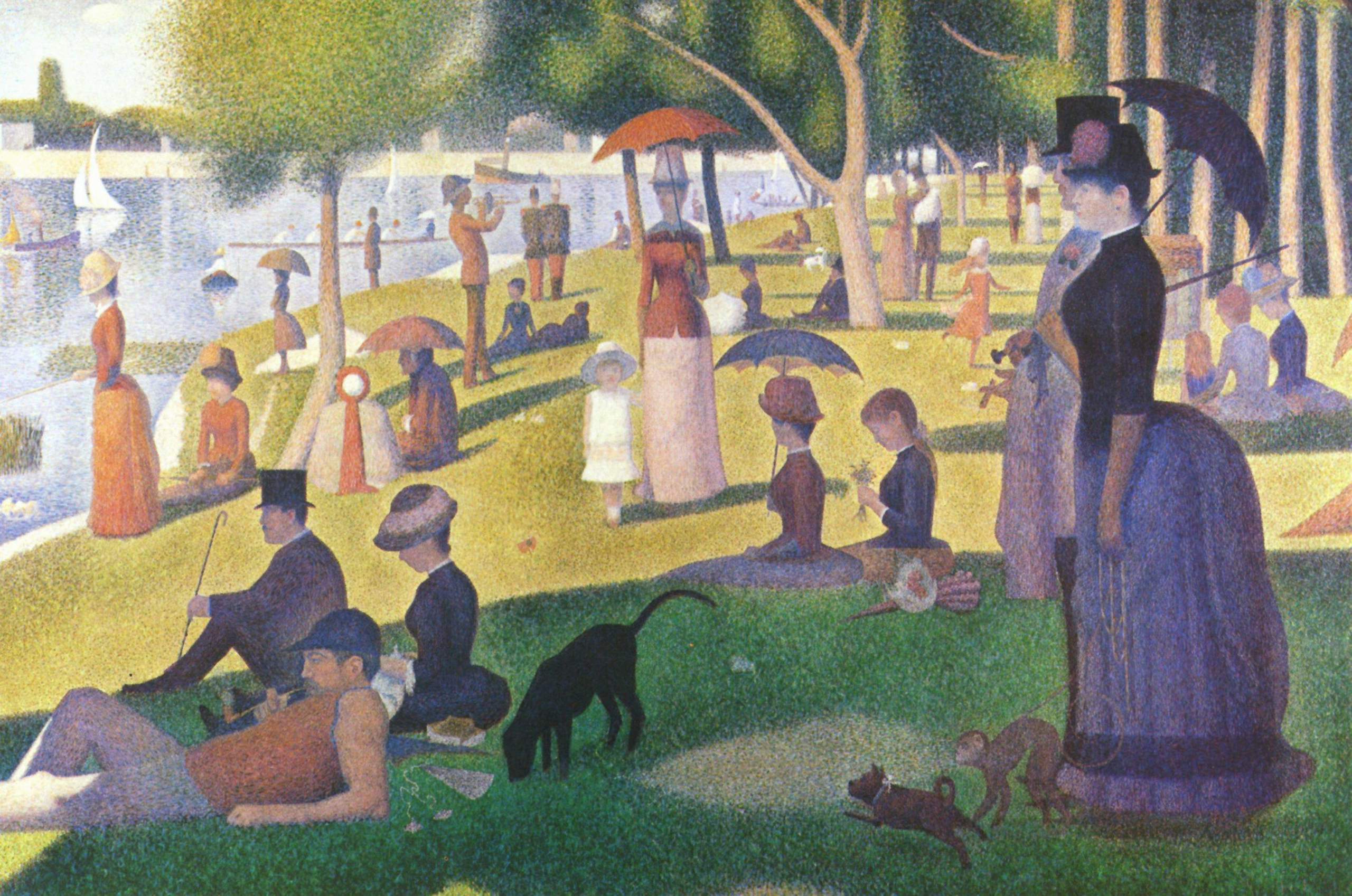
It’s like the Bagless Bobs of the world only see this  
Georges Seurat - A Sunday Afternoon on the Island of La Grand Jatte
via Wikimedia Commons


And the OCPDrs only see this  
Study for La Jatte - also via Wikimedia Commons

A "normal" person can zoom in and see the detail, or back away and see the big picture.

Sharon Begley (whose excellent, clear and informative writing is always worth reading, IMO) just wrote in Newsweek about information overload and how it affects judgment. I am reminded again of the overlapping symptoms of some with OCPD and some with autism - the reported sensitivity to light, sound, and odors. In addition, many have described having problems being in touch with their emotions. 
If the emotions are shut out of the decision-making process, we’re likely to overthink a decision, and that has been shown to produce worse outcomes on even the simplest of tasks. In one classic experiment, when volunteers focused on the attributes of various strawberry jams they had just rated, it completely scrambled their preferences, and they wound up giving a high rating to a jam they disliked and a low rating to one they had found delicious.
Now, even "nons" can experience information overload. This is why it’s crucial to periodically unplug from various devices and not have e-mail/text/video clips bombarding us 24/7.

But although the world is full of many, many things "coming at us at once," those without OCPD seem to have a built-in automatic filter that does a pretty good helping us focus. For example, I’m sitting at my desk, typing on the keyboard. I’m mostly aware of the monitor and the words appearing there, but if I pause, I can become aware of the scented candles I lit, the soft background music, the books and furniture and such that are all around me. It doesn’t feel "all in my face" at once.

Ex b-f frequently criticized me for "trying to do too much at once," and one of the places he stressed out the most was the car. I found music to be calming while I drove (especially with him) and he thought it was too distracting.  He was also always pointing out vehicles and other imminent dangers, as he thought, but was horrible at giving directions so I would have enough time to change lanes to make turns or enter the freeway.  Getting a vehicle with a built-in navigation system saved my sanity, because even if he thought it, too, was an unnecessary distraction, at least I could trust it to tell me when an turn was coming up.

Many other "nons" have related that driving with an unaware/untreated OCPDr is excruciating, regardless of whether they are the driver or the passenger.   This makes a lot of sense if those with OCPD are operating with a too-tight "filter." All the cars and signs and lights and pedestrians and so forth would seem to be coming at them at once, and that would be terrifying.

However... they do learn to drive, most quite safely, even if they white-knuckle it a bit in traffic situations, and, like anything else, the more they do it, the better they get at it.

So - can those with OCPD learn or be taught to loosen up their "filter"?  What's your experience with this?