Using writing, and meditation, and ice cream, and reading, and dreams,

and a whole lot of other tools to rediscover who I am,

after six years living with a man with OCPD.


Showing posts with label feelings. Show all posts

Friday, June 29, 2012

I Feel What I Feel When I Feel It

via Wikipedia

Recently, along with a lot of other folks, I felt caught up in exultation and "justice served, at last!" at the overwhelmingly "Guilty verdict" passed on child molester Jerry Sandusky.

Reading some of the message boards, I was struck by one commenter, who didn't "get" why so many people were rejoicing, and that made me take a closer look at myself.

I am not, and never have been, a prepubescent boy. True, I also experienced an incident of molestation when I was 12 (in central Pennsylvania, no less). However, without ever requiring my testimony or the cops even talking to me at all, the perp did did go to jail, where, rumor has it, he ended up dying an agonizing, long-drawn-out death of cancer several decades ago.

Karma wins - which is not always the case.

And while what happened to me was highly unpleasant, it wasn't the worst thing that ever happened to me; it wasn't something that ruined my life or haunted me.

As the saying goes, I "had no dog in this fight."

So why am/was I following the Sandusky case so closely? Why did it stir me up so much?

Was it because I related to the victims? To the struggling single mothers who thought that contact with a coach willing to act as a father figure would be good for them? Do I feel guilty as a former resident of Pennsylvania?

I don't fully know. I may never know.

What I do know, is that it's okay to feel what I feel. When I feel it. Maybe I want to sit down and pick that feeling apart, maybe I just want to notice it. You know, the whole Zen thing, sitting by the side of the stream, watching the stream, the leaves and twigs floating in it.  There's a feeling; how interesting.

I don't have to come up with a reason why I feel what I feel - not to myself, not to anybody else. I don't have to limit myself to only feeling certain emotions.

via Project Adventure
 There were years when, as a child, I was expected to suppress what I felt.

There were many years when I didn't allow myself to have certain feelings, at all, because it wasn't safe. I lost my mother to breast cancer when I was ten, but didn't begin serious grief work until I was 30 years old, and *I* was ready and felt safe enough to do so.

There were years living with my OCPD b-f when I was often told, if I expressed certain feelings, that they were wrong, and instructed as to what I "should" feel instead. I have had (former) friends try to do the same thing, tell me I was wrong/silly/unjustified in feeling a particular emotion.

I am SO done with that. I am done with anyone (outside of a trusted mental health professional) telling me that my feelings are over- or underdone; that they are inappropriate or wrong, somehow.

 I'm letting myself feel what I feel, when I feel it. Period.

How about you?
Have you ever been told you "shouldn't" feel a particular way?
Did you rejoice in the Sandusky verdicts?

Enhanced by Zemanta

Wednesday, April 25, 2012

A-Z: Validation Station

Not talking about for your parking pass.  Of course, it's important for us all to develop a strong inner sense of self, and not be constantly seeking the approval of others.

Yet both giving and receiving emotional validation is a key part of being a human being. People by nature are interdependent with one another.  What brings people together? A sense that we share the same feelings about: progressive music, or baseball, or RomCom movies.

When I am overflowing with feelings, and go to someone I love, I don't want to be cut off, told my feelings are stupid, or "fixed."

From Eqi.org

What Validation Is
To validate someone's feelings is first to accept someone's feelings. Next, it is to understand them, and finally it is to nurture them. 

To validate is to acknowledge and accept one's unique identity and individuality. Invalidation, on the other hand, is to reject, ignore, or judge their feelings, and hence, their individual identity. 

When we validate someone, we allow them to safely share their feelings and thoughts. We are reassuring them that it is okay to have the feelings they have. We are demonstrating that we will still accept them after they have shared their feelings. We let them know that we respect their perception of things at that moment. We help them feel heard, acknowledged, understood and accepted. 

Sometimes validation entails listening, sometimes it is a nod or a sign of agreement or understanding, sometimes it can be a hug or a gentle touch. Sometimes it means being patient when the other person is not ready to talk.

The concept of validation is what's behind this phrase from the movie Avatar, "I see you."


Being seen, being accepted, being honored not for the shell of our bodies, but as a soul, a divine spark. Namaste is sometimes translated as "I honor the place in you in which the entire universe dwells. I honor the place in you which is of love, of truth, of light and of peace. When you are in that place in you, and I am in that place in me, we are one." (from livestrong.com)

from The Antidote To Anger and Frustration:
Emotional Validation is a Basic Human Need
Emotional validation is something we all seek and crave far more than we realize. When we are upset, angry, frustrated, disappointed or hurt, our tendency is to want to discuss our feelings with others so we can get it off our chest.

However, getting things off our chest by telling others about our feelings is not always satisfying or cathartic. If the person to whom we vent simply looks at us and shrugs or responds by giving us advice or by telling us what we did wrong, we won't feel any better and we will probably feel worse after speaking with them.

What we seek when venting to others is for that person to 'get it', to understand what happened to us and why we feel the way we do. We want them to validate our feelings by conveying that understanding to us and to do so with a dollop of sympathy or empathy (read: How to Test Your Empathy).

When we are extremely angry or upset, we tell someone why and they totally get it truly and effectively validates our feelings. As a result, the relief and catharsis we experience is tremendous! Only then can we actually let go of at least some of the feelings we had built up. It is that which feels like an authentic visceral 'release'.


We don't have to agree with what someone is feeling to validate those feelings. We don't even have to be particularly empathetic to be good at validation.

Here's one technique, the I AM MAD. (Works for more than BPD)
Because I tend to be a fixer, myself, one thing I try to do when someone is telling me a story and I am overflowing with advice, is take a step back, and ASK, "Do you need suggestions or advice, or are you just looking to vent?"

Hoping with practice to get ever better at it.


My A-Z theme is Issues related to Mental Health or Mental Illness.

Have you ever felt emotionally invalidated?
How did it make you feel?
Do you try hard to validate the feelings of others?
Got any good tips?

Monday, April 23, 2012

A-Z: Therapy Is Not A Dirty Word

IMO, more people are afraid of a bad therapist than a bad marriage. Generally those who've experienced a disastrous love relationship will be willing to try again with a new partner, but if they've had a bad therapy experience...!

Besides which, there's a huge stigma factor.

When we hear that someone has been "in therapy" for an extended period of time, our initial reaction is not, "Oh, what a brave and courageous person. Kudos to her/him for facing her/his issues head on and getting the help s/he needs." It's more along the lines of, "Wow, that person must be really f---ed up."Am I right?

I am ashamed to admit, I tend to think that way - and I know better! I've had long term counseling myself, and I'd do it again tomorrow.

Sometimes people get stuck in a rut, whether that rut is grief, PTSD, or choosing bad relationships. If our car is stuck in a rut, would we feel ashamed or embarrassed to need a little push getting out of the ditch? (Okay, maybe a little embarrassed, depending on how we got into that ditch.)

But if we'd been in a car accident, and needed physical therapy to recover the use of, say, an arm, wouldn't we commit to it for as long as it took to get the maximum use of our arm back?

Yes, there are personality clashes, and sometimes, despite any number of impressive degrees, we may have hit on a "bad" therapist, but mostly, therapy fails because:
  • We aren't seeing the right kind of therapist.
  • We aren't getting the right kind of therapy.
  • We aren't committed to the very hard emotional homework of being honest with our therapist, and working on the exercises or changes s/he suggests.
Here's the different types of therapists:
  • Psychotherapist
  • Psychologist
  • School Psychologist
  • Psychiatrist
  • Mental Health Counselor
  • Marriage & Family
  • Social Worker
  • Psychiatric Nurse
  • Pastoral Counselor
The amount of education and training required for each varies, from none to a substantial amount. A psychiatrist is actually an M.D. and can write prescriptions for medications (in a few states, so can a psychologist), but generally a psychiatrist will refer any ongoing therapy work to a psychologist.

Because someone is "lower on the food chain," does not necessarily mean he or she will be an ineffective therapist. For some problems and disorders, medication is not indicated.  For others it may be helpful on a short-term basis in conjunction with CBT or other brain retraining exercises; and for some people, long-term medication may be necessary. In yet others inpatient care may be required. A nutritionist may add needed support.

A good therapist will recognize when a client needs more help than s/he can provide, and be eager to steer her/his client to the right kinds of additional help.

Different types of therapy include:

  • Psychoanalysis
  • Cognitive Behavior Therapy (CBT)
  • Dialectic Behavior Therapy (DBT)
  • Antipsychotic and/or antidepressant medications, and/or mood stabilizers

A treatment once promoted, which fell into some disrepute, and now gaining some proponents is ECT (Electroshock Therapy) as a treatment for bipolar disorder and depression. Diet modification, music therapy, group therapy, yoga and mindfulness exercises; all can form an integral part of helping a person become as whole and mentally healthy as possible.


The most important factor in therapy success is being committed to it. If we are not willing to embrace the process and say, "Yes, this area of my life is causing me and my loved ones too much pain. I will do whatever it takes to make it better for everyone I love - including me," then no matter how experienced and skilled the therapist, no matter how effective the treatment, it's not going to work.

Changing lifelong behaviors and thinking patterns is hard, hard work. In an earlier post, I compared it to shifting the course of the river - the river tries to flow along the same channels it always has. This is where medication in partnership with therapy often works well, interrupting the old patterns long enough for new ones to form (they say about 90+ days is the minimum time frame to quit an old habit or form a new one).


I know people who are diagnosed as mentally ill who religiously follow their medication, exercise, diet, and therapy regimes. I know others diagnosed as mentally ill who are willing to try certain therapies but not others. I know some who refuse to see any kind of counselor, under any circumstances, even if it means being fired from a job or losing a spouse or partner, using the excuse of, "I saw a therapist once, and it didn't help." They believe all it takes is willpower and determination to not be disordered.

Guess which group is most successful at managing their condition?


My A-Z theme is Issues related to Mental Health or Mental Illness.

Have you ever had good or bad therapy?
Would you be willing to try it again?
Why or why not?
Enhanced by Zemanta

Friday, February 24, 2012

Anyone Get the License Plate Number of that Truck?

via Rhys Asplundh at Flickr
I never saw it coming.

One of the things that happens when a person in a relationship with an OCPD'r begins telling stories to outsiders about the worst moments, is people look at you like you're insane.  Like either you're a liar and making stuff up, because the person who is so nice in public couldn't behave like that at home.  Or because you'd have to be a blithering idiot to sign up for that kind of abuse.

Well, we didn't sign up for it.  Most of us dated a person who seemed (relatively) normal, if a little quirky.  But don't we all have quirks?

Theirs seemed harmless enough, perhaps even an improvement over our own habits.  If he was excessively careful about his personal appearance, this seemed like a nice change from guys who were content to go out in public in a ratty T-shirt.  Maybe she seemed a little hung up on cleaning and arranging everything, but aren't women "supposed" to be like that?

They loved us and we loved them and we had excellent chemistry together.  They were smart and funny and seemed to be more organized and "together" than a lot of other people we'd been involved with.

And then the relationship moved to the next level, and like the frog in the pot of cold water, the heat gradually increased.  Or some "event" happened - marriage, moving in together, a new baby - and like a werewolf during a full moon, they transformed into an OCPD raging monster.

Everybody is on their best behavior while courting, anyway.  That initial stage of being "in love" that lasts anywhere from 4-6 months to up to two years.  During that time, the dopamine (feel-good/reward hormone) and oxytocin (promotes attachment) levels go way up.  So the anxiety and fear which seems to be at the root of OCPD controlling behaviors (if I do everything perfectly, and anticipate every possible catastrophe, bad things won't happen) is not simply masked, but overwhelmed.

But "the good guy hormones" will eventually take a break.  And now, because we have been added to the list of things the OCPD'r feels s/he must manage and control, lest disaster ensue, their anxiety level shoots way up.

English: An anxious personImage via WikipediaIt may be sweet at first, being fussed over, "Let's get those boots off you; I hope you didn't get your feet wet." "Make sure to wear your warm coat," but in a severely OCPD person, it becomes panic when you're driving.  (I blogged earlier about Mrs. Potatohead.) And "don't you realize if you leave the toaster plugged in it could burn the house down!"  Bring on the Crazy Rules!

It wasn't that they were being deceptive or putting on a deliberately false front; things were wonderful between us, and then (from the POV of an OCPD'r) we changed.  We started doing things that were annoying, slovenly, or downright dangerous.  We made mistakes, and mistakes are not permitted in OCPD, aka Perfectionism on steroids (except on a theoretical level).  Mistakes could lead to disaster.

If we only cared as much as they did, we wouldn't make mistakes.  At the very least, we would obsess over them as much as they did.

What?  They make mistakes, too?  Not possible.

Because OCPD is a mental disorder, those who have it are subject to distorted thinking.  They pride themselves on logic, therefore, even if they made a mistake, they get locked into loops where their reasoning in making a mistake - they were misled by circumstances, and so it really isn't their fault after all - is defended to the death.

Early on, we may get suckered in to trying to persuade an OCPD'r to see our point of view (aka JADEing).


What keeps us in the relationship, beyond the initial bonding is the difference between OCPD and say, a Narcissist or sociopath.  They don't torture their loved ones for the sheer sadistic pleasure of it, like a deranged child pulling the wings off flies to see them struggle. At the root of some horrifically abusive behaviors is genuine worry, genuine caring.  No matter how bad things get, we know and sense they deeply care.  There are moments when they have flashes of insight, or seem to revert to the fun, caring person we fell in love with.  We think, we hope, this time, the insights are going to stick.

And then the fog rolls in.  Sometimes it rolls out again, and everything we hope for happens - the OCPD'r gets hit by the cosmic two-by-four, realizes the problem isn't with everybody else, but in fact, within his/her own head.  S/he gets serious about changing her life, for herself, and with professional help, begins working to untwist OCPD-think and long-formed habits.  These people are true heroes.

More often, the fog doesn't roll out, the behaviors worsen, and we reach a point where we can no longer stay in the situation, living on thin hope that our partner will see the light and be willing to put in the very hard work to change.  S/he may be in denial or anosognosia; may have made moderate changes but our tolerance threshold has been exceeded.  We realize we can't stay and remain sane.


The one thing we need to do, the one thing we can do, is examine our own co-dependent behaviors.  Do we see ourselves as a Rescuer? Do we think our partner will crumble into a thousand bits if we leave him?  (I believed mine would; saw him a few weeks ago, he is just fine.  Well, he is not "fine," he is still dysfunctional, but no more dysfunctional than when I broke up with him.)

Do we pride ourselves on being kind and understanding (I certainly did) even while our "kindness" is helping neither us nor our partners?  In many ways, I think my ex is relieved I am gone.  In retrospect, I don't believe, for all my good intentions, I budged him one micrometer towards mental health, despite all the agony and heart-rending pain I went through.

I'm not saying it's right for you to go.  We all must make the decision to go, stay, or stay for now, according to what seems right for us.  It takes different kinds of strength to make each decision.

If you have made the decision to leave (or ask to leave) a disordered partner, I applaud you.  If you have made the decision to stay and work with him/her, because s/he is truly trying, I applaud you.  If you have made the decision to stay for now - until the kids are in college, the MasterCard is paid off, whatever - I applaud you.  If you have already left, I applaud you.  If you are getting professional counseling for yourself, I stand and applaud you.

Those of us who've been in that situation, know it's not black-and-white.  We didn't deliberately pick out a monster and choose to live with him or her, because we thought getting berated and criticized every day would be loads of fun.  More like, we checked carefully before entering the crosswalk, and got hit by a truck anyway.

And for those behind the wheel of the truck, with OCPD, who feel like they're in that defective Toyota, trying frantically to make the brakes work, turn the engine off - you know I love and respect you, as well.  My hope is that someday, we can find out how to turn the brakes back on, so you can drive and brake just like everybody else.
Enhanced by Zemanta

Tuesday, January 10, 2012

Too Perfect Tuesdays - Chap 6 - The Need To Stand Alone &
Suspiciousness

This post continues with The Need to Stand Alone and Suspiciousness  from Chapter Six.

This series looks at a small snippet of The book on the Perfectionist Personality, aka The Obsessive Compulsive disordered Personality, aka OCPD, each week. Please follow along, leave your comments, engage more on the FaceBook website... whatever your heart calls you to do.

Too Perfect, When Being in Control Gets Out of Control by Allan E. Mallinger, M.D. and Jeanette DeWyze was published by Random House in 1992.  If you believe you are dealing with OCPD or someone who is "Too Perfect," whether that's you or a loved one, please buy a copy of the book and read it for additional insights that will not all be covered in these excerpts.


THE NEED TO STAND ALONE
Earlier, I talked about how some obsessives fear being emotionally dependent on other people.  As a "solution," they may try to become as self-reliant as possible, even to the point of disavowing their emotional need for loved ones.

Margaret, for example, found herself unable to tell her husband, Jim, how much she missed him whenever he called home from business trips.  When I asked what made it so difficult, she told me that she disliked feeling dependent on anyone.  Pressed further, she admitted feeling afraid of being let down. <snip>

People who fear dependency ware often extremely reluctant to ask their friends and loved ones for such things as time together, affection, sex, or emotional support.  When I ask about this reluctance, at first patients will proudly cite their self-reliance.  Eventually, additional explanations emerge.

For example, they feel that anyone who really cared about them would know what they need, and give it without being asked.  Having to ask becomes evidence that they aren't truly loved. <snip>

Asking poses other risks.  The obsessive fears that the other party may secretly feel contemptuous of the "weakness" revealed by supplication.  Wost of all, the request might be denied, a turn of events that would be devastating to the obsessive.<snip>

Some obsessives may even avoid asking for much-needed assistance.  They may, for example, feel they have to be the one to fix anything needing repairs around the house.  <snip>
Many obsessives hate to take medications.  First they see the need for drugs as an acknowledgment that they already lack some degree of control.  And, second, they fear they will become psychologically dependent on the drug and will have trouble giving it up.  <snip>


Suspiciousness
<snip> He lived with a girlfriend, but the ulterior motives he ascribed to her kept undermining his positive feelings for her.  "I wonder if she isn't just trying to avoid being along for the rest of her life," he said.  "I also wonder if maybe she only thinks she loves me.  Her self-esteem is pretty low, so how can she truly love somebody?  I'm always in the detective mode, looking for the deeper meaning behind what she says."


<snip> But obsessives also fear exploitation in more than just close relationships.  I recently overheard a graphic example of this in a local photo shop, where a man was questioning the clerk about how his pictures would be processed.  What if he didn't like the way they turned out?  Did the business offer any sort of written guarantees?  Who would be the judge of whether the pictures were of adequate quality and would would the criteria be, he demanded.  He persisted, asking increasingly picayune questions, while his fear of "being taken" made him oblivious to the line of people rolling their eyes and expressing their exasperation behind him.
***
These things all become self-fulfilling prophecies.  Would he tell me he missed me?  Sometimes, and I tried to reinforce who charming I found it, but other times he wouldn't tell me, he would throw a tantrum because I was away for a few hours.  Which made me less than eager to rush home. 

I also got lectures about how people who loved each other should just be able to "tell" what the other was thinking.  To a certain degree, that's true, people learn to ready body language, but it's also true that he would get very upset when I didn't "read" him properly, and instead of telling me what he thought or felt, blame me for not being properly attuned to him.  Likewise, he was sure he knew what I was thinking or feeling - and if what I said contradicted what he assumed/thought he knew about me, then obviously, I was lying.

Exhausting.  As well as the third (or thirteenth) degree cross-examination of any merchant from whom we might consider buying a four dollar part.  Exhausting, embarrassing, humiliating.

He was convinced all along, talking of suspicious, that I was having an affair.  One year out of our relationship, and I still don't feel even ready to DATE.  Although it did cross my mind, perioidically, the old "You've got the name, why not have the game?" especially after he'd been particularly dreadful,  In some ways, it would have been lovely to be touched with tenderness and passion, rather than waiting for the next attack to come.  I cannot fault those in this kind of relationship to being vulnerable to outside consolation.


Your thoughts?
Enhanced by Zemanta

Tuesday, December 20, 2011

Too Perfect Tuesdays - Chap 6 - Fear of Being Found Out
Fear of Trusting

Swedish Guards via Wikimedia
This post continues with Fear of Being Found Out and Fear of Trusting from Chapter Six.

This series looks at a small snippet of The book on the Perfectionist Personality, aka The Obsessive Compulsive disordered Personality, aka OCPD, each week. Please follow along, leave your comments, engage more on the FaceBook website... whatever your heart calls you to do.

Too Perfect, When Being in Control Gets Out of Control by Allan E. Mallinger, M.D. and Jeanette DeWyze was published by Random House in 1992.  If you believe you are dealing with OCPD or someone who is "Too Perfect," whether that's you or a loved one, please buy a copy of the book and read it for additional insights that will not all be covered in these excerpts.


Guarded Against Intimacy
<snip> Human beings are social creatures, valuing and seeking a sense of connection with others throughout their lives.  <snip>  Without question, the experience of intimacy can open the way to feelings of unparalleled spiritual fulfillment.  But intimacy has other consequences that many obsessives find frightening.


THE FEAR OF BEING FOUND OUT
For one thing, the closer you are to someone, the more likely he or she is to see all aspects of your personality - both the "good" traits and those you feel are unattractive or even shameful.  Marvin, a successful banker, had little trouble meeting people and quickly winning their admiration.  Yet he kept friends, acquaintances, and even lovers at a carefully controlled distance.  "I'm afraid to let them really get to know me," he admitted in therapy one day.  "I feel like a phony - that people will find out how inadequate I am underneath it all, and they'll be disgusted and reject me."
<snip> With her [his girlfriend], Marvin felt compelled to stay one step ahead of exposure.  "I have to be the first to jump, to leave, to push them away," he disclosed.

FEAR OF TRUSTING

For many obsessives, another obstacle to intimacy is their difficulty with trusting.  They fear that other people will let them down.

<snip> If there is a single unifying theme of obsessiveness, it is the desire to eliminate feelings of vulnerability and risk, and to gain instead a sense of safety and security.

<snip> Sometimes this wariness persists after many tears in a close relationship. such as marriage, even when the spouse has demonstrated trustworthiness.  After twenty years of marriage, for example, Kyle and his wife were still arguing over his failure to express his love for her.  "She's filled with twenty years of resentment and anger," he told me.  "She says intimate communication with me is impossible, that I'm not willing to express my love of expose other feelings to her."

To me, Kyle acknowledged that he hasn't been a very trusting person, and his characteristic suspiciousness had intensified when he had been hurt several times after honestly disclosing his feelings.  "People have betrayed me by repeating confidences; they've embarrassed me," he stated.  But when I asked him how often his wife in all their years of marriage had betrayed his confidences, he confessed that he couldn't remember a single occasion.  I asked if she'd ever done anything to make him seriously doubt her love, and he again had to admit that the answer was no.  Nonetheless, he still felt threatened by the idea of "opening up" to her.
***
That last paragraph says it all.  Of all the dreadful things that occurred - and didn't occur - in my relationship with my ex, the sense that he didn't trust me, would never, ever trust me, no matter what, was one of the most damaging.

As time goes on, people in a relationship either get closer, or draw farther apart.  With certain relationships, such as co-workers or friendships, a little distance is okay, probably preferable.  Not so in a love relationship.

I felt like Kyle's wife - if not now, after all this time when I have never let you down, when will you trust me?  After 21 years?  31?  (Of course the answer was "Never.") 

He did tell me he loved me.  And I believe he did, as much as he could anyone, yet, as the truism goes, actions speak louder than words.  He showed me, a dozen times a day or more, that he didn't trust me, and never would.  Choice?  Habit too deeply ingrained over so many years?  Actually unable to trust because of the OCPD?

When someone is in physical danger - the house is on fire, they're drowning - there are (sometimes) ways to knock them out and rescue them, even against their will.  Not so with mental disorders.

He pushed me out the door, emotionally, long before I actually packed my bags and left.  I do not regret that I did leave, nor that I ended our relationship as lovers, just about a year ago.  Yet, I am deeply sorry that I had to leave him behind, in a mental jail of his own (and his disease's) making.

Your thoughts?
Enhanced by Zemanta

Friday, October 28, 2011

The Shadow Scar

Emotional Healing" ©Beth Budesheim
Go here for more stunning, soul-filled art.
www.PaintedJourneys.com
Some years ago, because I'm naturally graceful that way, I burned myself cooking.

I was baking cookies (despite the distress of my OCPD ex for messing up his kitchen by doing so) and as I removed a cookie sheet from the bottom rack of the oven, I brushed the top of my arm against the edge of the top rack for a few seconds.

It stung, and it left a red mark, about three inches long, a quarter inch or so wide.  It wasn't a bad burn, per se.  It was red, and it hurt a lot at the time, but it didn't even raise a blister, so it didn't cross the line from first to second-degree burn.  I've had burns on my hands from cooking that raised blisters.  As a child and teenager, had sunburns that blistered and peeled.  This particular burn seemed like no big deal.

Yet for whatever reason, this burn damaged the skin in such a way that I still have the shadow of it on my arm, noticeably darker than the surrounding skin, some six-seven years later.

It's a perfect metaphor to me for how emotional scars work, too.  It's not always the biggest wound that leaves the most lasting mark.  Sometimes a small burn, a cutting remark, some tiny soul-injury  that seemed like no big deal at the time, leaves a mark that lasts for years.  Perhaps forever.

We can tell ourselves there is no logical reason it should linger so, try to reason it away.  We can attempt to cover it up, or ignore it.  But maybe what we should do is simply acknowledge it's there, for whatever reason, and show love to ourselves about it.

Do you, too, have scars and wounds you tell yourself you "shouldn't" feel?
How well is that working out for you?
Please share some thoughts in the comments, below.

Thursday, March 17, 2011

What Was I Thinking?

I was recently validated as not being the only woman on the planet looking back on a relationship (or, alas, more than one relationship) and asking myself, What Was I Thinking?

They've got stories from 58 women asking themselves the same question.  So, I'm not the only slow learner.

I'm sure, if you asked a bunch of gay women, gay men, or straight men, they'd have similar "light bulb moment" stories about their girlfriends, boyfriends, and ex-spouses. 

Unfortunately, sometimes we turn the bulb out again.

From the Intro:
What Was I Thinking? is a collection of personal essays written by women describing that moment in a relationship when, no matter how much you think it should work or want it to work or need it to work, it becomes clear to you that it's not going to work.
The really hit me - too much of the time we focus on exactly that: "I think it should work" and "I want it to work" and "I need it to work" and we don't want to pay attention to: Hello?  It's not working.  They say you can't make a silk purse out of a sow's ear, but we get wrapped up in trying to help somebody else overcome their problems and live up to their potential.  Maybe our partner doesn't want to be a silk purse.
...this is not necessarily the moment of the actual breakup.  Rather, these stories describe the instant when logic, common sense, and simple self-interest triumph over the human need to be loved - or, at least, the need to be in a relationship.  The relationship may not last beyond lunch, or it may linger for weeks or even longer.  But inside, you know: He's going to be an ex.
Trying to remember when the first time I knew with OCPD ex b-f it was not going to work out.  There were so many, many moments, and I just kept overruling my common sense and gut instincts.  Was it the time he started in with the Shower Rules?  The jealous spazz attacks about my boss and co-workers?  The way he would come in to "touch base" with me (aka, constant interruptions) whenever I was trying to write?

I just kept telling myself, with enough time and love and patience, I would be able to make it work.  I was an idealist.


They cleaned this up just a smidge for the broadcast version.  The written version describes the guy as being built, not like a 16 oz can of beer, but like two 16 oz cans of beer, stacked on top of each other.  <wincing yet?>

I dated a guy like that for a while, and concocted an excuse to break up, because, well, sex wasn't fun because of his can-cans.  (Or big banana, take your pick.)  Couldn't think of  a tactful way to tell him that, though.

I'm having fun reading the stories and watching the video clips.  Apparently Nicole Hollander (cartoonist, Sylvia) was once married to somebody with OCPD - seems he felt she deliberately ruined his soup by making it with noodles that were the wrong width.

Aiiieee!

Well, I'm glad they rediscovered this holiday, and I'll definitely be celebrating.


Have you had a "Come To Your Senses" moment?
What triggered it for you?

Thursday, March 10, 2011

Learning to Recognize You're Being Played

So, as I move along this journey to rediscovering myself, I realize that OCPD ex-bf, in many ways, was one of my easier relationships.  The confrontation and tantrums were usually right in my face.

But, I've had other relationships in which I also played Ms. Co-Dependent to the Max, because, after all, I'm nice.  I'm a people pleaser (and if you're thinking, she's saying that like it's a bad thing - you may be one, too.)

Being kind and flexible is wonderful.  However, we can get so wrapped up in pleasing others, in trying to make others happy, that we forget all about us; our needs, wants, and best interests. 

We need to be able to say no (or, Hell no!) if someone tries to manipulate us into doing something that crosses our boundaries.  In my life, I've been pressured/manipulated by those who wanted me to:

  • Eat something when I was already full, or which contained ingredients that I don't like
  • Join them in the practice of particular religious beliefs
  • Perform sexual acts that I'd rather not
  • Go to certain parties, or stay longer when I wanted to leave
  • Take over someone else's job duties
  • Favors

Mind you, there is nothing wrong with someone asking, "Would you like to try doing it on a trapeze, while wearing a Batman mask?"  (Okay, maybe something a lot wrong with that.) 

An open, honest question or offer contains the implied freedom to say "No thank you."   If we feel that saying no is not an option - we're probably being played.    


Cats playing piano - awesome.
People being played by manipulators - NOT so awesome.

The only way we can have real, honest, fulfilling relationships, is if we are coming from our True Selves.  And that means, kindly, gently, but firmly, refusing to be manipulated.

Or, we can channel our Inner Bitch and say, "I don't think so."

Here's some good info from Wikihow:   
Understand the characteristics of a manipulative personality.  They're not always obvious because they play a silent game of building up obligations toward them, that end up with you feeling guilty, pressured, and obliged to carry out things for their sake even though you're still wondering how things got to this point.  Some of the characteristics of a manipulative personality include:   
  • A martyr style personality. This personality type behaves as if he or she is being considerate toward others but is actually messing up considerateness with a need to be significant to you. By "martyring" themselves, they are doing things nobody has asked of them or wants them to do but in the process creates a bind when they do them. In "doing you a favor", their expectation increases that you have to return the favor. They may also complain constantly about all the things they do for you and wonder rhetorically when you're going to return this favor...    
  • Excessively needy and dependent personalities. People who feel uncomfortable in their own skin, putting forth their own opinions and ideas can often hide behind manipulative behavior so that it seems as if you are responding on your own accord even though they've set up everything to have you respond directly to their neediness.  
  • Narcissists. This is the archetypal manipulative personality and it's very hard to deal with this master manipulator.  
  • You. Seriously, at one time or other, every single one of us practices manipulative behaviors in one form or other. It is just that for most people, manipulative actions tend to be one-off or only occasional instances rather than a purposeful map for daily living and interaction with others.
Note the possible types of ways in which people try to manipulate one another. There are some key behaviors that can end up in manipulation, and it's helpful to know how to spot them before walking right into them. The behaviors are set out briefly here, with the following steps providing more details along with suggestions for healthy ways to respond:

  • The guilt trip – this manipulative behavior seeks to make you feel guilty and is aimed at sending you into the land of "should" rather than standing up for your own values.   
  • The assumption statement – this manipulative tactic seeks to turn your behavior into what the beholder perceives it as, whether or not their interpretation is accurate. Soon leads to a guilt trip because no matter what, your refutation is proof of the assumption.   
  • He said, she said – this manipulative ploy is pseudo-sociology in action. The manipulator takes it upon themselves to tell you what someone else said was the right thing to do. It's a handy way of pushing aside the responsibility from themselves while loading it all onto you.  
  • The confronting statement – this manipulative approach is about causing an argument. That way, the provoker will end up making you feel terrible over something you didn't do or say but for which you ought to feel guilty anyway and they'll get a huge chunk of sympathy with which to manipulate you all over again.  
  • Self-pity: "But I'm so unloved/sick/victimized, etc." – At times each one of us has times when we're really in need of some tender self-care but long-term manipulators can make a habit of being the victim or the one needing special attention.
Go HERE for the rest of this great article for tips on how to respond to each technique.

Boy, have I suckered in to the martyrs in my life!  They're so kind, considerate, self-sacrificing, surely I should appreciate them more.  Of course, OCPD ex b-f used this technique too.  "I've been slaving all day to grow tomatoes" or make spaghetti sauce or some other thing he'd chosen to do, martyr-style, not even stopping to have lunch, that I never asked him to do in the first place, let alone suggest he work at such a pace that he didn't take reasonable breaks.  All his own choices.  Then he'd pick a fight because I wasn't sufficiently grateful, in his opinion.  And then the next time he asked for something, I would usually give in, whether I wanted to or not, because I felt guilty about "making him feel bad."

Good grief, Charlie Brown!  <Shaking my head to clear out the cobwebs>

Photo by -just-jen- at Flickr
But, as I said, I am recognizing he wasn't the only one to pull my strings.  That with good boundaries and better connection with my authentic self, I will have healthier relationships with everyone in my life.

Frankly, I'm beyond tired of guilt trips.  They're not a lot of fun, and I already know the boring scenery by heart.

The next trip I take, I want to pack a bag and stay in a gorgeous hotel.  Maybe get a massage.  I like the massage-type of manipulation.

How about you?  Have you been played like a cheap guitar too many times?  What do you do to recognize the manipulators and take care of you?

Saturday, March 5, 2011

Vacuuming up the OCPD

After being inspired by a great post at My Mother-in-Law is Still Sitting Between Us, I've been pondering vacuums and filters, as they relate to OCPD.  Work with me here, it will eventually make sense.  I think.

The filter traps dirt, lint, pet hair, and so forth (tip: never look too closely at the "and so forth.") But the filter has to be porous enough to allow air, and yes, a little bit of dust out.

Sid’s fabulous story about accidentally vacuuming without a bag in place made me think of someone I’ve worked with. Warm, friendly, great salesperson, fabulous "big ideas" kind of guy - but utterly lost at sitting down and working out the little nuts and bolts of life, like staying within a budget, or balancing a checkbook.

When I think of - let’s call him Bagless Bob - I think of that vacuum, merrily sucking up everything and spewing out a lot of junk behind it. It’s like his filter is missing or damaged.  Lucky for Bob, he does have a some partners to act as his filter - and sometimes he even listens to them!

And for those with OCPD, it’s like their filters are TOO tight. They go waaaay beyond a HEPA filter to sealing theirs all over with duct tape, lest a tiny mote of dust get out. And, of course, that doesn’t work out, either.

When someone with OCPD writes a report, they often include too much unnecessary detail, because... they have problems figuring out which are the important bits.

When someone with OCPD hoards, again, it’s often related to problems discerning what is valuable and what is junk. So, better keep all of it, just in case.  (Or, in some cases, they want to throw everything away.)

When they nit-pick their partners or children, it seems their perception glides right past the 115 things we said, did or looked right, zooming in on the single thing we said wrong, the sole cat hair we missed when brushing off our slacks.  You know when they played that Sesame Street game, "Which of these things are not like the others?" they figured it out in record time.

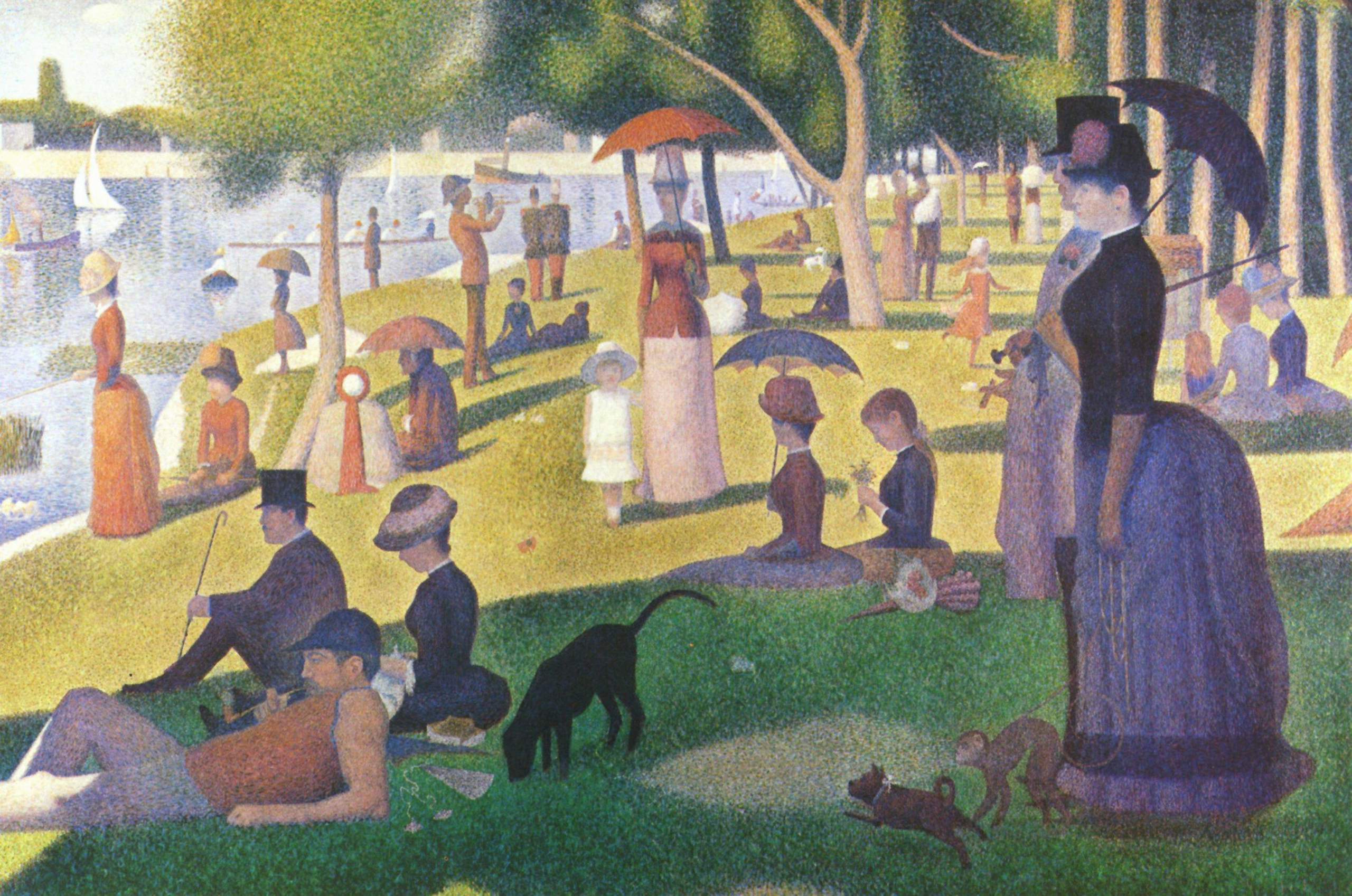
It’s like the Bagless Bobs of the world only see this  
Georges Seurat - A Sunday Afternoon on the Island of La Grand Jatte
via Wikimedia Commons


And the OCPDrs only see this  
Study for La Jatte - also via Wikimedia Commons

A "normal" person can zoom in and see the detail, or back away and see the big picture.

Sharon Begley (whose excellent, clear and informative writing is always worth reading, IMO) just wrote in Newsweek about information overload and how it affects judgment. I am reminded again of the overlapping symptoms of some with OCPD and some with autism - the reported sensitivity to light, sound, and odors. In addition, many have described having problems being in touch with their emotions. 
If the emotions are shut out of the decision-making process, we’re likely to overthink a decision, and that has been shown to produce worse outcomes on even the simplest of tasks. In one classic experiment, when volunteers focused on the attributes of various strawberry jams they had just rated, it completely scrambled their preferences, and they wound up giving a high rating to a jam they disliked and a low rating to one they had found delicious.
Now, even "nons" can experience information overload. This is why it’s crucial to periodically unplug from various devices and not have e-mail/text/video clips bombarding us 24/7.

But although the world is full of many, many things "coming at us at once," those without OCPD seem to have a built-in automatic filter that does a pretty good helping us focus. For example, I’m sitting at my desk, typing on the keyboard. I’m mostly aware of the monitor and the words appearing there, but if I pause, I can become aware of the scented candles I lit, the soft background music, the books and furniture and such that are all around me. It doesn’t feel "all in my face" at once.

Ex b-f frequently criticized me for "trying to do too much at once," and one of the places he stressed out the most was the car. I found music to be calming while I drove (especially with him) and he thought it was too distracting.  He was also always pointing out vehicles and other imminent dangers, as he thought, but was horrible at giving directions so I would have enough time to change lanes to make turns or enter the freeway.  Getting a vehicle with a built-in navigation system saved my sanity, because even if he thought it, too, was an unnecessary distraction, at least I could trust it to tell me when an turn was coming up.

Many other "nons" have related that driving with an unaware/untreated OCPDr is excruciating, regardless of whether they are the driver or the passenger.   This makes a lot of sense if those with OCPD are operating with a too-tight "filter." All the cars and signs and lights and pedestrians and so forth would seem to be coming at them at once, and that would be terrifying.

However... they do learn to drive, most quite safely, even if they white-knuckle it a bit in traffic situations, and, like anything else, the more they do it, the better they get at it.

So - can those with OCPD learn or be taught to loosen up their "filter"?  What's your experience with this?